
Bitcoin Address Types: Legacy, SegWit and Taproot
Bitcoin addresses starting with 1, 3, bc1q and bc1p are different types. See what each means, how they affect fees and which ones your wallet can send to.
Four Bitcoin address types are in common use, and the first characters tell them apart: 1 for legacy, 3 for script addresses, bc1q for native SegWit and bc1p for Taproot. All of them hold BTC on the same network. They differ in what it costs to spend from them later and in which wallets can send to them.
The four types at a glance
| Starts with | Common name | Format | Defined in | Relative cost to spend |
|---|---|---|---|---|
| 1 | Legacy (P2PKH) | Base58 | Original Bitcoin design | Highest |
| 3 | Script hash (P2SH), often “nested SegWit” | Base58 | BIP 16 | Medium |
| bc1q | Native SegWit (P2WPKH / P2WSH) | Bech32 | BIP 141, BIP 173 | Low |
| bc1p | Taproot (P2TR) | Bech32m | BIP 341, BIP 350 | Low |
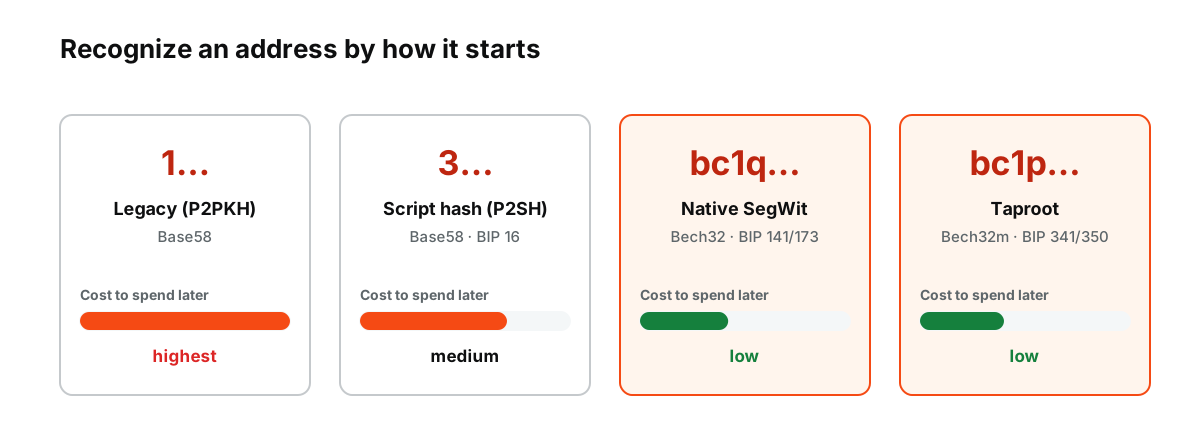
Figure: How to recognize each address type, and the relative fee for spending from it later. Bars are qualitative.
“Relative cost” refers to the fee you pay later, when you spend coins received at that address. Receiving costs you nothing; the sender pays.
Legacy addresses (starting with 1)
These are the original Bitcoin addresses. They encode a hash of a public key and use a format called Base58Check, which avoids characters that are easy to confuse, such as 0 and O. They work everywhere, which is their main advantage.
The downside is size. Spending from a legacy address puts the full signature data in the part of the transaction that counts at full weight, so each input takes more block space and costs more in fees than the newer types.
Script addresses (starting with 3)
BIP 16 introduced pay-to-script-hash, which lets an address stand for a set of spending conditions rather than a single key. Multisignature wallets that need, say, two of three keys to sign were the classic use.
When SegWit arrived, many wallets used this format to “wrap” a SegWit output inside a 3 address. That gave older software something it could recognize while still delivering part of SegWit’s fee savings. You will still see these addresses at some exchanges and older wallets.
Native SegWit addresses (starting with bc1q)
Segregated Witness, defined in BIP 141, activated on the Bitcoin network in 2017 at block 481,824. It moved signature data into a separate “witness” section that counts at a quarter of the weight of other transaction data, which lowers the effective size of each input.
Native SegWit addresses use the Bech32 format from BIP 173. They are lowercase, start with bc1, and include a strong checksum that catches most typing errors. As an approximate guide, spending one native SegWit input takes less than half the block space of a legacy input, which is why fees are noticeably lower. Our explainer on UTXOs shows why the number and type of inputs drive what you pay.
Taproot addresses (starting with bc1p)
Taproot, defined in BIP 341, activated at block 709,632 in late 2021. It introduced Schnorr signatures and a new output type that can hide complex spending conditions behind what looks like a single-signature payment, unless those conditions are actually used. That helps with both privacy and efficiency for multisignature setups and more advanced contracts.
Taproot addresses use Bech32m, a small revision of Bech32 specified in BIP 350 to fix a weakness in how the original checksum handled certain errors. For an ordinary single-key wallet, spending a Taproot input costs about the same as or slightly less than native SegWit.
Why newer address types cost less to use
Address types differ in how much data spending from them adds to a transaction. Because fees are paid per virtual byte, that difference shows up directly in what you pay. Spending from native SegWit addresses takes less block space than spending from legacy addresses, because signature data counts at a reduced weight, so the same payment usually costs noticeably less. Taproot can be smaller still in some cases, especially for more complex spending conditions. For anyone who receives many small payments and later spends them, the address type chosen at the start affects every future fee. See how blockchain transaction fees work.
Can every wallet send to every type?
Any modern wallet can send to all four types, but not every older wallet or service can. The most common problem is a service that does not yet support sending to bc1p addresses. If a platform rejects a valid-looking address, it may simply not support that format.
A few practical rules:
- Use the address your receiving wallet or exchange gives you. Do not convert it or retype it.
- Check the network as well as the format. Addresses on other blockchains can look similar, and some exchanges list BTC on more than one network. Our guide to choosing the correct blockchain network covers how to avoid a mismatch.
- Send a small test first when moving funds to a new address type for the first time. Our withdrawal checklist walks through the full process.
- Legacy addresses are case-sensitive; Bech32 addresses are not. Copy and paste rather than typing either kind.
How to tell which type you have
The first characters of an address tell you its type on Bitcoin’s main network: 1 for legacy, 3 for script addresses, bc1q for native SegWit and bc1p for Taproot. Most wallets let you choose the type when creating a new receiving address, often in the settings, and many now default to native SegWit or Taproot. Addresses for Bitcoin’s test networks use different prefixes, such as tb1, and should never be used to receive real funds, because coins on test networks have no market value; a wallet showing those prefixes is set to a test network.
Which address type should you use?
For most people, the answer is whatever your wallet creates by default today, which is usually native SegWit or Taproot. Both keep future fees low.
Reasons to stick with an older type are narrow: an old service that cannot send to your newer address, or a specific multisignature setup that was built on P2SH. If you have coins sitting on legacy addresses, you are not forced to move them, but spending from them will cost more. Some holders move them into a newer address type during a period of low fees.
Whichever type you use, the safety basics stay the same. Our guide to what a crypto wallet is covers how keys, seed phrases and addresses relate to each other.
This article is educational content and does not constitute financial, investment, legal or tax advice. Digital assets are volatile and you may lose the amount you invest.
Sources
- BIP 16: Pay to Script Hash — Bitcoin Improvement Proposals, GitHub
- BIP 141: Segregated Witness (Consensus Layer) — Bitcoin Improvement Proposals, GitHub
- BIP 173: Base32 Address Format for Native v0-16 Witness Outputs — Bitcoin Improvement Proposals, GitHub
- BIP 341: Taproot (activation at block 709,632) — Bitcoin Improvement Proposals, GitHub
- BIP 350: Bech32m Format for v1+ Witness Addresses — Bitcoin Improvement Proposals, GitHub
- Bitcoin Core source, chainparams.cpp (SegWit activation height 481,824) — Bitcoin Core, GitHub