
What Are Yield-Bearing Stablecoins?
Yield-bearing stablecoins pass income from reserves, lending or derivatives to holders. The main types, why payment stablecoins cannot pay yield, the risks.
Yield-bearing stablecoins are dollar-linked tokens that pass income to holders, usually by rising in value over time. Ordinary payment stablecoins keep their reserve income; under the US GENIUS Act and the EU’s MiCA, regulated payment stablecoin issuers may not pay holders interest. Yield-bearing versions therefore take other legal forms and carry risks plain stablecoins do not.
Why ordinary stablecoins pay nothing
Issuers of USDT and USDC invest reserves in short-term government debt and keep the interest. That is their business model, and since the GENIUS Act was signed in July 2025 it is also a legal requirement for US payment stablecoins: issuers may not pay any interest or yield to holders just for holding the coin. MiCA has a similar ban for e-money tokens in the EU. Our explainer on how much a stablecoin issuer earns on its reserves shows the economics.
The three main types
Tokenized Treasury products. Tokens such as Ondo’s USDY or BlackRock’s BUIDL fund hold short-term US Treasuries and pass the interest through. They are structured as notes or fund shares, often limited to eligible or non-US investors, and come with know-your-customer checks.
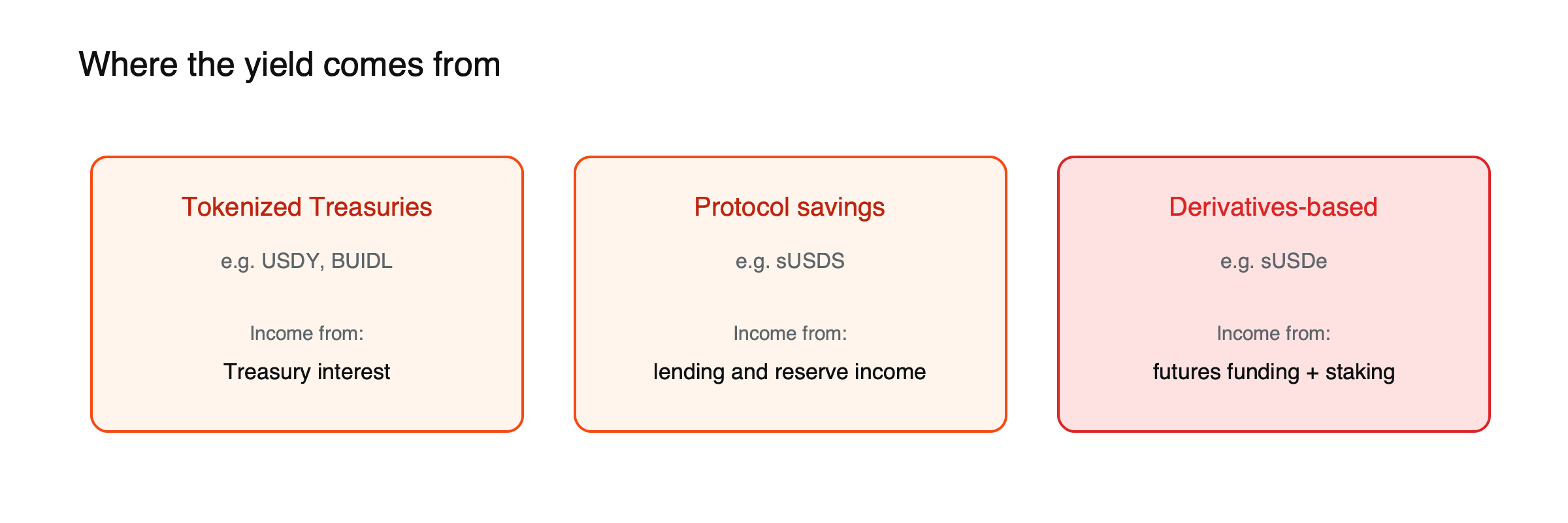
Figure: Where the yield comes from in each type.
Protocol savings wrappers. Sky (formerly MakerDAO) lets users deposit its USDS stablecoin into a savings module and receive sUSDS, which grows in value. The rate is set by the protocol’s governance and funded by income from its lending and reserve assets, so it can change at any time.
Derivatives-based tokens. Ethena’s sUSDe earns funding payments from short positions in perpetual futures plus staking rewards. Income depends on market conditions and can fall to zero or turn negative. Our guide to synthetic dollar stablecoins explains that design.
How the yield reaches you
Most of these tokens use one of two methods. Some keep your token balance the same and raise the token’s redemption value, so one token is worth slightly more each day. Others increase the number of tokens in your wallet. Both can have different tax treatment depending on where you live.
The two methods in numbers
Suppose you hold $1,000 in a yield-bearing token paying 4% a year. (Illustrative.) With a value-accruing token, you hold 1,000 tokens throughout, and each one rises from $1.00 to about $1.04 over the year. With a rebasing token, each token stays near $1.00, but your balance grows from 1,000 to about 1,040 tokens. Either way you end the year with about $1,040. The difference matters for which apps accept the token and, in some countries, for how the income is taxed.
When the yield falls
Each type has its own way of disappointing holders:
- Tokenized Treasury products pay what Treasury bills pay, minus fees. When central banks cut rates, the yield falls with them, automatically.
- Protocol savings wrappers pay a rate set by governance. Token holders can vote to cut it, sometimes sharply, if the protocol’s income drops or it needs to attract more borrowers.
- Derivatives-based tokens depend on futures funding payments. In bearish markets funding can turn negative, the yield can fall to zero, and the protocol may draw on a reserve fund to cover the shortfall.
The stated rate is a snapshot, not a promise. Looking at how a token’s yield behaved during past rate cuts or market stress says more than the current figure.
Tokenized Treasuries vs money market funds
A tokenized Treasury product is close in substance to a money market fund: both hold short-term government debt and pass on the interest. The differences are in the wrapper. The token can move on a blockchain at any hour and be used in on-chain applications, while a traditional fund settles through brokers during business hours. In return, the token adds smart-contract and custody risks and often stricter eligibility rules. For someone who does not need on-chain use, a regulated money market fund usually offers the same income with fewer moving parts.
Risks to know
- They are not payment stablecoins. Legal protections for payment stablecoins, such as priority claims on reserves, may not apply.
- Securities status: many are offered as securities or fund shares, with access limits by country.
- Variable income: rates depend on interest rates, protocol decisions or derivatives markets.
- Smart contract and custody risk on top of the risks of the underlying assets.
- Redemption terms can include delays, minimums or eligibility rules.
Where the yield comes from, at a glance
| Type | Source of income | What moves it | Main extra risk |
|---|---|---|---|
| Tokenized Treasuries | Interest on government debt | Central bank rates | Eligibility limits, custody |
| Protocol savings wrappers | Protocol lending and reserve income | Governance decisions | Smart contracts, governance |
| Derivatives-based | Futures funding and staking | Market sentiment | Exchanges, negative funding |
Beware promotional rates
Some platforms advertise rates well above what the underlying assets earn, funded temporarily by token incentives or marketing budgets. Those rates can disappear without notice, and the incentive tokens may lose value quickly. If a yield is far above short-term Treasury rates, the extra return has to come from somewhere: more risk, a subsidy that will end, or both.
How to compare them
Ask where the income comes from, who holds the underlying assets, who is allowed to hold and redeem the token, and what happened to it during past market stress. A higher rate usually means more risk, not a better deal.
For how stablecoins differ, read centralized vs decentralized stablecoins. For the basics, see what a stablecoin is.
This article is educational content and does not constitute financial, investment, legal or tax advice. Digital assets are volatile and you may lose the amount you invest.
Frequently asked questions
Are yield-bearing stablecoins safe?
They carry the risks of their underlying assets plus the risks of the token structure. A token backed by Treasury bills is closer in risk to a money market fund; a token earning futures funding carries market and exchange risk. None has the protections of an insured bank deposit.
Can anyone buy them?
Not always. Many are offered only to verified or non-US investors, or are restricted in certain countries, because they are treated as securities or fund shares. Check eligibility before buying on a secondary market, since redemption rights may depend on it.
Sources
- Yield-Bearing Stablecoin (types; GENIUS Act and MiCA ban issuer yield; securities treatment) — Spark
- Yield-Bearing Stablecoins Compared (three sources of yield: protocol revenue, real-world assets, derivatives; GENIUS effective January 18, 2027) — Spark
- Yield-Bearing Stablecoins and Tokenized Money Market Funds Explained (GENIUS Act section 4(a)(11)) — Web3 AI Blog, 2026
- What Is the GENIUS Act? (signed July 18, 2025; no yield to holders) — Transak