
Who Can Buy Tokenized Assets?
Many tokenized assets are securities with limits on who can buy them. How eligibility works, typical minimums, why location matters and what to check first.
Who can buy tokenized assets depends on what the token legally is and where you live. Tokenized funds, bonds and shares are usually securities with the same eligibility rules as the underlying asset: many are limited to institutions or wealthy investors, some to non-US buyers, and most require identity checks. Public chains do not mean open access.
Why limits exist
Securities laws restrict who can be offered certain investments, usually to protect retail investors from complex or illiquid products. The US SEC has said tokenized securities are subject to the same rules as their underlying securities. Issuers also apply anti-money-laundering checks and sanctions screening.
Common eligibility tiers
- Institutional or professional investors only.
- Wealthy individuals: in the US, “accredited investors” or the higher “qualified purchaser” tier.
- Non-US investors only: some products exclude US persons entirely.
- Retail in specific regions: some products are offered to verified retail users in particular jurisdictions.
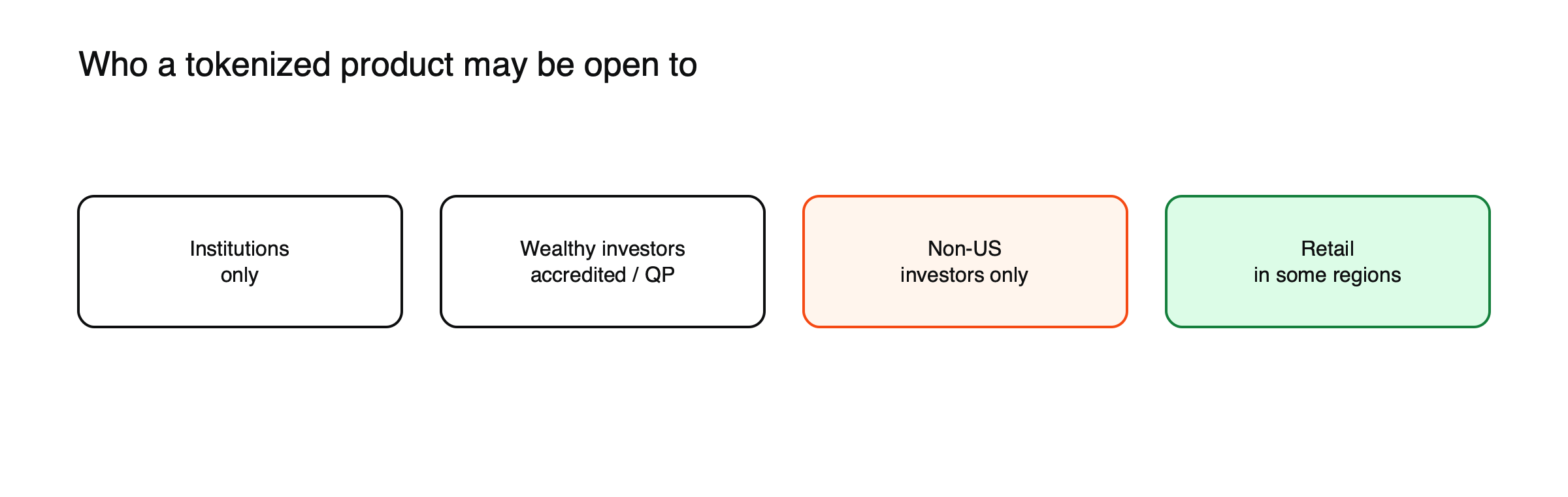
Figure: Typical eligibility tiers. Each product sets its own rules.
The US thresholds, in plain numbers
In the United States, an individual generally counts as an accredited investor with income above $200,000 a year, or $300,000 together with a spouse or partner, in each of the last two years, or a net worth above $1 million not counting their main home. Certain licensed financial professionals also qualify. A qualified purchaser is a higher tier, generally an individual with at least $5 million in investments. Products limited to qualified purchasers are therefore out of reach for most private investors, whatever platform they use.
Outside the United States
Other countries use their own categories. In the European Union, tokenized shares, bonds and fund units remain securities under existing financial rules rather than under the crypto-asset framework, and platforms classify customers as retail or professional, with different products and protections for each. Several financial centers, including Singapore and the UK, have their own accredited or professional investor definitions. A product open to retail investors in one country may be closed to them in the next.
Examples from 2025–2026
- BlackRock’s BUIDL targets qualified purchasers with a $5 million minimum.
- Ondo’s OUSG starts at $5,000 for eligible investors; USDY is offered to non-US investors.
- Franklin Templeton’s BENJI can start at $20 for eligible users.
- Robinhood’s EU stock tokens were available to verified EU and EEA users, with the US blocked.
See what tokenized treasuries are and what tokenized stocks are.
What this means in practice
You may be able to see a token on a block explorer but not be allowed to hold it: many tokens can only be sent to wallets on an approved list. Buying through an unofficial route can leave you holding a token the issuer will not redeem for you.
How eligibility is enforced on the blockchain
Many tokenized securities enforce the rules in their code. The token contract keeps a list of verified wallets, and transfers to any address not on the list simply fail. Some use standards designed for permissioned tokens, which tie each wallet to an identity check held by the issuer or a transfer agent. Issuers can usually freeze or recover tokens held by a wallet that should not have them. For buyers, this means a token visible on a block explorer may still be impossible to receive or sell without passing the issuer’s checks.
Routes that are open to retail investors
Retail access exists, but it is narrower. Some tokenized money market funds accept very small minimums for eligible users in particular countries, some yield-bearing dollar tokens are offered to non-US individuals after verification, and tokenized stocks are available to retail customers in selected regions. Each route has its own conditions, so the starting point is always the issuer’s eligibility page rather than a trading screen.
What platforms usually ask for
Expect the same paperwork as opening a brokerage or investment account, sometimes more. Identity documents and proof of address are standard. Products limited to accredited or professional investors ask for evidence of income, assets or professional status, sometimes confirmed by an accountant or lawyer. Tax forms identifying your country of residence are common; non-US investors buying products with US exposure, for example, are often asked to certify their foreign status. Wallet addresses must usually be registered before they can receive tokens.
The risk of unofficial routes
Tokens sometimes appear on decentralized exchanges or in wrapped form, offered to people who could not buy them directly. Holding such a version can leave you without redemption rights, without the issuer’s protections and, if transfers are restricted, unable to sell. If a route lets you skip checks the issuer requires, the shortcut is usually the risk.
Eligibility rules are not fixed. Regulators review investor categories from time to time, issuers launch new share classes for different audiences, and a product closed to you today may open later, or the reverse. Checking the issuer’s current terms before each purchase, rather than relying on what was true last year, avoids holding a token you are no longer allowed to keep or add to.
What to check first
- Whether you meet the issuer’s eligibility rules where you live.
- Whether the token can be held in your own wallet or only on a platform.
- Who you would redeem with, and on what terms.
A note on rules
Rules differ by country and change over time; this is general information, not legal advice. Read how to check what backs a tokenized asset and what RWA tokenization is.
This article is educational content and does not constitute financial, investment, legal or tax advice. Digital assets are volatile and you may lose the amount you invest.
Frequently asked questions
Why can I see a token but not buy it?
Because the blockchain is public while the offering is not. Anyone can view a token’s contract and transfers, but the contract and the issuer decide who may hold it, usually after identity and eligibility checks.
Will tokenized assets become open to everyone?
Some may, as regulators approve retail-friendly structures and platforms add investor protections. But tokenization does not change securities law by itself; products that are restricted in traditional form tend to stay restricted when tokenized.
Sources
- Tokenized Equities 2026 (SEC staff: tokenized securities subject to the same rules; non-US retail for xStocks) — Eco
- Tokenized US Treasuries near $14 billion (BUIDL $5 million minimum for qualified purchasers; BENJI $20) — Yahoo Finance, April 2026
- RWA tokenization record Q1 2026 (OUSG $5,000 minimum) — BlockEden
- Ondo USDY explained (non-US investors only) — Eco
- Accredited investors (income and net worth thresholds) — US Securities and Exchange Commission