
What Is Bitcoin Hash Rate?
Bitcoin hash rate is the computing power securing the network. Learn the units, how it is estimated from difficulty, and what it does and doesn't tell you.
Bitcoin hash rate is the total number of guesses per second that all miners are making while trying to find the next block. It is the clearest single measure of how much computing power is securing the network. Nobody reports it directly, though. Every published figure is an estimate worked backward from mining difficulty and block times.
What a “hash” is in mining
Miners repeatedly run a block header through the SHA-256 function, changing a small number called the nonce each time, until the output falls below the network’s target. Each of those attempts is one hash. A machine’s hash rate is how many attempts it makes per second, and the network hash rate is the sum across every machine on the network. If the mechanics are new to you, our pillar guide on how Bitcoin mining works covers them from the start.
Because the numbers are enormous, hash rate is written with metric prefixes:
| Unit | Hashes per second | Typical use |
|---|---|---|
| TH/s (terahash) | 10¹² | A single modern mining machine |
| PH/s (petahash) | 10¹⁵ | A small mining farm, or the unit behind “hashprice” |
| EH/s (exahash) | 10¹⁸ | The whole network for most of the 2020s |
| ZH/s (zettahash) | 10²¹ | 1,000 EH/s |
How the network hash rate is estimated
There is no central counter. What the blockchain does record is the difficulty of each block and the time between blocks. From those two numbers you can work out how many hashes, on average, it must have taken to produce the blocks you observed.
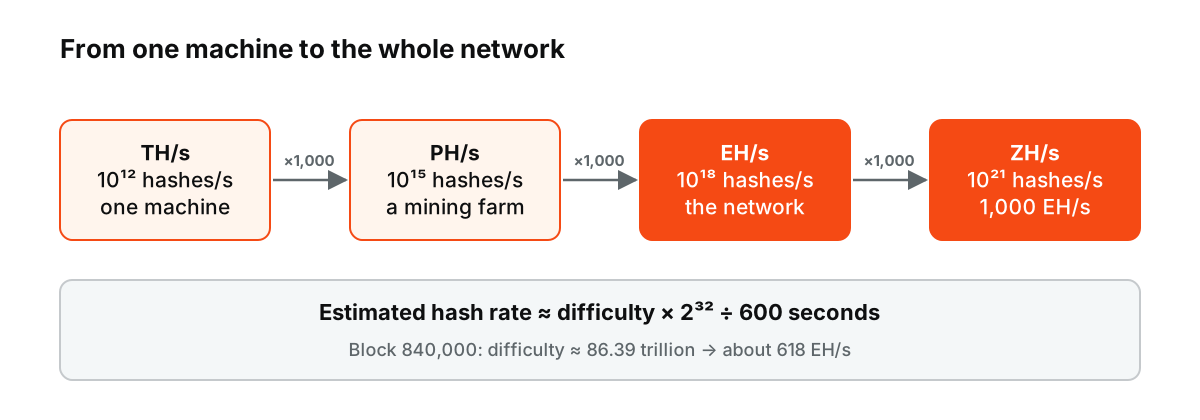
Figure: Hash rate units and the standard estimate from difficulty. Example uses block 840,000.
The rule of thumb for a single difficulty level is:
Estimated hash rate ≈ difficulty × 2³² ÷ 600 seconds
The 2³² factor converts difficulty into the expected number of hashes per block, and 600 seconds is the 10-minute target between blocks.
A real example: block 840,000, the April 2024 halving block, was mined at a difficulty of about 86.39 trillion. Plugging that in gives roughly 618 EH/s. Published estimates from around the same day were in the same range but not identical; FXStreet, for instance, reported about 636 EH/s at the halving. The difference comes from method. Some sites average over the last day of blocks, some over a week, and luck in block timing moves short-window estimates around.
That is the practical lesson. Treat any single day’s hash rate figure as a noisy reading, and look at weekly or monthly averages when you want to know the real trend.
Reading a hash rate chart
Because daily estimates are noisy, most charts show a moving average, often over seven days, and many use a logarithmic scale so that growth over years is easier to compare. Two habits help. First, look at the direction over weeks rather than the latest point. Second, read hash rate alongside difficulty: hash rate is estimated from difficulty and block times, so a sudden “spike” that difficulty does not later confirm is usually just a run of lucky blocks.
What hash rate tells you
How expensive an attack would be. To rewrite recent blocks, an attacker would need to outpace the honest network’s hashing power. A higher hash rate means more hardware and electricity standing in the way.
How much capital and energy miners are committing. Rising hash rate means miners are adding machines, which usually signals that they expect mining to stay profitable after the cost of new hardware.
Where difficulty is heading. Bitcoin resets its difficulty every 2,016 blocks. If hash rate has risen during a period, blocks have been coming faster than every 10 minutes, and the next adjustment will make mining harder. Our explainer on Bitcoin mining difficulty shows the calculation.
An individual miner’s share. Your expected revenue is your hash rate divided by the network’s, multiplied by what the network earns. That is the starting point of our worked example on Bitcoin mining profitability.
What hash rate does not tell you
It is not a price signal. Hash rate tends to follow mining profitability, which depends heavily on the BTC price, rather than lead it. New machines take months to order, ship and plug in, so hash rate often keeps climbing for a while after prices have already turned. Reading a hash rate record as a reason prices must rise reverses the usual direction of cause and effect. For what actually moves the market, see our guide to what moves the Bitcoin price.
It does not measure decentralization. A high total can still be concentrated in a few large pools or in a few regions. The distribution of hashing power matters as much as the total for anyone assessing the network’s resilience.
It does not show efficiency. Two networks of equal hash rate can burn very different amounts of electricity depending on the age of the machines. Efficiency, measured in joules per terahash, is a separate number.
Why hash rate has kept rising over time
Bitcoin’s hash rate has grown by many orders of magnitude since 2009, and the reasons compound. Each new generation of mining chips performs more hashes for the same electricity, so replacing old machines raises the total even without new sites. Higher bitcoin prices make it worth deploying more machines, and miners keep searching for cheaper power, which lowers their costs and lets them run more hardware. The halvings push the other way by cutting revenue, but so far efficiency gains and price increases have more than offset them over the long run.
Sudden drops in hash rate
Hash rate can fall quickly when a large group of miners goes offline at once: a regional power curtailment, extreme weather, a government crackdown, or older machines becoming unprofitable after a halving cuts the block subsidy. When that happens, blocks slow down until the next difficulty adjustment, and transactions take longer to confirm in the meantime.
These dips are usually temporary. Difficulty falls at the next adjustment, mining becomes profitable again for the remaining machines, and the displaced hardware often comes back online somewhere with cheaper power.
Questions people ask about hash rate
Is a higher hash rate good for Bitcoin?
For security, generally yes: more hashing power makes rewriting the chain more expensive. It does not, by itself, say anything about where the BTC price is going.
Why do different websites show different hash rates?
Hash rate is estimated, not measured. Sites use different averaging windows and methods, so their figures for the same day can differ by several percent.
This article is educational content and does not constitute financial, investment, legal or tax advice. Digital assets are volatile and you may lose the amount you invest.
Sources
- Block 840,000 (difficulty at the 2024 halving) — Blockchain.com Explorer
- Bitcoin Halving Concludes Successfully as BTC Miner Rewards Reduce to 3.125 — FXStreet, April 2024
- Bitcoin Core source, pow.cpp (difficulty retarget every 2,016 blocks) — Bitcoin Core, GitHub
- Bitcoin: A Peer-to-Peer Electronic Cash System — Satoshi Nakamoto, October 2008