
Bitcoin Myths That Refuse to Die
Bitcoin myths about anonymity, recovery, supply, hacks and halvings still cost people money. Here is what each one gets wrong and what is actually true.
The costliest of the Bitcoin myths is the belief that someone can recover your coins if you lose access. If you hold your own keys and lose your seed phrase, nobody can restore them. Most other myths cost less, but they still lead people to take risks they did not understand or to dismiss Bitcoin for the wrong reasons.
The myths in one table
| Myth | What is actually true |
|---|---|
| Support can recover my coins | With self-custody, the seed phrase is the only backup |
| The network gets hacked all the time | Losses usually come from exchanges, wallets and stolen keys |
| Bitcoin is anonymous | It is pseudonymous; every transaction is public |
| Payments can be reversed | Confirmed transactions are final |
| Someone can print more | Every node rejects blocks that break the issuance rules |
| A government can switch it off | Governments can restrict access, not stop the network everywhere |
| It is a Ponzi scheme | There is no operator promising returns, but speculation is real |
| Mining just wastes energy | The energy buys security; whether it is worth it is debated |
| The halving guarantees a rally | It is a supply schedule, not a forecast |
| Quantum computers will steal it all soon | A real long-term question, not a present-day attack |
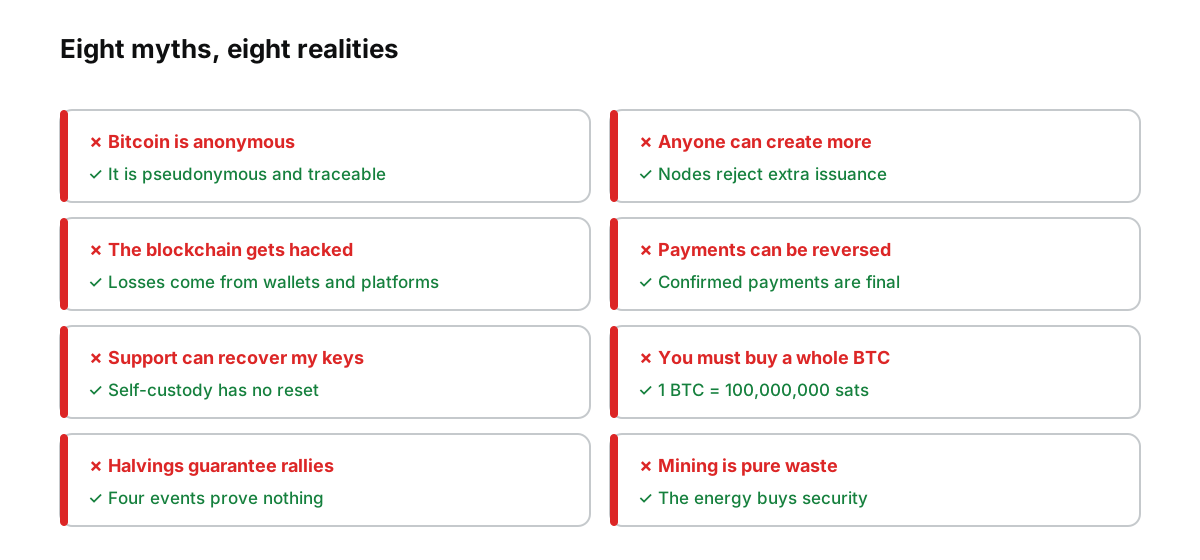
Figure: The eight myths in this article, with the short version of what is true.
The rest of this guide takes the ones that cause the most confusion in turn.
Nobody can rescue a lost seed phrase
A self-custody wallet is controlled by its private keys, and the seed phrase is the human-readable backup of those keys. There is no company behind the network that can reset access. If the phrase is lost and the device fails, the coins stay on the blockchain forever, unspendable.
Exchange accounts work differently: the platform holds the keys and can restore your login after identity checks. That convenience comes with its own risk, because the coins are only as safe as the company. See custodial vs non-custodial wallets. The belief that «support» can help is also what scammers exploit; anyone offering to recover a wallet if you share your phrase is trying to empty it.
The network is rarely what gets hacked
Headlines about «Bitcoin hacks» almost always describe exchanges, custodians or individual wallets being compromised through stolen keys, phishing or poor security. The Bitcoin protocol itself, the rules every node enforces, has not been the source of those losses. The practical risk lies in how coins are stored and accessed, which is why protecting your account from phishing matters more than worrying about the blockchain breaking.
Pseudonymous is not anonymous
Every Bitcoin transaction is recorded publicly and permanently. Addresses do not carry names, but they can be linked to people through exchange records, address reuse and the way coins are combined in transactions. Blockchain analysis is now a large industry used by exchanges and law enforcement. See is Bitcoin anonymous.
The same permanence applies to mistakes. A confirmed payment cannot be reversed by anyone, so sending to the wrong address or to a scammer is usually final. See why network confirmations matter.
No one can print more, and no one can simply switch it off
New bitcoin enters circulation only through the block subsidy, on a schedule every node checks. A block that pays its miner more than the rules allow is rejected, however much work went into it. Changing that would require most of the network to adopt new rules, and those who refused would continue on the old chain. See what happens when all 21 million bitcoin are mined.
Governments have a different kind of power. They can ban exchanges, restrict banks from serving crypto businesses, or prohibit mining within their borders, and those measures can sharply limit access for people in that country. What they cannot easily do is stop a network whose nodes and miners are spread across many jurisdictions. Restriction and shutdown are not the same thing.
Is Bitcoin a Ponzi scheme?
A Ponzi scheme has an operator who promises returns and pays earlier investors with money from new ones, until the inflows stop. Bitcoin has no operator, no promised return and no account holding investors’ money; its rules and transactions are public. In that strict sense, it is not a Ponzi scheme.
The criticism usually points at something real, though. Bitcoin produces no cash flow, so holders profit only if later buyers pay more, and its price is heavily driven by speculation. That makes it a speculative asset whose value depends on continuing demand. Fraudulent schemes that use Bitcoin’s name, promising guaranteed returns, are a separate matter, and many of them are Ponzi schemes in the full sense.
Energy use: what it buys and what is debated
Mining consumes large amounts of electricity, and that is by design. The energy spent makes rewriting Bitcoin’s history extremely expensive, which is what secures the ledger without a central authority. Whether that security is worth the energy is a genuine debate, involving how the electricity is generated, what it would otherwise be used for and how one values the network itself. Calling it simply «wasted» skips the part that matters. See how Bitcoin mining works.
The halving is a schedule, not a forecast
There have been four halvings, each followed by a new high, which makes the pattern tempting. But four events are too few to prove cause and effect, the schedule is public years in advance, and many other forces were at work in each cycle. Returns have also shrunk each time. See the Bitcoin halving.
Quantum computing: a real question, not an emergency
Bitcoin’s signatures rely on cryptography that a sufficiently powerful quantum computer could in theory break, allowing someone to derive a private key from a public key. That is a legitimate long-term research question, especially for coins whose public keys are already visible on the blockchain. It is not a present-day attack: no existing machine can do it, and the network can adopt new signature schemes through an upgrade if the threat becomes practical. The open question is how early and how smoothly such a change would be made.
Checking a Bitcoin claim yourself
Many Bitcoin myths can be tested against public sources. The rules are in the open-source code and the published improvement proposals, every transaction can be looked up on a block explorer, and the original design is set out in the nine-page white paper. A claim that cannot be traced to any of these deserves caution. For the basics, start with what Bitcoin is, and for myths about crypto more broadly, see crypto myths beginners still believe.
This article is educational content and does not constitute financial, investment, legal or tax advice. Digital assets are volatile and you may lose the amount you invest.