
Bitcoin vs Gold
Bitcoin vs gold compared on supply, volatility, custody, portability and track record, plus the situations where each one tends to matter more.
The biggest difference in Bitcoin vs gold is track record. Gold has served as money and a store of value for thousands of years and is held by central banks; Bitcoin has existed since 2009 and swings far more in price. Both are scarce assets with no issuer’s promise behind them, which is why they are so often compared.
Side by side
| Bitcoin | Gold | |
|---|---|---|
| Form | Digital, recorded on a public blockchain | Physical metal |
| Supply | Capped just under 21 million BTC, issued on a published schedule | No fixed cap; mining adds to the stock every year |
| New supply | About 164,000 BTC a year since the April 2024 halving, under 1% of existing supply | Depends on mine output, which tends to rise when prices are high |
| Verifying it is real | Any node can check every coin’s history | Assaying, trusted vaults and certificates |
| Moving it | Any amount, worldwide, in minutes to an hour | Costly to ship, insure and store in size |
| Price swings | Large and frequent | Smaller and slower |
| Track record | Since 2009 | Thousands of years |
| Main holders | Individuals, funds, companies | Central banks, jewelry demand, investors |
| Industrial use | None | Electronics, dentistry and other uses |
The Bitcoin issuance figure is calculated from the protocol: 144 blocks a day at 3.125 BTC each is 450 BTC a day. Our guide to what happens when all 21 million bitcoin are mined shows the full schedule.
Where the two are alike
Both are valued partly because nobody can create more of them at will. Gold’s supply grows only as fast as miners can dig, and Bitcoin’s issuance follows rules every node enforces. Neither pays interest or dividends, so their value depends on what other people will pay for them later.
Both can also be held without relying on a bank. Physical gold in your possession and BTC in a self-custody wallet share that property, along with the responsibility of keeping them safe. Our guide to what a crypto wallet is covers the Bitcoin side.
Where they really differ
Volatility. Bitcoin has fallen by more than half from a previous peak several times, and it has also had years of very large gains. Gold moves too, but far less. Anyone comparing the two as a «safe haven» should account for that gap first.
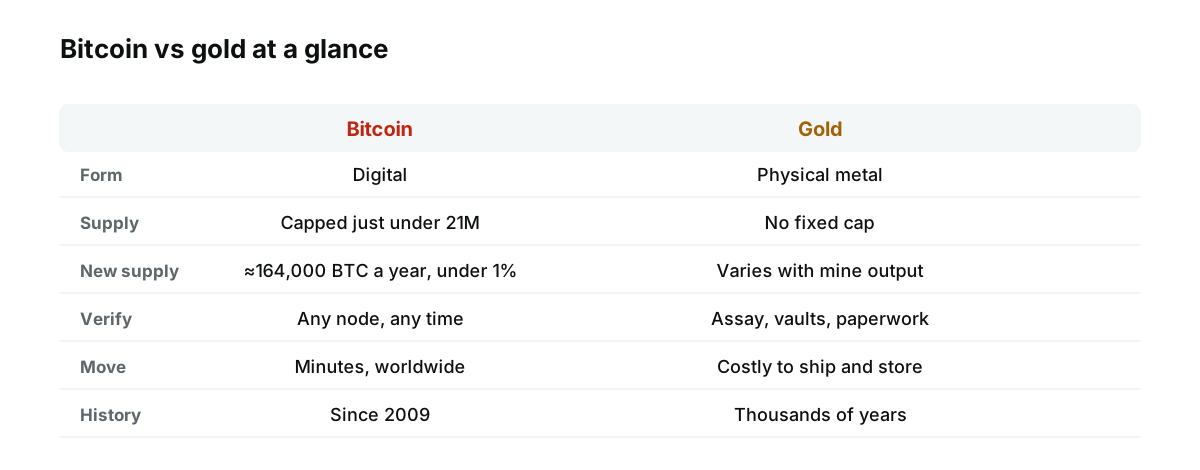
Figure: Bitcoin and gold at a glance. Issuance figure calculated from Bitcoin’s protocol schedule.
Verification and divisibility. Checking that a gold bar is genuine requires testing or trusting a vault’s paperwork. Checking a BTC balance requires a node or a block explorer. BTC divides into 100 million satoshis; our guide on converting satoshis to Bitcoin explains the unit.
Supply response. When gold prices rise, mining becomes more profitable and output tends to grow over time. When Bitcoin’s price rises, more miners join, but the schedule does not change; only the difficulty does. Our explainer on the Bitcoin halving shows why issuance falls no matter what the price does.
Who owns it. Central banks hold large gold reserves and add to them in some years. That official demand is a pillar of gold’s market that Bitcoin does not have in the same way.
Risk you cannot see on a chart. Gold carries storage, theft and counterfeiting risk. Bitcoin carries key-loss, hacking and network risk, plus the possibility that the rules around how it can be held or traded change in a given country.
2025 to 2026: the two parted ways
The most recent period gave an unusually clear test of the comparison. Gold rose more than 60% in 2025 and passed $5,100 an ounce in January 2026, supported by heavy central bank buying: according to the World Gold Council, central banks bought 1,045 tonnes in 2024 and 863 tonnes in 2025. By late June 2026 gold had pulled back to around $4,060, still far above where it began 2025.
Bitcoin went the other way over much of the same stretch. It peaked at about $126,000 in October 2025 and fell roughly 47%, to near $60,000, by early 2026. In a period of geopolitical and financial uncertainty, investors treated gold as the safe asset and bitcoin as a risk asset. That does not settle the long-term debate, but it is a reminder that «digital gold» describes an aspiration more than how bitcoin has reliably behaved in stress.
Ways to hold each
Gold can be held as physical bars and coins, which you store yourself or in a vault; through exchange-traded funds that hold metal on investors’ behalf; or through futures and other derivatives. Physical metal carries storage and insurance costs and wide dealer spreads on small purchases; funds charge an annual fee.
Bitcoin can be held in a self-custody wallet, on an exchange, or, since January 2024 in the United States, through spot bitcoin ETFs in an ordinary brokerage account. Self-custody removes the intermediary but makes you responsible for your keys; exchanges and funds add convenience and counterparty or fee costs.
The same amount, very different risk
Because bitcoin’s price swings so much more than gold’s, putting the same amount of money into each does not create the same amount of risk. A bitcoin holding can lose half its value within months; a gold holding of the same size rarely moves that far. Investors who hold both often size them by how much they could lose rather than by how much they put in, which usually means a smaller bitcoin position than a gold one. See why position size matters.
When each one tends to matter more
Gold tends to matter more to investors who want a long-tested reserve asset, low correlation with the banking system and price behavior that is relatively steady. It is also the asset many central banks reach for.
Bitcoin tends to matter more to people who want a fixed, verifiable supply, easy transfer across borders and the option to hold it without any intermediary. It also attracts those willing to accept much larger swings for the chance of larger moves.
The usual comparison can flip in a market panic. When investors rush for cash, they often sell whatever they can sell quickly, and both gold and Bitcoin can fall in the first days of a sell-off before their usual behavior reasserts itself. «Safe haven» describes a tendency over time, not a guarantee on any given day. Both demand patience through long and uncomfortable drawdowns.
For more on what pushes Bitcoin’s price in particular, see our guide to what moves the Bitcoin price.
This article is educational content and does not constitute financial, investment, legal or tax advice. Digital assets are volatile and you may lose the amount you invest.
Sources
- Bitcoin Core source, validation.cpp (block subsidy schedule) — Bitcoin Core, GitHub
- Bitcoin Core source, amount.h (COIN = 100,000,000 satoshis) — Bitcoin Core, GitHub
- Breaking: Bitcoin Halving Is Sealed After Mining of Block 840,000 — Finance Magnates, April 2024
- Bitcoin price at each halving and subsequent cycle highs — Nasdaq, 2024
- Bitcoin down 47% from $126,000 peak (October 2025 high; early 2026 low near $60,000) — Analytics Insight, February 2026
- IBIT: the ETF that made bitcoin a blue chip (US spot bitcoin ETFs began trading January 11, 2024) — BIT Knowledge Hub