
Is Bitcoin Anonymous?
Bitcoin is pseudonymous, not anonymous. Every transaction is public, and exchanges, address reuse and chain analysis can link addresses to real identities.
Is Bitcoin anonymous? No. Bitcoin is pseudonymous: your name is not written on the blockchain, but every transaction is public and permanent, and addresses can be linked to real people. Once an address is tied to an identity, through an exchange account, a reused address or a careless payment, its history and many connected transactions become visible.
What is public and what is not
Every Bitcoin transaction is recorded on a ledger that anyone can download and read. For each one, the blockchain shows:
- the addresses that sent and received coins
- the amounts
- when it was confirmed
- which earlier transactions the coins came from
What it does not show is a name, email or bank account. An address is a string derived from a public key, and anyone can create new ones for free. That gap between “everything is public” and “no names are attached” is what pseudonymous means.
The Bitcoin white paper described this model directly: privacy comes from keeping public keys anonymous, so the public can see that someone is sending an amount to someone else without knowing who.
How addresses get linked to people
Pseudonymity breaks down at the edges, wherever Bitcoin touches the regulated world or the same person’s habits repeat.
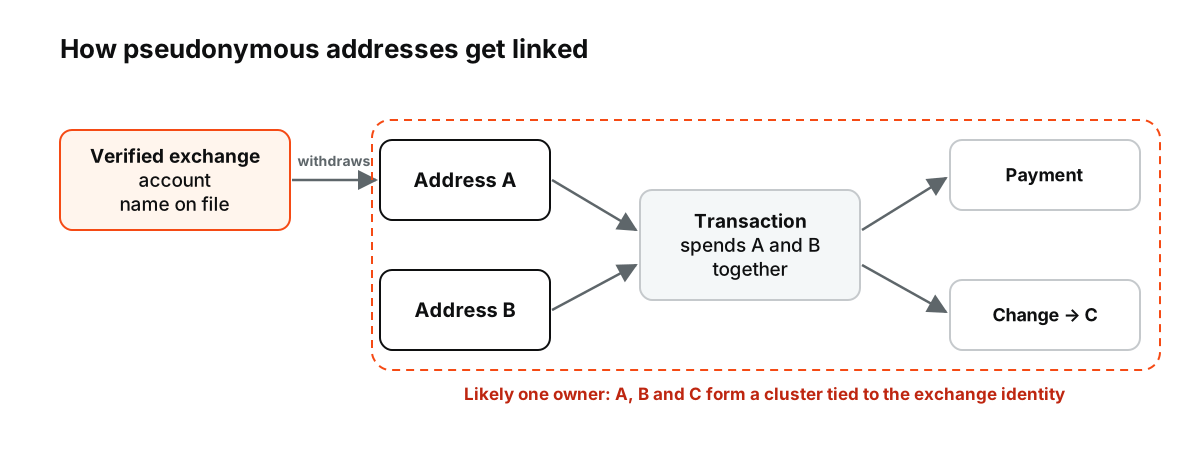
Figure: Common ways analysts link Bitcoin addresses into clusters that can be tied to an identity.
Exchanges and brokers. Regulated platforms verify customers’ identities and keep records of deposits and withdrawals. Rules such as the crypto Travel Rule also require identifying information to move with many transfers between providers. If you withdraw from a verified account to your own wallet, that wallet address is now linked to you in the platform’s records.
Combining coins. When a transaction spends several coins at once, observers reasonably assume they all belong to the same owner. The white paper itself flagged this weakness. Our explainer on UTXOs shows why most payments combine inputs.
Change outputs. Most payments send leftover coins back to the sender as change. Patterns in amounts and address types often reveal which output is the change, which lets observers follow the sender’s coins forward.
Address reuse. Receiving many payments to one address links all of them together and makes your balance easy to watch.
Network-level data. When you broadcast a transaction, the node you connect through can see your IP address unless you take steps to hide it.
Public posts. Sharing a donation address, a screenshot or a payment receipt can connect an identity to an address permanently.
Blockchain analysis is a whole industry
Specialized firms combine these clues at scale. They cluster addresses that are likely controlled by the same entity, label clusters that belong to exchanges or known services, and trace flows of funds over many hops. Law enforcement agencies, regulators and compliance teams at exchanges use these tools routinely.
Because the ledger is permanent, analysis can also be done years later. A transaction that looked untraceable when it happened can be linked to its owner long after the fact, once one address in the chain is identified.
Ways to improve your privacy, and their limits
Some privacy steps are simple good practice:
- Use a new receiving address for each payment. Most modern wallets do this automatically.
- Avoid publishing addresses tied to your name unless you intend them to be public.
- Be careful with what you share about amounts, dates and wallets on social media.
Other tools go further, and come with trade-offs:
- Lightning payments do not record each payment on the blockchain, which improves privacy for everyday spending, though channel openings and closings are public. Our guide to the Lightning Network explains how it works.
- Coin-mixing techniques such as CoinJoin combine many users’ transactions to blur the links between inputs and outputs. Rules on mixing services differ by jurisdiction, and many regulated platforms flag, delay or refuse deposits that they associate with mixers. Check how your platform treats them before using one.
None of these makes Bitcoin anonymous in the way cash can be. They raise the effort needed to link activity, rather than removing the trail.
Privacy tools and the law
Using a privacy-focused wallet or coin-mixing technique is legal in many countries, but the legal position varies and has become stricter in some places. Some mixing services have faced sanctions or prosecutions when authorities concluded they were used to launder proceeds of crime. Separately, many regulated exchanges screen incoming deposits and may delay, question or refuse coins that blockchain analysis links to mixers, sanctioned addresses or stolen funds. A privacy step taken for legitimate reasons can still make it harder to use those coins later, which is worth knowing before you take it.
Why the transparency matters
Bitcoin’s public ledger is a feature for verification: anyone can check that coins are not being created out of thin air or spent twice, and that rules apply equally to everyone. The same transparency means users should treat their transaction history as something that could become public.
For a practical sense of what anyone can see, paste a transaction ID into a block explorer, as described in our guide to what a blockchain explorer is. For the bigger picture, start with what Bitcoin is.
Questions people ask about Bitcoin privacy
Can the police trace Bitcoin?
Often, yes. Investigators combine the public ledger with exchange records and analysis tools, and many high-profile cases have relied on tracing funds on-chain.
Is Bitcoin more private than a bank account?
In some ways yes and in others no. Your bank does not publish your transactions, while Bitcoin’s are public. But a Bitcoin address is not automatically tied to your name the way a bank account is.
This article is educational content and does not constitute financial, investment, legal or tax advice. Digital assets are volatile and you may lose the amount you invest.
Can Bitcoin be made fully anonymous?
Not reliably. Privacy techniques can make tracing harder and more expensive, but they leave patterns of their own, and a single slip, such as reusing an address or moving coins to an exchange account in your name, can undo much of the effort. Anyone who needs strong financial privacy should assume Bitcoin offers less of it than it first appears.