
How to Convert Between Satoshis and Bitcoin
1 BTC equals 100,000,000 satoshis. Learn the two-step conversion between sats, BTC and dollars, with worked examples and a quick reference table.
1 BTC = 100,000,000 satoshis. To convert satoshi to bitcoin, divide the number of sats by 100,000,000; to go from BTC to sats, multiply by 100,000,000. A satoshi is the smallest unit Bitcoin’s software counts in, so every balance and every fee is really a whole number of satoshis underneath.
Why satoshis exist
Bitcoin’s software does not store decimals. Internally, every amount is an integer number of satoshis, and the constant that defines one BTC is literally 100,000,000. Wallets and exchanges divide by that number to show you a BTC figure with up to eight decimal places.
The unit is named after Satoshi Nakamoto, Bitcoin’s pseudonymous creator, and is usually shortened to “sats.” It became popular for a practical reason: as the price of one BTC rose, everyday amounts started to look like 0.00004 BTC, which is easy to misread. “4,000 sats” is harder to get wrong.
How many satoshis exist
Bitcoin’s supply is capped just under 21 million BTC, and each BTC is 100 million satoshis. That puts the maximum at a little under 2.1 quadrillion satoshis, about 2,100,000,000,000,000. Eight decimal places were enough when a bitcoin was worth a fraction of a cent, and they leave plenty of room today: even at very high prices, a single satoshi is worth a small fraction of a dollar, so everyday amounts can still be expressed precisely.
Worked example: sats to BTC to dollars
The price below is illustrative. Use the live price on your platform.
You received 250,000 sats and want to know what that is in BTC and in dollars.
- Sats to BTC: 250,000 ÷ 100,000,000 = 0.0025 BTC
- BTC to dollars: 0.0025 BTC × $80,000 = $200
Going the other way: how many sats is $50?
- Dollars to BTC: $50 ÷ $80,000 = 0.000625 BTC
- BTC to sats: 0.000625 × 100,000,000 = 62,500 sats
Now change one input. If the BTC price is $50,000 instead of $80,000, the same $50 buys 0.001 BTC, which is 100,000 sats. The number of sats in one BTC never changes; the number of sats per dollar moves with the price.
A shortcut for the dollar side: sats per dollar = 100,000,000 ÷ BTC price. At $80,000, one dollar is 1,250 sats. At $50,000, it is 2,000 sats.
Quick reference
| Satoshis | BTC |
|---|---|
| 1 | 0.00000001 |
| 100 | 0.000001 |
| 1,000 | 0.00001 |
| 10,000 | 0.0001 |
| 100,000 | 0.001 |
| 1,000,000 | 0.01 |
| 10,000,000 | 0.1 |
| 100,000,000 | 1 |
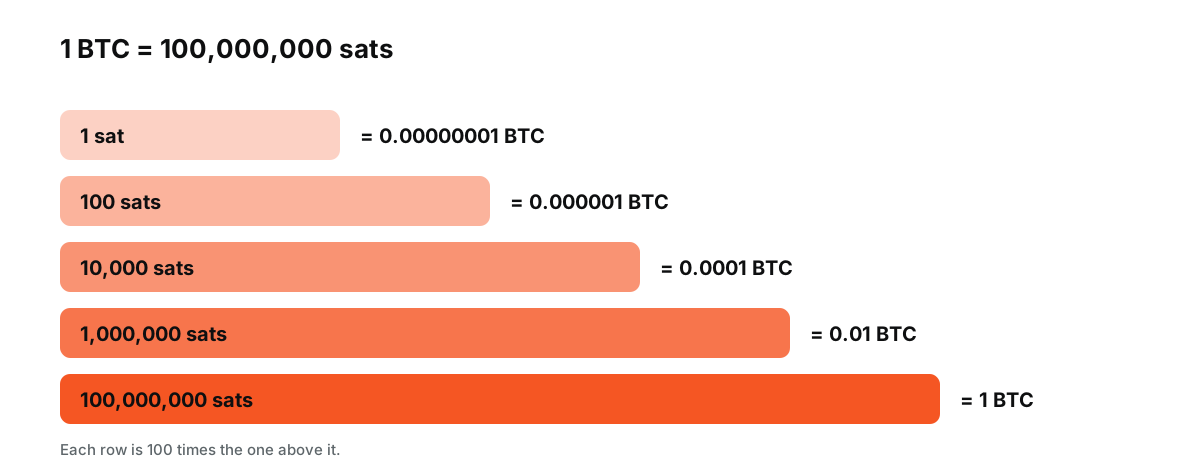
Figure: Satoshis to BTC. Multiply by 100,000,000 to go from BTC to sats; divide to go back.
Each step down the table adds one zero to the satoshi column and moves the BTC decimal point one place to the right.
Where you will see sats instead of BTC
Network fees. Fee rates are quoted in satoshis per virtual byte (sat/vB). A transaction of 140 virtual bytes at 10 sat/vB costs 1,400 sats, or 0.000014 BTC. Our guide to blockchain transaction fees explains how the rate is chosen.
Lightning payments. Lightning wallets usually show balances in sats, and the protocol itself can account in millisatoshis (thousandths of a satoshi) while routing. Only whole satoshis can settle on the Bitcoin blockchain. Our explainer on the Lightning Network covers how payments move.
Mining payouts. Small, frequent pool payouts are often easier to read in sats. In our worked example on Bitcoin mining profitability, one machine earns about 9,144 sats a day.
“Bits”. BIP 176 proposed “bits” as a name for 100 satoshis, or one millionth of a BTC. A few wallets use it, but sats have become the more common everyday unit.
Sats as a way of thinking about bitcoin
Counting in sats has also become a habit among people who buy small amounts regularly. Saying you hold 250,000 sats rather than 0.0025 BTC makes small, steady purchases feel concrete, and it avoids the common misconception that bitcoin is only for people who can afford a whole coin. Some wallets now show balances in sats by default, and prices for small goods or tips over the Lightning Network are often quoted in sats too.
The flip side is that sats can make an amount look larger than it is. A balance of 50,000 sats sounds substantial; it is still 0.0005 BTC, worth whatever 0.0005 BTC is worth at the current price. Converting back to your own currency before making decisions keeps the numbers honest.
Fees look different in sats
Counting in sats makes the cost of small transfers easier to see. Suppose you want to withdraw 50,000 sats from an exchange and the withdrawal fee is 5,000 sats. (Example values.) That fee is 10% of the amount, which is easy to miss when it is written as 0.00005 BTC. Fixed fees hurt small amounts most, so it often makes sense to let a balance build up before withdrawing it on-chain, or to use a Lightning withdrawal where one is offered.
Why apps may show different numbers
Different apps round BTC amounts differently. Some show only four or six decimal places, which hides the last few digits of a balance; others show all eight. Local-currency values also depend on which price feed an app uses and how often it updates. When an exact amount matters, such as when entering a withdrawal, check the full figure in sats or with all eight decimal places rather than relying on a rounded display.
Mistakes that cause real losses
Counting decimal places by eye. 0.0001 BTC and 0.00001 BTC look similar and differ by a factor of ten. Convert to sats or copy the exact amount instead of retyping it.
Mixing up fee rates and fee totals. A “10 sats” fee rate means 10 per virtual byte. The total fee is that rate multiplied by the size of the transaction.
Assuming every platform shows the same unit. Some show BTC, some sats, some local currency. Check which one a field expects before you enter a withdrawal amount, and confirm the result on the review screen. Our checklist on how to withdraw crypto safely includes this step.
For how amounts are actually held and spent under the hood, see our guide to UTXOs, and for the bigger picture, what Bitcoin is.
This article is educational content and does not constitute financial, investment, legal or tax advice. Digital assets are volatile and you may lose the amount you invest.
Frequently asked questions
Is a satoshi a separate coin?
No. It is simply a smaller unit of bitcoin, the way a cent is a smaller unit of a dollar. Any amount of BTC can be expressed in sats, and nothing changes on the blockchain when you do.
Can you own less than one satoshi?
Not on the Bitcoin blockchain, where one satoshi is the smallest amount that can be recorded. Lightning can track millisatoshis while routing payments, but only whole satoshis settle on-chain.