
What Is a Blockchain Node?
A blockchain node is a computer that keeps a copy of the chain and checks the rules. Learn the main node types, what running one involves and why it matters.
A blockchain node is a computer running the network’s software that keeps a copy of the blockchain, checks new transactions and blocks against the rules, and passes valid ones on to other nodes. Thousands of independent nodes doing this at once is what lets a blockchain work without a central server deciding what is true.
What a node actually does
Every node performs the same basic jobs:
- Receives transactions and blocks from other nodes it is connected to.
- Verifies them: signatures are valid, no coin is spent twice, the block follows the consensus rules.
- Stores the data it needs to keep checking future blocks.
- Relays valid data to its peers and refuses to pass on anything invalid.
That fourth step matters more than it looks. A block that breaks the rules does not spread, no matter who created it, because each node checks it independently. On Bitcoin, for example, a miner can spend enormous amounts of electricity on a block and still see it rejected if it pays itself too much; our guide to how Bitcoin mining works explains why miners produce blocks but nodes decide which ones count.
Types of nodes
| Type | What it stores | What it verifies | Typical user |
|---|---|---|---|
| Full node | The data needed to verify new blocks, often pruning older detail | Every new block and transaction against the full rules | Users who want to verify for themselves, businesses, exchanges |
| Archive node | Everything a full node keeps, plus every historical state | Everything | Block explorers, analytics firms, developers |
| Light node | Block headers and small proofs | Limited checks, relying on full nodes for the rest | Mobile wallets and devices with little storage |
| Validator or mining node | Usually a full node plus block-production software | Everything, and also proposes blocks | Validators on proof-of-stake chains, miners on proof-of-work chains |
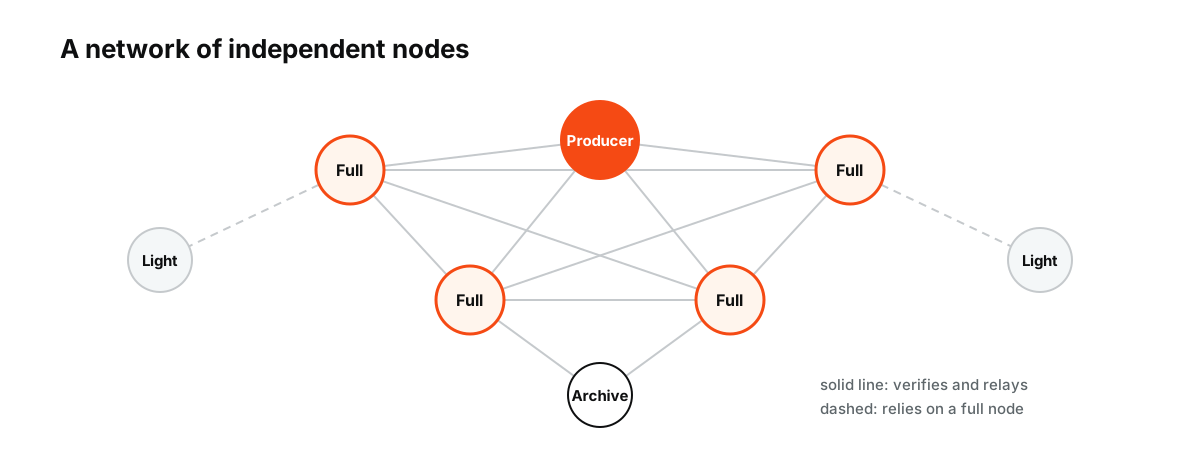
Figure: Node types on a blockchain network. Every full node checks blocks independently before relaying them.
On Ethereum, a full node keeps only recent state locally and can regenerate older data when needed, while an archive node never deletes anything, which is why archive nodes need far more storage. On Bitcoin, a “pruned” full node can delete old blocks after verifying them and still check every new block.
Running a node is different from producing blocks. Anyone can run a full node; producing blocks requires mining hardware on proof-of-work chains or staked coins on proof-of-stake chains. Our comparison of proof of work vs proof of stake covers that difference.
Clients and why diversity matters
A node runs client software, the program that implements the network’s rules. Bitcoin is dominated by a single reference implementation, Bitcoin Core. Ethereum deliberately has several independent clients, written by different teams in different programming languages, and since the Merge each Ethereum node runs two pieces of software: an execution client, which processes transactions, and a consensus client, which follows proof of stake.
Having several clients reduces the damage a single bug can do. If one client with a small share of the network misbehaves, the others keep the chain running. If a client used by a large majority has a serious bug, it could finalize an incorrect chain or stall the network. That is why Ethereum’s developers encourage node operators to avoid concentrating on any one client.
Why running your own node matters
You verify instead of trusting. A wallet connected to your own node checks your balance and incoming payments against the rules itself. A wallet that relies on someone else’s node trusts that operator to report the truth.
You help decentralization. The more independent full nodes there are, the harder it is for any group to change the rules quietly. Bitcoin’s history includes a moment when that mattered a great deal; our guide to the Bitcoin block size war explains how node operators, not just miners, decided the outcome.
You gain privacy. Querying your own node means you are not telling a third party which addresses you care about.
The trade-offs are hardware, bandwidth and maintenance. A full node needs reliable storage and an internet connection that can handle continuous syncing, and the first sync can take a long time. For most people, a reputable wallet that connects to public infrastructure is a reasonable choice; for businesses that handle significant funds, running their own nodes is standard practice.
Nodes, RPC providers and what your wallet trusts
Most people never run a node, yet their wallets still need one. Instead, wallets connect to RPC providers: companies that run large fleets of nodes and answer requests on behalf of many users. This is convenient and fast, but it means the provider sees which addresses you query, can rate-limit or block requests, and could in principle return incorrect information. If a provider goes down, wallets that rely on it can stop working even though the blockchain itself is fine.
Some wallets let you change the RPC endpoint, including pointing them at your own node. Doing so moves you from trusting a provider to verifying for yourself.
What it takes to run a node
The requirements depend on the network and the node type. A Bitcoin full node can run on modest hardware with a few hundred gigabytes of storage, and less if it is pruned. An Ethereum full node needs more: a fast solid-state drive with considerably more space, more memory and a stable connection, while an archive node needs far more storage still. In both cases, the first synchronization can take from hours to days, and the node needs to stay online and updated to remain useful. Many users run nodes on a small dedicated computer at home.
How nodes stay in agreement
Nodes do not vote on what happened. Each one applies the same rules to the same data and reaches the same result. When two valid versions of the latest block briefly exist, nodes follow the chain with the most accumulated work (on proof of work) or the one chosen by the fork-choice rules (on proof of stake), and the network converges quickly. Our guide to why network confirmations matter explains why platforms wait for a few blocks before crediting deposits.
When nodes run incompatible rules, the network can split into two chains. That is what a fork is, and our guide to blockchain forks explains the difference between hard and soft forks.
This article is educational content and does not constitute financial, investment, legal or tax advice. Digital assets are volatile and you may lose the amount you invest.
For where nodes sit among the other building blocks of decentralized applications, see what Web3 is.