
What Is Data Availability in Blockchains?
Data availability means a block's data is published so anyone can check it. Learn why rollups depend on it, how blobs work and what sampling does.
Data availability is the guarantee that the data needed to check a block has actually been published, so anyone can download and verify it. It becomes a real problem for layer-2 networks and light clients, which rely on others to post data. If that data is withheld, nobody can prove whether the transactions inside were valid.
An everyday way to picture it
Imagine a shop that hands you a receipt showing only the total. The total might be right, but you cannot check it, because the itemized list is missing. Data availability is the guarantee that the itemized list exists and that anyone can read it. A blockchain or layer 2 that publishes only a summary of its transactions, without the underlying data, is asking users to trust the total.
Why it is easy on a simple blockchain
On a base chain like Bitcoin or Ethereum’s main layer, a full node downloads every block in full and checks every transaction. If part of a block is missing, the node cannot validate it and simply rejects it. Data availability is guaranteed by the act of verification itself. Our guide to blockchain nodes explains that process.
Why it becomes hard for rollups
A rollup processes transactions off the main chain and posts a summary back. For the system to be safe, anyone must be able to reconstruct the rollup’s state and challenge or verify what the operator did. That is only possible if the underlying transaction data is published somewhere others can get it.
The risk has a name: a data withholding attack. An operator could post a valid-looking commitment while hiding the data behind it. With optimistic rollups, nobody could produce a fraud proof without that data. With ZK rollups, the proof still shows the state change was valid, but users could not work out their own balances to withdraw independently. Our guide to layer 1 vs layer 2 blockchains explains the two rollup designs.
What happens if data is withheld
Consider an optimistic rollup whose operator turns dishonest. It posts a new state to Ethereum claiming that it now owns everyone’s funds, along with a commitment to the transactions that supposedly produced that state. Normally, anyone watching would download the transaction data, see that the claim is false and submit a fraud proof within the challenge period, and the bad state would be rejected.
If the operator also withholds the transaction data, nobody can build that proof, because nobody can show which step was wrong. The fraudulent state could then become final. The same missing data would also stop users from using the rollup’s escape routes, which let them withdraw directly through the layer 1 if the operator stops cooperating, because those routes require users to prove what they own. Publishing the data is what keeps both safety mechanisms working.
How Ethereum handles it: blobs
Rollups used to post their data as ordinary transaction data on Ethereum, which is processed by every node and kept forever. That made it the largest part of rollup fees.
An Ethereum upgrade in 2024, known as proto-danksharding (EIP-4844), introduced blobs: a separate type of data attached to blocks. Blobs are cheaper because the execution layer does not process them and nodes delete them after a fixed period, about 18 days. That is long enough for anyone to download and check the data, and the commitments to it stay on-chain permanently. The result was a large drop in fees on many layer-2 networks.
Who checks that data is available?
On Ethereum today, every consensus node downloads the blob data for each block, at least until it expires. Rollup users and independent watchers rely on that.
Blob space has its own market
Blobs are priced separately from ordinary transactions, with their own fee that rises when demand for blob space exceeds the target amount per block and falls when demand is low. For most of the time since their launch, blob space has been cheap, which is why rollup fees dropped so sharply. But because many rollups draw on the same blob space, a surge in demand from one part of the ecosystem can raise data costs for all of them at once. Rollup fees therefore depend partly on activity elsewhere, not only on the rollup’s own traffic.
| Where a rollup posts its data | Relative cost | How long nodes keep it | Who guarantees availability |
|---|---|---|---|
| Ethereum transaction data (calldata) | Highest | Permanently | Ethereum validators |
| Ethereum blobs | Lower | About 18 days | Ethereum validators |
| A separate data availability network | Usually lowest | Depends on the network | That network’s validators |
Data availability sampling
Blobs still require nodes to handle all the blob data, which limits how much can be added. The longer-term plan, often called full danksharding, uses data availability sampling (DAS).
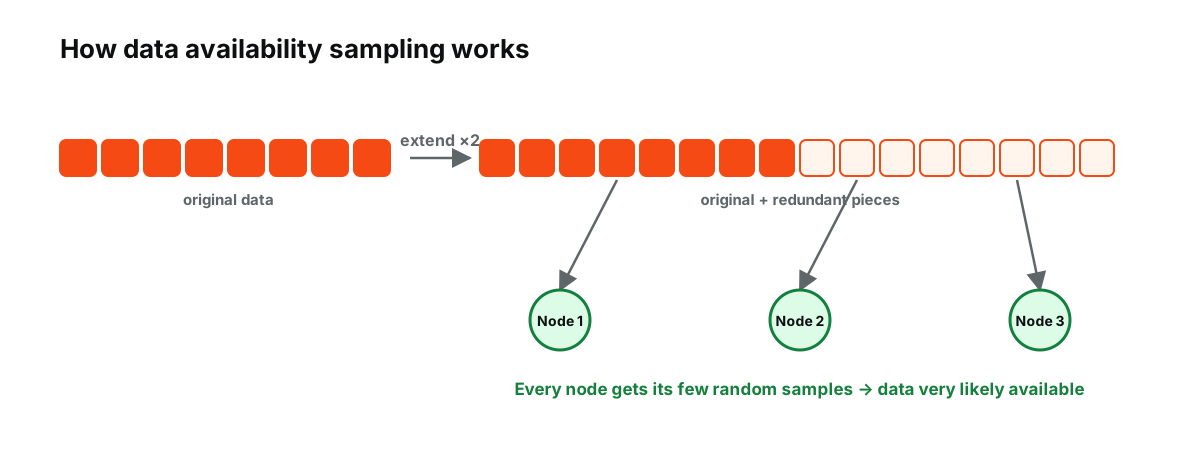
Figure: Data availability sampling. Because of the redundant encoding, hiding any data makes many samples fail.
The idea is clever. Data is expanded with extra redundant pieces, so that if any part of the original is missing, a large share of the expanded data is missing too. Each node then downloads a few small, random samples. If all its samples come back, it can be highly confident the full data is available, without downloading everything. Many nodes sampling independently make it extremely hard to hide data.
Data availability layers
Some projects specialize in data availability as a separate service: networks whose main job is to publish and guarantee data for rollups and other chains, rather than to execute transactions. This is one of the pieces behind the idea of modular blockchains, where execution, settlement, consensus and data availability can be handled by different layers.
Using a separate data availability layer can lower costs, but it changes the security assumptions. A rollup that posts its data to Ethereum relies on Ethereum’s validators for availability; one that posts elsewhere relies on that other network.
You will rarely see the words “data availability” in a wallet, but they shape two things you do notice. It is a major part of what you pay in fees on layer-2 networks, and it determines whether you can exit a layer 2 with your funds if its operator stops cooperating. When comparing networks, it is worth knowing where each one posts its data. For background on fees, see our guide to blockchain transaction fees.
Rollups and validiums
Where a layer 2 keeps its data decides what kind of system it is:
| Design | Proof of correct execution | Where the data goes | Main trade-off |
|---|---|---|---|
| Optimistic rollup | Fraud proofs during a challenge period | On Ethereum | Long withdrawal wait |
| ZK rollup | Validity proof with each batch | On Ethereum | More complex technology |
| Validium | Validity proof with each batch | Off Ethereum, with a separate data committee or network | Cheaper, but users rely on whoever holds the data |
A validium can prove that its state changes are correct and still leave users unable to withdraw if the data holders stop cooperating. That is why “where is the data?” is one of the most useful questions to ask about any layer 2.
This article is educational content and does not constitute financial, investment, legal or tax advice. Digital assets are volatile and you may lose the amount you invest.
For where data availability fits among the other building blocks of decentralized applications, see what Web3 is.