
What Is Proof of Stake?
Proof of stake secures a blockchain with locked-up coins instead of mining. Learn how validators are chosen, how slashing works and what stakers risk.
Proof of stake is a way for a blockchain to agree on new blocks by having participants lock up the network’s own coins as collateral, instead of spending electricity on mining. These participants, called validators, propose and vote on blocks. Honest work earns rewards, and provable cheating can cost them part of their stake.
The problem every blockchain has to solve
A blockchain has no central administrator, so it needs a way for thousands of computers to agree on one history and to make attacks expensive. Proof of work, used by Bitcoin, makes attackers spend real energy; our pillar guide on how Bitcoin mining works explains it.
Proof of stake makes attackers put up and risk capital instead. To influence which blocks are accepted, you need a large share of the coins being staked, and misbehaving puts those coins at risk.
How validators are chosen and what they do
On a proof-of-stake network, anyone who meets the requirements can lock coins in a special contract and run validator software. On Ethereum, the largest proof-of-stake network, a validator needs 32 ETH to activate.
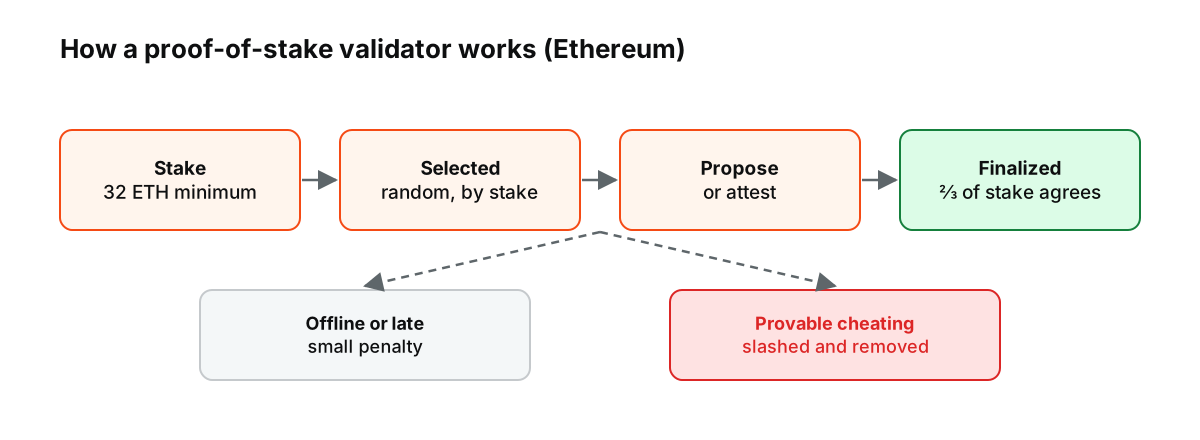
Figure: The validator cycle on Ethereum, with the two kinds of penalty.
Time on the network is split into short slots. For each slot, the protocol picks a validator at random to propose a block, with the odds weighted by stake. Other validators are assigned to attest, which means checking the proposed block and voting for it if it is valid. Blocks that collect enough votes become part of the chain.
On Ethereum, an upgrade known as Pectra raised the maximum effective balance for a single validator to 2,048 ETH, so large stakers can run fewer, larger validators. The 32 ETH minimum stayed the same.
How the clock works on Ethereum
Ethereum’s proof of stake runs on a fixed schedule. Time is divided into slots of 12 seconds, and every slot has one chosen proposer. Thirty-two slots make up an epoch, about 6.4 minutes. During each epoch, every active validator is assigned to vote once, so the whole validator set weighs in without everyone voting on every block.
At the boundary of each epoch is a checkpoint. When validators holding two-thirds of the stake vote to justify one checkpoint and then the next, the earlier one becomes final. In normal conditions that takes about two epochs, roughly 13 minutes. A transaction is therefore usually “in a block” within seconds and “final” within a quarter of an hour.
Rewards for honest participation
Validators earn rewards for proposing blocks and for timely, correct votes. On Ethereum, these come from new ETH created by the protocol plus transaction fees and tips paid by users. Rewards vary over time with the number of validators, network activity and fees, so there is no fixed return.
Validators that are offline when they should be voting lose small amounts as a penalty. The penalty is mild for occasional downtime and grows when many validators go offline at the same time.
Slashing: the cost of cheating
Slashing is the stronger penalty, reserved for actions that can only be deliberate or the result of a serious setup mistake, such as signing two different blocks for the same slot or casting contradictory votes. A slashed validator loses part of its stake and is forced out of the validator set.
Slashing is what gives proof of stake its teeth. An attacker who tries to support two competing versions of history can be caught by anyone, and the evidence is enough for the protocol to destroy part of their stake.
Finality
Many proof-of-stake networks offer finality: a point after which a block cannot be reversed without destroying a large amount of staked capital. On Ethereum, blocks become final once validators holding at least two-thirds of the total stake have voted on checkpoints that include them.
That differs from Bitcoin, where a transaction becomes progressively harder to reverse with each new block but never reaches a formal “final” state. Our guide to why network confirmations matter covers how platforms handle both models.
Getting in and out takes time
Validators cannot join or leave instantly. Ethereum limits how many validators can enter or exit in each epoch, so when many want to move at once, they wait in a queue. This churn limit protects the network: a large share of stake cannot leave suddenly, for example right after behaving badly, before penalties can be applied. For stakers, it means exit plans should allow for waiting periods that can stretch from days to weeks in busy times.
The main criticisms
Concentration among large providers. Much staked ether flows through a small number of exchanges and liquid staking protocols. If a few operators control a large share of validators, they hold outsized influence over which transactions get included.
“The rich get richer.” Rewards are proportional to stake, so large holders earn more in absolute terms. Defenders point out that the rate is the same for everyone, unlike proof of work, where large miners can buy cheaper electricity and hardware.
Weak subjectivity. A brand-new node cannot tell a fake history from the real one purely from the chain’s rules, because old validators who have withdrawn could in theory sign an alternative past at no cost. New nodes therefore start from a recent, widely agreed checkpoint. Critics see that as a reliance on social trust; supporters see it as a small, practical assumption.
Ways people take part in staking
- Solo staking. Running your own validator with the full minimum stake. You keep control of your keys and your rewards, and carry all of the technical responsibility.
- Pooled or liquid staking. Combining funds with others through a protocol, often receiving a token that represents your share. This lowers the minimum but adds smart-contract and provider risk.
- Staking through a platform. An exchange or custodian runs the validators for you. It is simple, but you rely on that provider and its terms.
Each option involves risks: price swings in the staked coin, penalties, waiting periods before you can withdraw, and the risk of the provider or software you rely on.
Variations on proof of stake
Ethereum’s design lets any holder with enough coins run a validator, but other networks take different approaches:
- Delegated proof of stake. Token holders vote for a limited set of block producers, often a few dozen, who run the network. It can be fast, but it concentrates block production among those elected.
- Nominated and pooled models. Holders nominate or back validators with their stake and share in both rewards and penalties, which spreads risk but ties delegators to their validators’ behavior.
- Combined designs. Some networks pair proof of stake with other techniques for ordering transactions quickly, using stake mainly to decide who may produce blocks and to punish misbehavior.
The common thread is collateral: whatever the variation, participants put up the network’s own coins as a guarantee of good behavior.
Where proof of stake is used
Ethereum moved from proof of work to proof of stake on September 15, 2022, in an upgrade called the Merge, which cut the network’s energy use by an estimated 99.95%. Many newer networks were designed around proof of stake from the start, often with their own variations, such as delegating stake to a smaller set of validators.
For a direct comparison of the two main approaches, see our guide to proof of work vs proof of stake. For how Ethereum fits into the bigger picture, read what Ethereum is.
This article is educational content and does not constitute financial, investment, legal or tax advice. Digital assets are volatile and you may lose the amount you invest.
Frequently asked questions
Can I lose my staked coins?
Yes, in several ways. Slashing can remove part of a validator’s stake, delegators can share in their validator’s penalties, the coin’s price can fall, and coins held through a provider are exposed to that provider’s risks.
Is proof of stake less secure than proof of work?
They secure the chain differently rather than one being simply weaker. Proof of stake can punish attackers directly by destroying their stake; proof of work ties security to ongoing physical cost. Each has trade-offs explored in proof of work vs proof of stake.
Sources
- The Merge (date and ~99.95% energy reduction) — ethereum.org
- Ethereum consensus specifications, Phase 0 beacon chain (32 ETH effective balance) — Ethereum, GitHub
- Ethereum consensus specifications, Electra beacon chain (32 ETH minimum activation balance; 2,048 ETH maximum effective balance) — Ethereum, GitHub
- Proof-of-stake (slots, epochs, finality) — ethereum.org Developer Docs
- Weak subjectivity — ethereum.org Developer Docs