
What Do Exchange Inflows and Outflows Show?
Exchange inflows track coins moving onto exchanges; outflows track coins leaving. What each usually signals, why internal transfers mislead and how to read it.
Exchange inflows and outflows track coins moving onto and off crypto exchange wallets. Inflows add coins that could be sold; outflows usually mean coins going into self-custody or long-term storage. Net flow, inflows minus outflows, is one of the most watched on-chain signals, but internal transfers and imperfect address labels often make it look more meaningful than it is.
The basic measures
- Inflow: coins sent to wallets labeled as belonging to an exchange.
- Outflow: coins withdrawn from those wallets.
- Net flow: inflow minus outflow over a day, week or month.
- Exchange reserve: the running total of coins held in exchange wallets.
How they are usually read
Large inflows, especially during rallies, can mean holders preparing to sell.
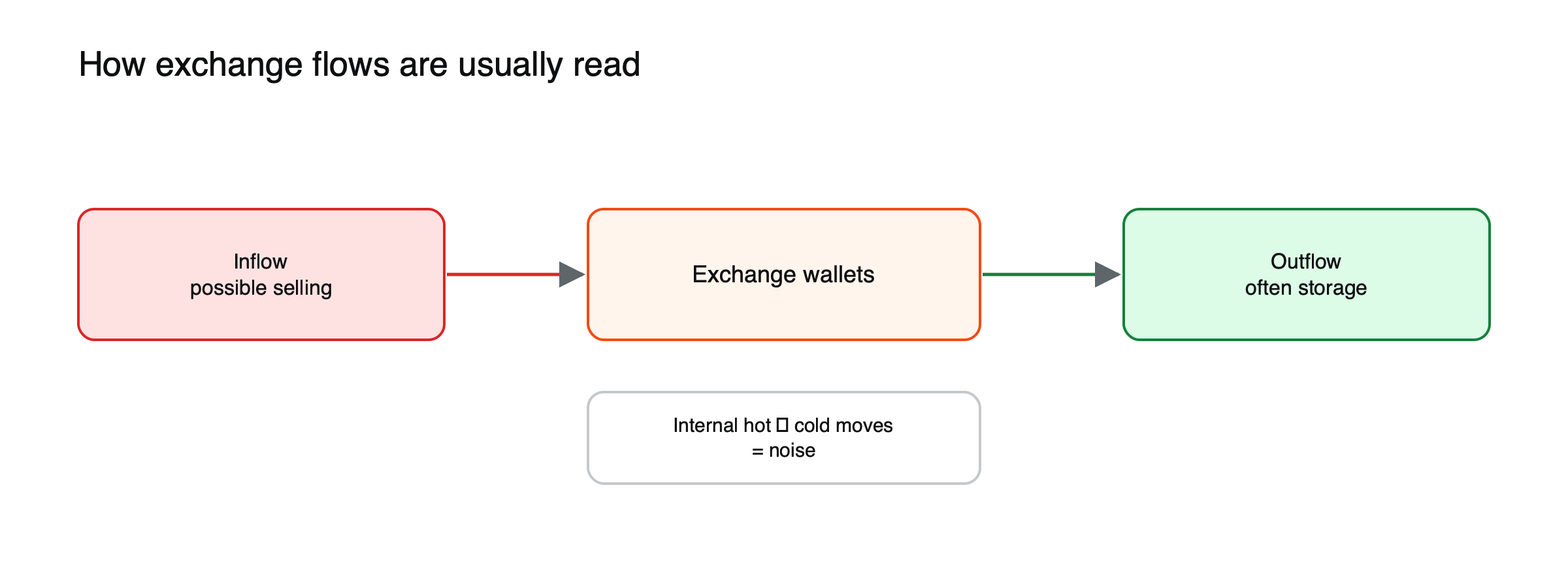
Figure: The usual readings of exchange flows, and the noise to filter out.
Sustained outflows and falling reserves are often read as accumulation: buyers moving coins off exchanges to hold.
A worked example
Suppose that over one week, analytics data shows 25,000 BTC flowing into exchange wallets and 32,000 BTC flowing out. (Illustrative figures.)
- Net flow = 25,000 − 32,000 = −7,000 BTC (a net outflow)
- If exchange reserves started the week at 2.4 million BTC, they end at about 2.393 million, a fall of about 0.29%
A single week of that size says little. Several months of similar outflows, alongside steady or rising prices, would be read as coins moving steadily into long-term storage. The same 7,000 BTC appearing in one day, from one address, would more likely be a single large holder or an exchange reorganizing its wallets.
Price and flows together
A price drop with coins leaving exchanges looks like buyers stepping in; a drop with coins flooding in looks like more selling to come.
Why the signal is noisy
Internal transfers. Exchanges move coins between their own hot and cold wallets. If labels are wrong, those moves look like deposits or withdrawals.
Labels change. Analytics firms label exchange addresses through patterns and disclosures; labels are incomplete and revised over time, so historical charts can change.
Not every inflow is a sale. Coins may be deposited as collateral, for market making or for transfers between platforms.
Off-chain activity. ETFs, custodians and trades inside exchanges do not show up as exchange flows.
Spot exchanges and derivatives exchanges
Not all exchanges are the same kind of destination. Coins sent to a spot exchange can be sold directly for cash or stablecoins. Coins sent to a derivatives exchange are often posted as margin for futures positions, which can mean more leverage rather than selling. Many analytics providers split flows by exchange type for that reason. A spike in bitcoin deposits to derivatives venues during a rally can signal growing leverage, which has preceded sharp liquidations in the past.
After exchange failures
Flows also respond to trust. After major exchange collapses, users have tended to withdraw coins from exchanges broadly, not just from the failed platform, shifting holdings into self-custody. Those outflows reflect fear about custody rather than a decision to hold for the long term, so reading them as bullish accumulation would be a mistake. Context about what is happening in the industry matters as much as the numbers.
The supply squeeze argument, and its limits
When exchange reserves fall for a long period, a popular argument holds that a “supply squeeze” is building: fewer coins sit on exchanges ready to sell, so new demand must push prices higher. The logic has some force, but it overlooks that coins in private wallets can be sent back to exchanges within minutes, that a growing share of trading happens through ETFs and custodians whose coins may not appear in exchange data, and that price is set at the margin by whoever is trading, not by the total held on exchanges. Falling reserves are context, not a countdown.
Flows beyond bitcoin
The same measures exist for ether and other tokens, with extra noise. Large amounts of ether move between exchanges, staking services and decentralized applications, and tokens can be bridged between networks, so a coin leaving an exchange may simply be moving to another platform. For smaller tokens, a few large wallets can dominate the data, making flows more a record of individual decisions than of market-wide behavior.
Stablecoin flows
Stablecoins moving onto exchanges can mean buying power arriving, the mirror image of coin inflows. Analysts often read rising exchange stablecoin balances alongside falling coin reserves as a setup for buying.
Combining flows with other signals
Exchange flows are most useful when they agree with other evidence. Inflows from long-dormant wallets plus a rising share of coins in profit plus heavy leverage in futures markets describe a market where selling pressure may be building. Outflows plus falling leverage plus a price near holders’ average cost describe one where sellers may be exhausted. Any one of these on its own can mislead; the combination is what gives the reading weight. Checking the same combination over several weeks, rather than reacting to a single day’s spike, filters out most of the noise. Small daily moves are rarely worth acting on, especially for holders with a long horizon. See what on-chain analysis is and how MVRV is calculated.
How to use the data
Compare several providers, look at trends over weeks rather than single days, and check large moves against known exchange wallet reshuffles. For related tools, read what bitcoin dominance is, how to track crypto whale wallets and what on-chain analysis is.
This article is educational content and does not constitute financial, investment, legal or tax advice. Digital assets are volatile and you may lose the amount you invest.
Frequently asked questions
Do large inflows always mean a price drop is coming?
No. They can reflect deposits for collateral, transfers between platforms or an exchange’s own wallet moves. Inflows are more meaningful when they come from wallets that held coins for a long time and coincide with rising prices, when holders have reasons to take profit.
Where can I see exchange flow data?
Several on-chain analytics providers publish exchange flows and reserves, some for free with delays and some in real time for subscribers. Because labeling differs, comparing two providers before drawing conclusions is a good habit.
Sources
- Exchange Net Flow (definitions; internal hot and cold wallet moves; cross-check providers; price and flow context) — BIT Knowledge Hub
- Exchange and Stablecoin Flows (labels incomplete and revised; not every inflow is a sale; stablecoin reserves) — LuxAlgo
- Exchange Flows (internal wallet changes can look like outflows) — CryptoQuant user guide