
How to Calculate a Liquidation Price on a Leveraged Crypto Trade
The liquidation price formula for leveraged long and short crypto positions, worked examples at different leverage levels and what moves your liquidation price.
For isolated margin, a common liquidation price estimate is long = entry × (1 − 1 ÷ leverage + maintenance margin rate) and short = entry × (1 + 1 ÷ leverage − maintenance margin rate). At 10x with a 0.5% maintenance margin rate, a long is liquidated after about a 9.5% drop. Fees and funding move the real figure.
The terms
Leverage: position size divided by your margin. $1,000 of margin at 10x controls a $10,000 position.
Maintenance margin rate (MMR): the minimum share of the position value that must remain as margin. It is often around 0.5% for smaller positions and rises for larger ones.
Isolated margin: only the margin assigned to this position is at risk. With cross margin, your whole balance supports it, so the liquidation price depends on your other positions too.
Worked example 1: a 10x long
Entry $60,000, leverage 10x, MMR 0.5%.
Liquidation price = $60,000 × (1 − 0.10 + 0.005) = $60,000 × 0.905 = $54,300, a fall of 9.5%.
Worked example 2: a 10x short
Same entry and MMR, short position.
Liquidation price = $60,000 × (1 + 0.10 − 0.005) = $65,700, a rise of 9.5%.
How leverage moves the liquidation price
Long at $60,000, MMR 0.5%:
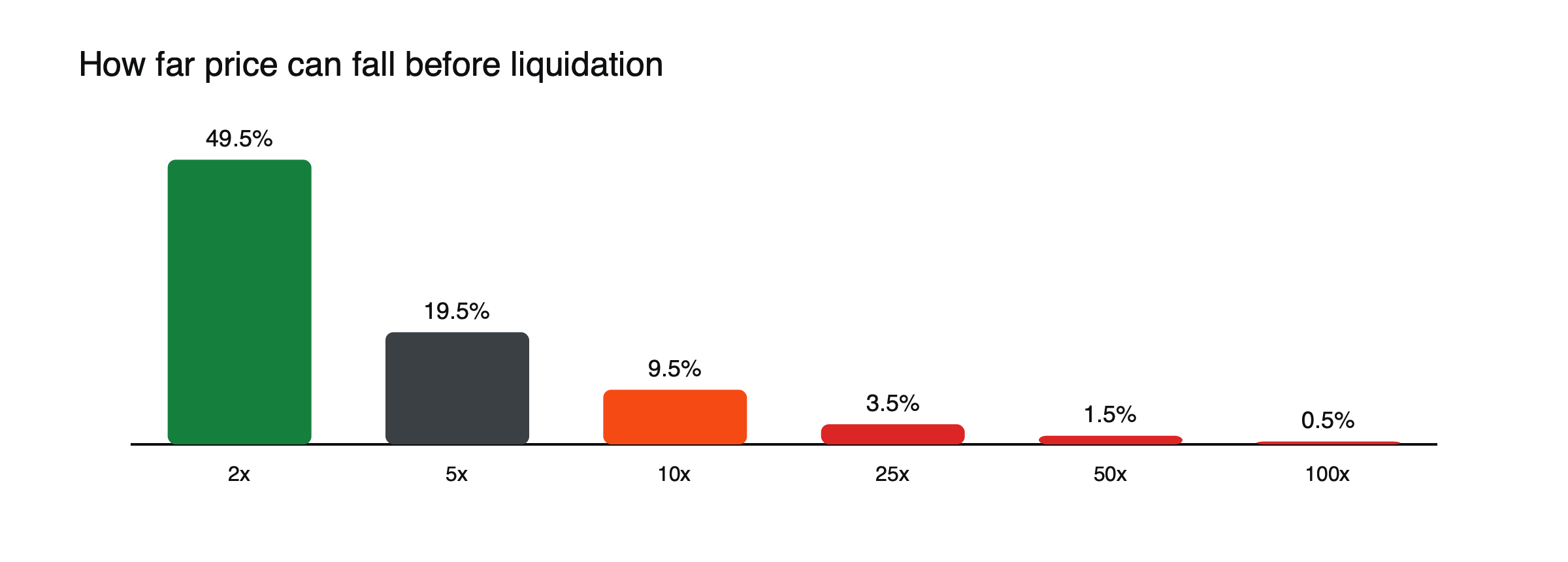
Figure: Drop to liquidation for a long, by leverage (MMR 0.5%, estimate before fees).
| Leverage | Liquidation price | Drop to liquidation |
|---|---|---|
| 2x | $30,300 | 49.5% |
| 5x | $48,300 | 19.5% |
| 10x | $54,300 | 9.5% |
| 25x | $57,900 | 3.5% |
| 50x | $59,100 | 1.5% |
| 100x | $59,700 | 0.5% |
At 50x or 100x, a normal intraday move is enough.
Worked example 3: a larger position
Exchanges raise the maintenance margin rate for bigger positions. Suppose the same 10x long at $60,000 is large enough to fall into a tier with an MMR of 1%. (Illustrative tier.)
Liquidation price = $60,000 × (1 − 0.10 + 0.01) = $54,600, a fall of only 9.0% instead of 9.5%.
The bigger the position, the less room it has, even at the same leverage.
Worked example 4: fees and funding
Return to the $10,000 long with $1,000 of margin at $60,000. Suppose $8 of trading fees and $12 of funding have been taken from the margin, leaving $980. Effective leverage is now about 10.2x.
Liquidation price ≈ $60,000 × (1 − 1 ÷ 10.2 + 0.005) ≈ $54,420, about $120 closer than the original estimate.
Small costs add up on long holds, especially when funding is high.
Worked example 5: cross margin
Now suppose the same $10,000 long uses cross margin, and your whole account holds $5,000 with no other positions. The account balance, not just $1,000, supports the trade, so effective leverage is 2x.
Liquidation price ≈ $60,000 × (1 − 0.5 + 0.005) = $30,300.
The position can survive a far larger fall, but if the price does reach that level, you lose almost the entire $5,000 rather than $1,000.
What changes the real number
- Fees and funding paid from margin move liquidation closer.
- Tiered MMR: bigger positions need more maintenance margin.
- Mark price: liquidation uses the exchange’s mark price, not the last trade.
- Adding margin moves liquidation further away; adding to a losing position can move it closer.
Your exchange shows the exact liquidation price before you confirm; use that, not the estimate.
Liquidation price and bankruptcy price
Two prices matter. The liquidation price is where the exchange takes over your position, while some margin still remains. The bankruptcy price is where your margin would be exactly zero. The gap between them, set by the maintenance margin, gives the exchange room to close the position without the loss exceeding your margin. If it manages to close above the bankruptcy price, the leftover usually goes to the exchange’s insurance fund rather than back to you.
Partial liquidation
Some exchanges close large positions in stages, liquidating only enough to bring the remaining position back above its maintenance requirement. That can leave you with a smaller open position and a new, slightly different liquidation price, which can itself be reached if the market keeps moving.
A useful rule of thumb is to compare the distance to liquidation with the asset’s typical daily range. If bitcoin often moves 3% to 5% in a day, a position that is liquidated by a 3.5% move is likely to be closed by ordinary noise rather than by the trade idea proving wrong. Lower leverage turns that noise into something a position can survive.
Moving your liquidation price
- Add margin to the position, which lowers effective leverage and pushes liquidation further away.
- Reduce the position size, which has the same effect.
- Avoid averaging down with more leverage: adding to a losing long raises the size of the position and can bring liquidation closer.
- Close part of the position early rather than waiting for the exchange to do it for you at a worse price.
Keeping room to move
A stop-loss should sit well before your liquidation price, and the distance to liquidation should be large compared with the asset’s normal daily moves. Fast markets can push price through many liquidation levels at once; see what causes liquidation cascades and perpetual futures mistakes that lead to liquidation and what perpetual futures are.
Trading with leverage magnifies losses as well as gains and can lead to the rapid loss of your entire margin.
This article is educational content and does not constitute financial, investment, legal or tax advice. Digital assets are volatile and you may lose the amount you invest.
A stop-loss before liquidation
In the 10x long above, liquidation sits at $54,300. A stop-loss at, say, a 4% fall would close the trade at about $57,600, losing roughly $400 of the $1,000 margin instead of almost all of it. (Illustrative.) In fast markets a stop can fill below its level, so placing it well before liquidation, rather than just above it, leaves room for that slippage.
Frequently asked questions
Why is my exchange’s liquidation price different from my calculation?
Exchanges include their exact maintenance tiers, fees, funding and mark price rules, and cross-margin accounts include other positions. The simple formula is an estimate; the number on the order screen is the one that applies.
Does the liquidation price change after I open a trade?
Yes, if margin changes. Funding payments, fees, added margin and, in cross mode, gains or losses on other positions all move it.