
Litecoin vs Bitcoin
Litecoin copied Bitcoin's design with faster blocks, a larger 84 million supply and a different mining algorithm. Compare the two and see where each one fits.
The most important difference in litecoin vs bitcoin is role, not technology. Litecoin is a 2011 copy of Bitcoin’s design with faster blocks, four times the supply and a different mining algorithm, meant for everyday payments. Bitcoin, older and far larger, is mainly held as a store of value. Their rules are close; their liquidity and security budgets are not.
Where Litecoin came from
Charlie Lee, a former Google engineer, released Litecoin on October 7, 2011, as a fork of Bitcoin’s code with changed parameters. Lee sold almost all his litecoin in December 2017, saying he wanted to avoid conflicts of interest.
Side by side
| Bitcoin | Litecoin | |
|---|---|---|
| Launched | January 2009 | October 7, 2011 |
| Maximum supply | 21 million | 84 million |
| Block time | About 10 minutes | About 2.5 minutes |
| Mining algorithm | SHA-256 | Scrypt |
| Halving interval | Every 210,000 blocks (~4 years) | Every 840,000 blocks (~4 years) |
| Privacy option | None at the base layer | Optional MWEB since May 2022 |
| Relative size | By far the largest crypto asset | A small fraction of bitcoin’s value |
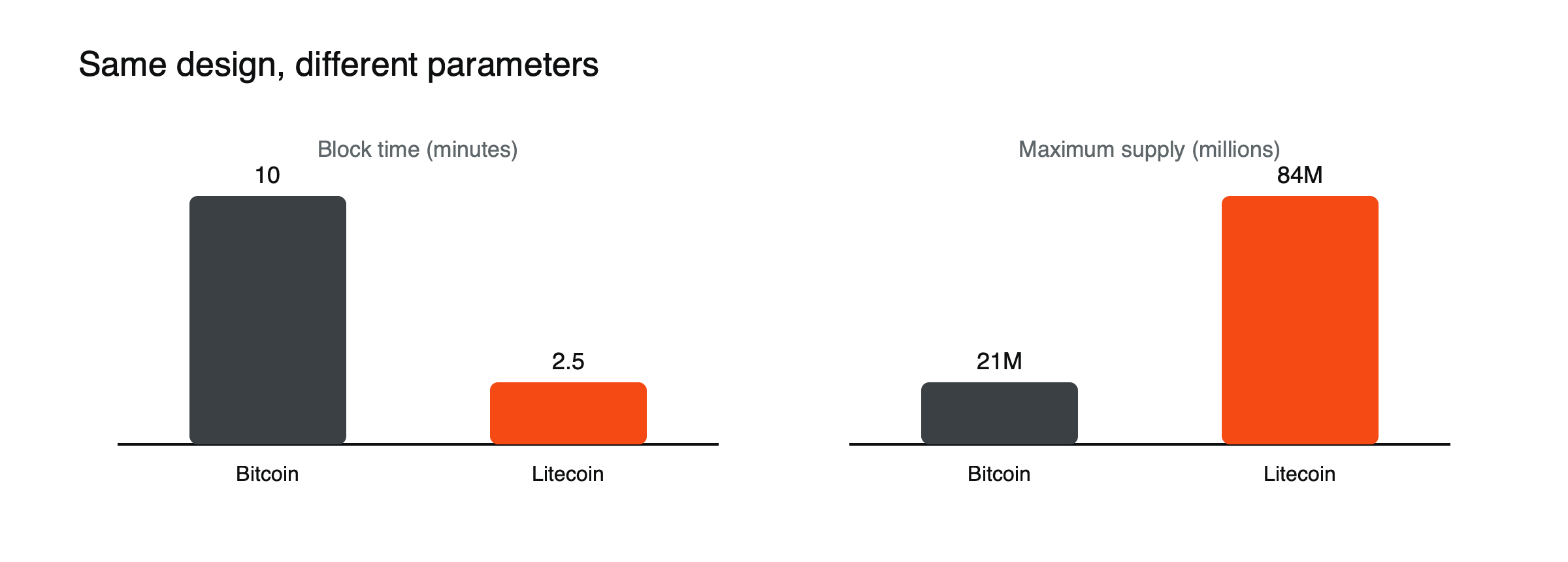
Figure: Litecoin keeps Bitcoin’s design with a 4:1 ratio on both block time and supply.
What the differences mean in practice
Faster blocks mean a first confirmation arrives sooner, which helps payments, but speed alone does not make a network more secure.
A larger supply does not make Litecoin cheaper in any meaningful sense; it just changes the price per coin. What matters is the share of supply issued and the schedule, which mirrors Bitcoin’s four-year halvings.
A different algorithm means Litecoin is mined with different hardware, so Bitcoin miners cannot simply point their machines at it. Dogecoin uses the same Scrypt algorithm.
Optional privacy arrived in May 2022 with MimbleWimble Extension Blocks (MWEB), which can hide amounts for users who opt in.
Confirmations in practice
Faster blocks do not mean equally fast security. A recipient waiting for a payment to be hard to reverse might wait for about six Bitcoin confirmations, roughly an hour. On Litecoin, six blocks take about 15 minutes, but each block represents less total mining work than a Bitcoin block, so platforms often ask for more Litecoin confirmations to reach a similar level of comfort. Litecoin is still quicker for most everyday uses, but the gap is smaller than the block times alone suggest. Exchanges also tend to process Litecoin deposits and withdrawals quickly.
Mining and security
Litecoin’s network is secured by Scrypt miners, and since 2014 many of them have mined Dogecoin at the same time through merged mining, which adds incentive to keep hardware pointed at both chains. Litecoin’s total security spending is far smaller than Bitcoin’s, which matters mainly for very large transfers or for anyone worried about a well-funded attack. For a network of its size, it has a long record without successful majority attacks. See what a 51% attack is.
Halvings on a matching schedule
Litecoin halves its block reward every 840,000 blocks, which, at 2.5-minute blocks, works out to about every four years, the same rhythm as Bitcoin. Its supply therefore follows a similar curve, approaching 84 million coins instead of 21 million. Litecoin halvings attract less attention than Bitcoin’s and have had a less consistent relationship with price.
MWEB and its trade-offs
MWEB lets users move litecoin into an extension block where amounts are hidden, then move it back out. It is optional, and most Litecoin activity still happens on the transparent main chain. Optional privacy can be valuable for ordinary users who do not want their balances visible to everyone, but it also drew scrutiny: some exchanges in jurisdictions with strict anti-money-laundering rules restricted Litecoin after the upgrade, worried about tracing funds. Bitcoin has no comparable privacy layer in its base protocol.
Testing ground for Bitcoin upgrades
Litecoin has often adopted upgrades before Bitcoin. It activated Segregated Witness on May 10, 2017, months before Bitcoin did in the block size war. That role made it useful as a live test of changes later used on the larger network.
Is faster still an advantage?
“Litecoin is better for payments because it is faster” is true at the base layer, but Bitcoin users can now pay through the Lightning Network in seconds, and stablecoins handle most crypto payments by value. Meanwhile, bitcoin’s much larger market and mining power make it far harder to attack. For most purposes, the gap in liquidity and security matters more than the gap in block time.
For how Bitcoin’s supply works, read what happens when all 21 million bitcoin are mined. For the wider category, see what an altcoin is.
This article is educational content and does not constitute financial, investment, legal or tax advice. Digital assets are volatile and you may lose the amount you invest.
Litecoin’s place in the market today
Litecoin remains one of the longest-running cryptocurrencies, widely listed and accepted by many payment processors. Its share of the overall crypto market has shrunk over the years as new platforms, stablecoins and layer 2 networks took on roles it once filled. It now occupies a stable but modest niche: a well-known, conservative coin with fast confirmations, rather than a contender for Bitcoin’s position.
Which one fits which purpose
For long-term holding as a scarce asset, bitcoin’s size, liquidity and security budget make it the default for most people. Litecoin suits those who want a similar design with quicker confirmations, lower fees and optional privacy, and who accept a smaller market and less institutional support. Many payment uses that once favored Litecoin are now handled by stablecoins or Bitcoin’s Lightning Network, which narrows its niche.
Frequently asked questions
Is Litecoin just a copy of Bitcoin?
It began as a fork of Bitcoin’s code with different settings, and its design remains close. Over time it added features such as optional privacy through MWEB, and it has served as an early adopter of upgrades later used by Bitcoin.
Why is Litecoin’s price so much lower than bitcoin’s?
Partly because there are four times as many coins, and mostly because far less money is invested in it. Comparing total market value, not price per coin, is the meaningful comparison.
Sources
- Litecoin (released October 7, 2011; 84 million supply; Scrypt; 2.5-minute blocks; halving every 840,000 blocks; MWEB May 2022) — Wikipedia
- Litecoin: what it is and how it works (SegWit May 10, 2017; MWEB 2022) — Trezor
- Litecoin (LTC) price and profile (Charlie Lee sold holdings in December 2017) — The Block