
What Happened to Mt. Gox?
Mt. Gox handled most bitcoin trading before losing about 850,000 BTC in 2014. The timeline from collapse to repayments, why it failed and what it changed.
Mt. Gox was a Tokyo exchange that handled an estimated 70% of bitcoin trading in 2013. In February 2014 it halted after disclosing that about 850,000 bitcoin, nearly 7% of all bitcoin then, had been lost to thefts unnoticed for years. Repayments only began in July 2024, with the deadline now October 31, 2026.
From card trading to bitcoin’s biggest exchange
Mt. Gox did not start as a financial company. Programmer Jed McCaleb created the site for trading cards from the game Magic: The Gathering, which is where the name came from: Magic: The Gathering Online eXchange. In July 2010 he repurposed it as a bitcoin exchange, at a time when buying bitcoin at all was difficult. In 2011 he sold it to Mark Karpelès, a French developer living in Tokyo, who grew it into the dominant venue for buying and selling bitcoin.
That growth outpaced the company’s systems. Mt. Gox handled a rapidly rising volume of customer money with the controls of a small start-up, and for most of its life there was no regulator checking whether the bitcoin it reported actually existed.
The 2011 warning
The first serious breach came in June 2011, when attackers stole about 25,000 bitcoin from 478 accounts, worth around $400,000 at the time. The exchange recovered and kept growing, but the incident showed how exposed customer funds were. In hindsight, it was an early warning of the security weaknesses that would later prove fatal.
Timeline
- 2013: Mt. Gox is the dominant bitcoin exchange, with an estimated 70% of trading volume.
- February 7, 2014: Mt. Gox halts bitcoin withdrawals, blaming a technical issue known as transaction malleability.
- February 24–28, 2014: the exchange goes offline, discloses the loss of about 850,000 BTC, roughly 750,000 belonging to customers, and files for bankruptcy protection in Tokyo.
- March 20, 2014: it reports finding nearly 200,000 BTC in an old wallet used before 2011, cutting the loss to about 650,000 BTC.
- 2018: the case moves into civil rehabilitation, allowing creditors to be repaid in crypto rather than only cash.
- 2021: a Tokyo court approves the rehabilitation plan for about 24,000 creditors.
- July 5, 2024: repayments begin through exchanges such as Kraken and Bitstamp. The news contributes to a sharp bitcoin sell-off.
- October 2024 and October 2025: the repayment deadline is extended, most recently to October 31, 2026.
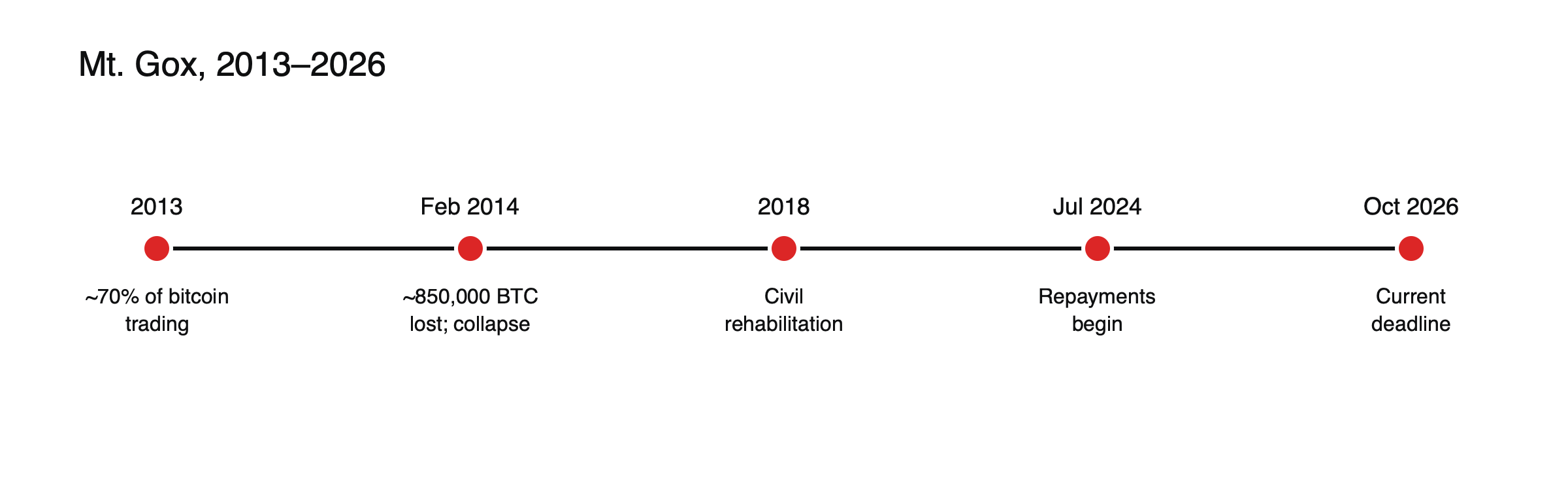
Figure: More than a decade from collapse to final repayment deadline.
Why it failed
Funds were taken from Mt. Gox’s wallets over years without the company noticing. The exchange combined weak security, poor internal controls and little outside oversight. Customers had no way to verify whether their deposits were actually held.
The transaction malleability explanation
When Mt. Gox stopped withdrawals, it blamed transaction malleability, a quirk in how Bitcoin transactions were identified at the time. Someone could alter a transaction’s identifier without changing what it did, which could make a completed withdrawal look as if it had failed. An exchange that relied on those identifiers might then send the same withdrawal again. Mt. Gox suggested attackers had exploited this to drain funds. Later analysis found that malleability could not explain losses on anything like the scale reported; the coins had leaked away over years through theft and poor accounting. The malleability issue itself was eventually fixed by the SegWit upgrade in 2017. See the Bitcoin block size war.
How coins can vanish without anyone noticing
It seems impossible for an exchange to lose hundreds of thousands of bitcoin without realizing it, but the structure made it possible. Customer balances lived in Mt. Gox’s internal database, while the actual coins sat in a set of wallets the company controlled. As long as withdrawals could be paid from whatever was on hand, nobody had to reconcile the two in full. Small, repeated thefts from the wallets, combined with sloppy accounting, could widen the gap year after year. Customers saw their balances on screen and had no way to check that the coins behind them existed. Only when withdrawals could no longer be met did the gap become visible, by which point most of the bitcoin was long gone.
Where the bitcoin went
Investigators traced much of the stolen bitcoin to accounts linked to BTC-e, another exchange later described by US authorities as a money-laundering operation. Its alleged operator, Alexander Vinnik, was indicted in the United States. Mark Karpelès was not found to have stolen the coins, but a Tokyo court convicted him in 2019 of falsifying data to inflate the company’s holdings. The broad conclusion was negligence on a huge scale rather than a single heist.
What creditors got back
About 142,000 BTC was eventually available for creditors, along with bitcoin cash and cash. When repayments began in July 2024, that bitcoin was worth roughly $9 billion, far more in dollar terms than the coins had been worth at the collapse, because bitcoin’s price had risen enormously in the decade between. Creditors who waited and received bitcoin back did far better than the original losses suggested, while those who sold their claims early took much less.
The repayments and the market
When distributions began in July 2024 through exchanges including Kraken and Bitstamp, traders worried that creditors receiving bitcoin worth thousands of times what they had paid would sell immediately. The news coincided with a sharp drop in bitcoin’s price. In practice, repayments were spread over time and across platforms, and many creditors appear to have held. The episode showed how a failure from 2014 could still move markets a decade later, simply because a large block of coins was about to become liquid again.
Mt. Gox and the failures that followed
| Mt. Gox (2014) | FTX (2022) | Bybit (2025) | |
|---|---|---|---|
| What went wrong | Thefts and poor accounting over years | Customer funds used by a sister trading firm | Signers tricked into approving a malicious transaction |
| Was the exchange solvent afterwards? | No; bankruptcy | No; bankruptcy | Yes; covered the loss and kept operating |
| How long customers waited | About a decade | About two years for most | Balances not reduced |
What it changed
Custody became the central question. “Not your keys, not your coins” spread as a lesson: coins left on an exchange are only as safe as that company. See custodial vs non-custodial wallets.
Transparency tools followed. Proof of reserves and regulated custody standards grew partly from the demand to see that exchanges hold what they owe. See what proof of reserves is.
Long tails. Large repayments years later can still move markets, as the July 2024 sell-off showed.
For later failures, read what happened when FTX collapsed and what happened in the Bybit hack. For the basics, see what crypto custody is.
This article is educational content and does not constitute financial, investment, legal or tax advice. Digital assets are volatile and you may lose the amount you invest.
Lessons that still apply
- Check how an exchange holds customer assets, and whether anyone outside the company verifies them.
- Do not keep more on any platform than you need there. Withdraw long-term holdings to a wallet you control.
- Be wary of technical explanations for halted withdrawals. Pauses are sometimes genuine, but a platform that cannot let customers leave is a serious warning sign.
Sources
- Mt. Gox repayment deadline (70% of volume in 2013; 850,000 BTC, nearly 7% of supply; repayments began July 5, 2024; extended to October 31, 2026) — Decrypt, updated October 2025
- Mt. Gox Pushes Back Bitcoin Repayments to October 2026 (2021 court approval; about 24,000 creditors; July 2024 sell-off) — Decrypt, October 2025
- What was Mt. Gox? (roughly 200,000 BTC later recovered) — Binance Square
- What was Mt. Gox? From the hack to repayment (founded by Jed McCaleb; sold to Mark Karpelès in 2011; June 2011 hack of 25,000 BTC; withdrawals halted February 7, 2014; 141,686 BTC recovered) — KuCoin Learn
- Mt. Gox explained (Magic: The Gathering origin; 478 accounts; Karpelès convicted of data falsification; ~140,000 BTC worth about $9 billion) — Trust Wallet
- What you need to know about the MtGox hack (launched July 2010; transaction malleability explanation; ~200,000 BTC found March 20, 2014; Vinnik and BTC-e indictment) — PostQuantum