
What Is a Seed Phrase?
A seed phrase is 12 or 24 words that can restore every key in a crypto wallet. How it works, why it is the most important secret you hold, how to keep it safe.
A seed phrase, or recovery phrase, is a list of 12 or 24 words that encodes the master secret of a self-custody crypto wallet. From it, a wallet can regenerate every private key and address it has used. Whoever has the phrase controls the funds, so keep it offline, private and backed up. No legitimate service will ask for it.
How it works
Most wallets follow a standard called BIP-39:
- The wallet generates a large random number: 128 bits for 12 words or 256 bits for 24 words.
- A short checksum is added, so most typing mistakes are detected.
- The result is split into chunks, each mapped to one word from a fixed list of 2,048 English words.
- The words are turned into a master seed, from which the wallet derives all your keys.
Because the process is standard, you can usually restore the same wallet in different compatible apps or devices using only the phrase.
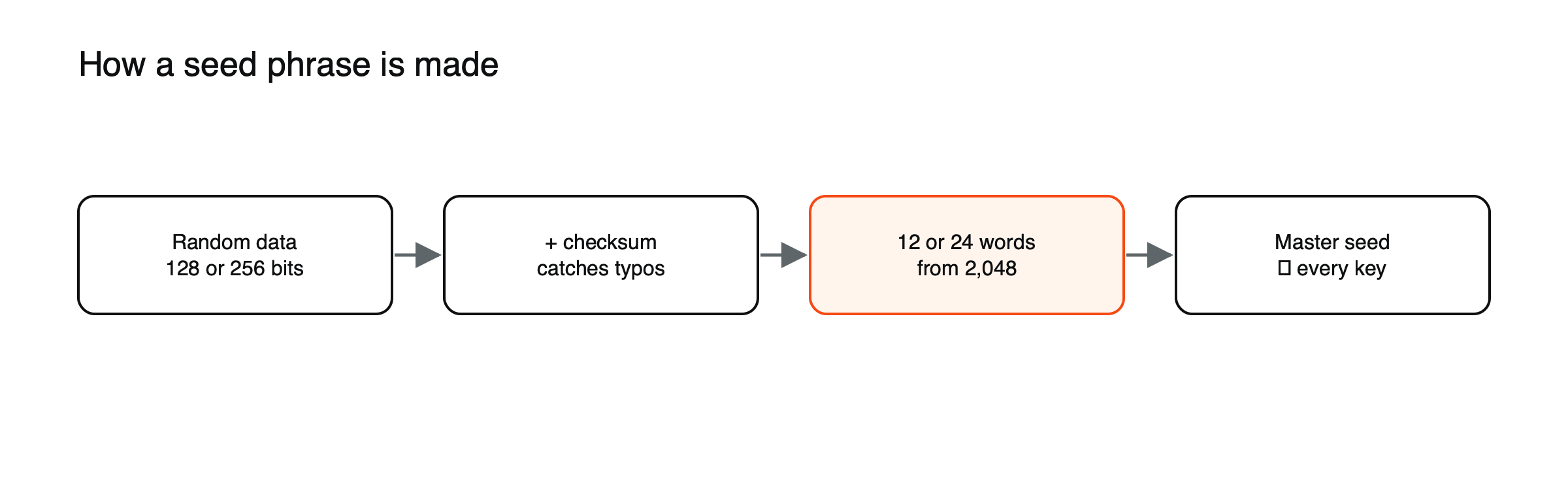
Figure: From random data to words to every key in the wallet (BIP-39).
Why nobody can guess it
A 12-word phrase encodes 128 bits of randomness, which means about 3.4 × 10^38 possible combinations; a 24-word phrase encodes 256 bits, vastly more. Even an attacker trying billions of combinations every second would not get through a meaningful fraction of the possibilities in the lifetime of the universe. That is why seed phrases are not stolen by guessing. They are stolen by being seen: in a photo, a cloud backup, a fake website or a careless glance at a screen.
The checksum built into the last word helps in a different way. If you mistype or swap a word while restoring, the wallet will usually reject the phrase rather than quietly opening an empty wallet.
One phrase, many accounts and networks
From the master seed, a wallet derives keys along standard “paths,” like branches of a tree. The same phrase can produce separate accounts within one wallet, and separate addresses for Bitcoin, Ethereum and other networks, all regenerated in the same order on any compatible wallet. This is why one backup can protect holdings across several blockchains, and also why exposing one phrase can expose all of them at once. Occasionally, two wallet apps use different paths, so a restored wallet appears empty until the right path is selected; the funds are still there.
Seed phrase, private key and password compared
| Seed phrase | Private key | Password | |
|---|---|---|---|
| What it is | Human-readable backup of the master secret | The secret for one address or account | A login to a service |
| What it controls | Every key the wallet can derive | One address | Access to an account someone else holds |
| Can a company reset it? | No | No | Usually yes |
| If someone else sees it | They control all your funds | They control that address | They may access your account, often stopped by 2FA |
Why it matters so much
The seed phrase is the wallet. If your phone or hardware wallet breaks, the phrase restores everything. If someone else sees the phrase, they can restore your wallet on their own device and empty it, without needing your device or password.
The optional passphrase
Many wallets support an extra passphrase, sometimes called a “25th word.” Combined with the seed phrase, it opens a separate wallet. A thief who finds only the written words gets nothing; but if you forget the passphrase, those funds are gone for good.
12 words or 24?
Both are secure against guessing with today’s technology. Twenty-four words add a larger safety margin and are the default on many hardware wallets; twelve are quicker to write down and check without errors. The practical risks, exposure and loss, are the same for both, so the choice matters far less than how the words are stored.
When there is no seed phrase
Not every way of holding crypto involves one. Exchange accounts use passwords and two-factor authentication, because the exchange holds the keys. Some newer wallets split the key into shares held by different devices or parties, or use smart-contract accounts with recovery through trusted contacts. These designs remove the single list of words but replace it with other recovery methods that need just as much care. See custodial vs non-custodial wallets.
If anyone asks for it
No wallet company, exchange, support team, government agency or airdrop needs your seed phrase. Requests for it arrive as “wallet validation” forms, support chats, urgent security warnings and prize claims, all designed to make sharing it feel routine or necessary. The rule is absolute: the only place the words should ever be typed is the wallet you are restoring yourself, on a device you trust. Anyone asking for them, however official they look, is trying to take your funds. A phrase written in pencil can fade, so ink or metal is the safer choice for anything you intend to keep for years.
Keeping it safe
- Write it by hand on paper or stamp it on metal; never photograph it, type it into a phone or store it in the cloud.
- Keep it somewhere private and protected from fire and water.
- Test that it works before storing much value.
- Never enter it on a website or share it with “support.”
Our guide on how to back up a seed phrase safely covers storage options, and seed phrase mistakes that lead to lost funds covers what goes wrong. For wallet basics, read what a crypto wallet is and custodial vs non-custodial wallets.
This article is educational content and does not constitute financial, investment, legal or tax advice. Digital assets are volatile and you may lose the amount you invest.
Frequently asked questions
Can I change my seed phrase?
Not for an existing wallet. If you think it has been exposed, create a new wallet with a new phrase and move all your funds to it, then stop using the old one.
Does a hardware wallet need a seed phrase?
Yes. The device stores the keys, but the phrase is the backup that lets you recover them if the device is lost, broken or stolen. See how to set up a hardware wallet.
Sources
- Seed Phrase (BIP-39; 2,048-word list; checksum; 12 words = 128 bits, 24 = 256; the phrase is the complete backup) — LearnBitcoin
- What are recovery words? (BIP39 standard; keep offline; optional passphrase) — BitBox support
- What is a seed phrase? (checksum bits; no legitimate support agent will ask for it) — btc.network