
What Is a Stablecoin Attestation?
A stablecoin attestation is an accountant's report that reserves covered tokens on one date. What it proves, what it misses and how it differs from an audit.
A stablecoin attestation is a report by an independent accounting firm confirming that, on a specific date, an issuer’s reserves were at least equal to the tokens in circulation and matched the issuer’s description of them. It is a snapshot, not a full audit. Circle publishes attestations monthly and Tether quarterly, and US law now requires monthly reserve reports.
What an attestation checks
The issuer makes a statement, for example: “On this date, 100 billion tokens were in circulation, backed by reserves worth at least that much, made up of these assets.” The accounting firm tests that statement against bank records, custody statements and blockchain data, and reports whether it is fairly presented.
Typical contents include:
- Tokens in circulation on the report date.
- Total reserve value and any excess over circulation.
- Breakdown of reserve assets, such as Treasury bills, repurchase agreements, cash and other holdings.
- The standard used, such as AICPA attestation standards in the US or ISAE 3000 internationally.
Attestation vs audit
| Attestation | Full audit | |
|---|---|---|
| Covers | One statement about reserves | The issuer’s complete financial statements |
| Time | A single date | A full financial year |
| Controls | Usually not tested in depth | Internal controls examined |
| Frequency | Monthly or quarterly | Usually annual |
An attestation tells you what was there on the day. It does not tell you what happened between report dates, how reserves are managed or whether the company is profitable and solvent overall.
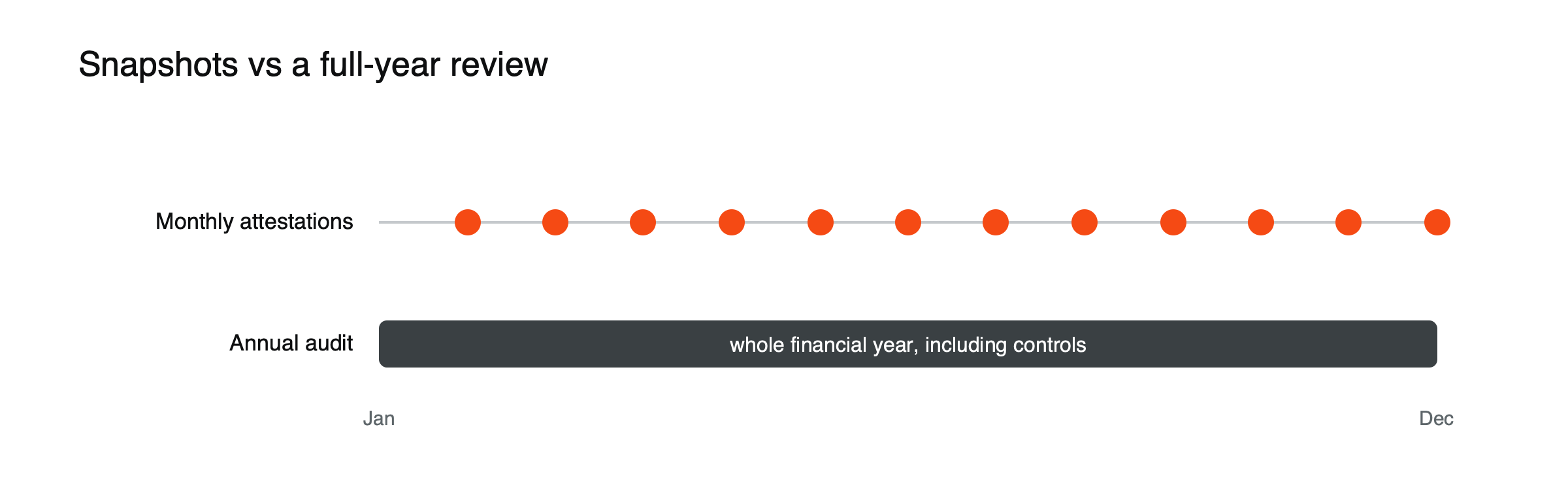
Figure: An attestation is a snapshot on one date; an audit covers a full year.
Reading a sample report
Suppose an attestation states the following for a single date. (Illustrative figures.)
| Line | Amount |
|---|---|
| Tokens in circulation | 60.0 billion |
| Total reserves | 60.4 billion |
| Of which: US Treasury bills | 80% |
| Of which: overnight repurchase agreements | 12% |
| Of which: cash at banks | 7% |
| Of which: other assets | 1% |
The first check is coverage: reserves exceed tokens by 0.4 billion, a cushion of about 0.67%. The second is quality: 99% sits in short-term government debt, repos backed by government debt and cash, assets that can be turned into dollars quickly. The third is concentration, which the summary table does not show: how much of that 7% in cash sits at any one bank. The March 2023 USDC episode showed why that question matters. The last line, “other assets,” deserves the closest look in any report, because that is where riskier or harder-to-sell holdings tend to appear.
What an attestation cannot catch
An attestation confirms that assets existed and matched the issuer’s description on one date. It cannot rule out assets being moved in just before that date and out again afterward. It usually does not examine whether reserve assets are pledged elsewhere as collateral, whether the issuer has other large liabilities, or whether token holders would have a priority claim on the reserves if the company failed. Those questions are about the issuer’s legal structure and overall finances, which is what full audits and regulation are meant to cover. Comparing several consecutive reports, rather than reading one in isolation, helps: a reserve mix that shifts sharply around report dates is worth questioning.
Attestations vs on-chain proof of reserves
Some exchanges and issuers publish proof of reserves: cryptographic evidence that certain blockchain addresses hold given amounts, sometimes combined with a way for customers to check that their balances are included. On-chain proof is fast and continuous but can only show assets that live on a blockchain. A stablecoin’s reserves mostly sit in banks and Treasury bills, off any chain, which is why an accountant’s attestation remains the main evidence. See what proof of reserves is.
Who publishes what
Circle publishes monthly attestations for USDC, examined by Deloitte since 2023 after earlier reports by Grant Thornton. Circle has also been audited as a listed company since its June 2025 stock market listing. Tether publishes quarterly reports examined by BDO Italia and engaged KPMG in 2026 for its first full financial statement audit.
What the GENIUS Act changes. For US payment stablecoins, the GENIUS Act requires monthly public reports of tokens outstanding and reserve composition, examined by a registered public accounting firm and certified by the issuer’s CEO and CFO. The largest issuers will also face annual audits.
Red flags
- Stale reports, or a schedule that slips without explanation.
- A qualified or limited opinion, where the firm notes it could not verify something.
- Frequent changes of accounting firm, especially to smaller or less known firms.
- Vague categories, such as large “other investments” or loans with few details.
- Reserves held with affiliates, where the issuer’s own related companies hold or manage the assets.
- Gaps in coverage, such as reports that leave out tokens issued on some blockchains or skip certain months.
How to read one
Check the date, the firm and the standard first. Then compare reserves with circulation, look at how much is in cash and short-term Treasuries versus other assets, and see whether the report is recent. Our step-by-step guide on how to check a stablecoin’s reserves yourself walks through it.
For on-chain checks that exchanges use, read what proof of reserves is. For the basics, see what a stablecoin is.
This article is educational content and does not constitute financial, investment, legal or tax advice. Digital assets are volatile and you may lose the amount you invest.
Frequently asked questions
How often should a stablecoin publish an attestation?
Monthly is now the common standard for large issuers, and it is what US rules require for payment stablecoins. Quarterly reports leave longer gaps in which reserves could change unseen, so frequency is itself part of how transparent an issuer is.
Does a clean attestation mean a stablecoin is safe?
It means the reserves existed and matched the description on that date. It does not cover the issuer’s wider finances, how reserves are managed between reports or whether holders could redeem quickly in a crisis. It is necessary evidence, not a guarantee, and it should be read alongside the issuer’s redemption terms and its regulatory status. Read all three together before deciding.
Who pays for the attestation?
The issuer hires and pays the accounting firm, as companies do for their audits. Professional standards require the firm to stay independent of the issuer, and its reputation depends on the quality of its work, but the arrangement is one reason the size and standing of the firm matter when reading a report.
Sources
- Stablecoin Reserve Transparency (attestation vs audit; Circle monthly with Deloitte; Tether quarterly with BDO Italia under ISAE 3000) — Spark
- Stablecoin Attestation (Circle moved from Grant Thornton to Deloitte in early 2023; Tether KPMG audit 2026) — Spark
- Stablecoin Reserve Audits Compared (Circle NYSE listing June 2025) — Spark
- Genius is now law (monthly attestations; annual audits above $50 billion) — Cryptio
- GENIUS Act (monthly disclosure examined by a registered public accounting firm; CEO and CFO certification) — Spark