
Stablecoin Myths That Mislead New Users
Stablecoins can lose their peg, freeze funds and pay you nothing. Six common stablecoin myths, what is actually true and what each one means for your money.
The biggest stablecoin myths are that a stablecoin can never lose its peg, that you can always swap it for exactly $1, and that holding it earns interest like a bank account. None is reliably true. Stablecoins are useful tools, but their stability depends on reserves, redemption access and the issuer, and each of these can fail.
Why these myths are so easy to believe
Stablecoins are designed to feel like cash. Balances show in dollars, prices barely move on a normal day, and many apps display them next to a bank balance. Most of the time, that impression is accurate enough. The myths come from assuming the calm of an ordinary day also holds in a crisis, and from treating a privately issued token as if it carried the protections of money in a bank. The questions below are the ones new users ask most often, with the answers that matter when conditions are not ordinary.
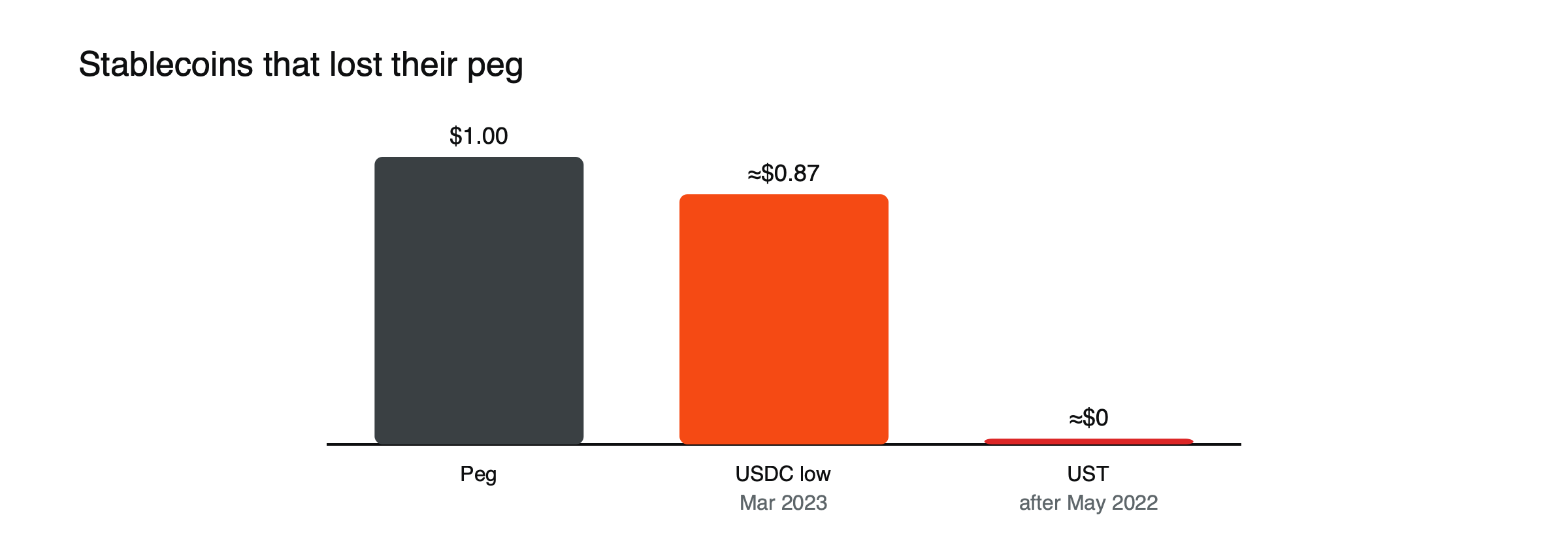
Figure: Two stablecoins that lost their peg. USDC recovered within days; TerraUSD did not.
Can a stablecoin fall below $1?
Yes, and major ones have. TerraUSD, which relied on an algorithm rather than reserves, collapsed in May 2022 and never recovered. Even fully backed USDC fell to about $0.87 in March 2023, when part of its reserves was caught in the failure of Silicon Valley Bank, before recovering once US authorities guaranteed the bank’s deposits. See what happened when USDC lost its peg and the TerraUSD collapse.
The useful way to think about it: a well-run, reserve-backed stablecoin is low-volatility most of the time, and its price in a crisis depends on whether holders believe the reserves are there and reachable.
Can I always swap it for exactly $1?
Not directly, for most people. Redemption with the issuer is usually limited to verified businesses. Tether, for example, requires a $100,000 minimum and charges the greater of $1,000 or 0.1%, while Circle redeems USDC through a platform for business accounts. Everyone else sells on an exchange at the market price, which normally sits within a fraction of a cent of $1 but can move further in stress, and fees and spreads apply on top. See how stablecoins are minted and redeemed.
Do stablecoins earn interest?
Payment stablecoins do not. The issuer invests the reserves and keeps the income, and US and EU rules now prohibit regulated payment stablecoin issuers from paying interest just for holding the coin. When an app or platform offers a return on a stablecoin balance, the money comes from somewhere else: lending your coins to borrowers, a promotional budget, or a different kind of token altogether. Each source carries its own risk. See what yield-bearing stablecoins are.
Are stablecoins insured like bank deposits?
No. A stablecoin is a claim on its issuer, not a deposit at a bank. Circle’s own terms state that USDC held in a Circle Mint account is not covered by FDIC or SIPC protection. What protects holders is the quality of the reserves, how they are held and the law that applies to the issuer, which is why new rules in the US and EU focus on reserve composition, segregation and redemption rights.
Can my stablecoins be frozen?
Yes, for centralized stablecoins. Issuers of tokens such as USDT and USDC can freeze specific addresses, for example under court orders, in response to hacks or for sanctions, and the US GENIUS Act requires issuers to be able to comply with lawful freeze orders. A wallet that receives funds from a frozen or sanctioned address can find those tokens unusable. Decentralized stablecoins are harder to freeze but carry other risks. See centralized vs decentralized stablecoins.
Are stablecoins anonymous?
No more than other tokens on public blockchains. Every transfer is recorded and visible, issuers and exchanges verify the identities of their customers, and blockchain analysis firms trace flows between addresses. Stablecoins are widely used precisely because they are transparent enough for regulated businesses to accept. Anyone who needs privacy should assume that every stablecoin payment they make can be linked back to them.
Is holding a stablecoin the same as holding dollars?
It is closer to holding a dollar-denominated claim on a company. The dollars behind it sit in banks and Treasury bills that the issuer controls; you hold a token that the issuer has promised to honor. For short periods, such as moving funds between platforms, the difference rarely matters. For larger balances held for months, the issuer’s reserves, regulation and redemption terms become the main things you are relying on.
Is a stablecoin safer than holding bitcoin?
Safer against price swings, yes: a reserve-backed stablecoin is designed to hold its value while bitcoin can move tens of percent in weeks. But the risks are different rather than absent. Bitcoin has no issuer that can fail, freeze funds or mismanage reserves; a stablecoin does. Someone holding a stablecoin has traded market risk for issuer, banking and regulatory risk, which is a sensible trade for short-term balances and worth understanding for long-term ones.
Are all stablecoins basically the same?
No. They differ in backing, issuer, regulation, redemption terms and the networks they run on. USDT and USDC alone differ in reserve mix, reporting frequency and redemption rules, and euro stablecoins, synthetic dollars and decentralized stablecoins each work differently again. Even the same token on two different blockchains is only interchangeable if both the sender and the receiving platform support that network. See USDT vs USDC. Treating every stablecoin as a short-term tool until you have checked its issuer is a simple habit that avoids most of these surprises.
A one-minute check before holding a stablecoin
- Who issues it, and under which regulator?
- What backs it, according to a recent independent report?
- How would you exit, and at what cost, if you needed to sell in a hurry?
- Which network are you using, and does every platform involved support it?
Our step-by-step guide on how to check a stablecoin’s reserves covers the second question in detail. For the basics, see what a stablecoin is.
This article is educational content and does not constitute financial, investment, legal or tax advice. Digital assets are volatile and you may lose the amount you invest.
Sources
- USDC regained its dollar peg (low of $0.87, March 2023) — FXStreet
- How to Redeem a Stablecoin for Dollars (Tether minimum and fee; Circle Mint) — Stablecoin Insider, 2026
- USDT vs USDC (Circle terms: USDC in Mint not FDIC or SIPC protected) — Stablecoin Insider, 2026
- What Is the GENIUS Act? (no yield to holders) — Transak
- Genius is now law (freeze orders; reserves) — Cryptio