
What Is Tokenized Real Estate?
Tokenized real estate splits ownership of a property or property fund into blockchain tokens. How it is structured, what holders own, and the main risks.
Tokenized real estate is property ownership, or a share in a property company or fund, represented by blockchain tokens. It promises smaller minimums and easier transfers than buying buildings directly. In practice, holders usually own shares in a legal entity that owns the property, so the tokens are only as good as that structure.
How it is structured
Most projects do not put a house deed on-chain. Instead:
- A company or fund is set up to own one property or a portfolio.
- Shares or notes in that entity are issued as tokens.
- Rental income, after costs, may be paid to token holders.
- A transfer agent or platform keeps the legal register in line with the blockchain.
Platforms emphasize compliance wrappers, enforceability of token rights and investor eligibility checks because the tokens are usually securities. See what RWA tokenization is.
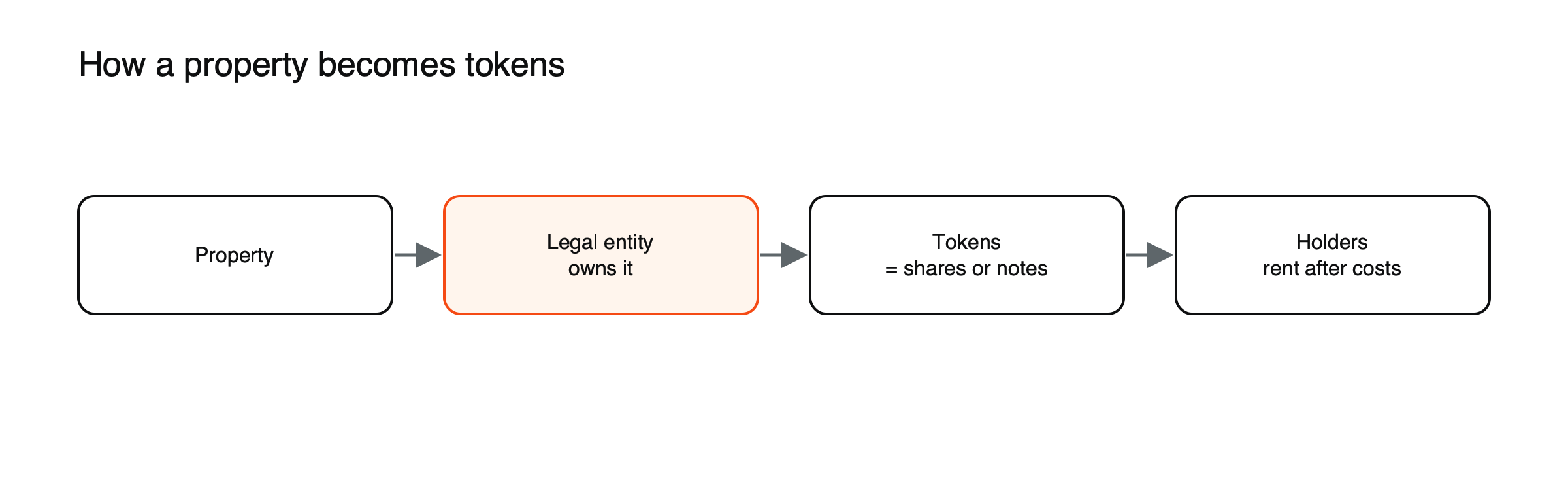
Figure: Token holders usually own the entity, not the building.
Income per token, worked through
Suppose a company owns a property valued at $1 million and issues 10,000 tokens at $100 each. It collects $70,000 a year in rent and pays $25,000 in maintenance, management, insurance and local taxes, leaving $45,000 to distribute. (Illustrative figures.) Each token would receive $4.50 a year, about 4.5% on its $100 price, before any platform fees and personal taxes. A vacancy, a large repair or a rise in costs reduces that payment directly, and the token’s value moves with periodic revaluations of the building.
What “owning” a tokenized property means
In most offerings, token holders do not own the building or appear on its title. They own shares or notes in a company that owns it, governed by that company’s documents and the law of the country where it is registered. Those documents decide whether holders can vote on a sale or refinancing, how income is distributed and what happens if the manager wants to change the arrangement. Two offerings with similar marketing can give very different rights, which is why the legal documents matter more than the token itself. Reading them, or asking an adviser who knows property law in that country to read them, is part of the cost of investing this way.
How an investment works in practice
A typical purchase starts with identity and eligibility checks on the platform. The investor then subscribes, paying in cash or stablecoins, and receives tokens in a platform account or an approved wallet. Rental income, after costs, is paid out periodically, often in stablecoins, along with reports on occupancy, expenses and valuations. When the property is sold, or the offering reaches its planned end, proceeds are distributed to token holders according to the company’s documents.
Types of offering
- Single-property tokens: a company owns one building, and tokens represent shares in it.
- Portfolio or fund tokens: shares in a fund owning many properties, spreading risk across them.
- Property debt tokens: shares in mortgages or development loans, paying interest rather than rent.
Compared with real estate investment trusts
| Tokenized property | Listed REIT | |
|---|---|---|
| Minimum investment | Often low | One share |
| Diversification | Often one building | Usually many properties |
| Liquidity | Thin; few buyers | Traded on a stock exchange |
| Pricing | Periodic valuations | Market price every trading day |
| Investor protections | Depend on structure and country | Established securities rules |
For most people, the main advantage of tokenized property over a listed REIT is access to a specific building or market; the main disadvantage is liquidity.
What holders usually get
- A share of rental income and of any sale proceeds.
- Smaller minimum investments than buying property outright.
- In theory, the ability to sell tokens to other eligible buyers.
Risks to know
- Thin secondary markets: tokens may be technically transferable but have few buyers.
- Property risks: vacancies, repairs, falling values and local regulation.
- Structure risk: your rights depend on the legal entity, its documents and the jurisdiction.
- Valuation: property is valued infrequently, so token prices may not reflect real value.
- Platform risk: if the operator fails, managing and selling the property can become difficult.
Why the secondary market stays thin
Tokens can make transfers technically easy, but buyers still need to be eligible, informed and willing to pay a price that reflects an asset valued only occasionally. Each property is different, which makes comparison hard, and small offerings attract few traders. The result is often a token that can be sold in principle but finds few buyers in practice, especially when the property or the wider market is under pressure.
Property valuations also lag the market. A building valued once a year can carry a price that reflects last year’s conditions, so token prices may stay steady while comparable properties nearby are already selling for less, and then drop sharply when the next valuation arrives. Always check the valuation date before buying.
Questions before investing
- Which entity owns the property, and what rights do the tokens give over it?
- Who manages the property, and what do they charge?
- How often is the property valued, and by whom?
- How can you exit, and has anyone actually sold tokens on the secondary market?
- What happens if the platform operator closes?
How it fits in the RWA market. Treasury products and private credit dominate tokenized real-world assets by value; real estate remains a small, fragmented part. See what tokenized treasuries are and what tokenized private credit is. Before buying, read how to check what backs a tokenized asset.
This article is educational content and does not constitute financial, investment, legal or tax advice. Digital assets are volatile and you may lose the amount you invest.
Frequently asked questions
Can I live in or use a property I hold tokens in?
Generally no. Tokens give a financial interest in the company that owns the property, not a right to occupy it. Any personal use would have to be arranged separately, like any tenancy.
Are rental payments from tokens taxed?
Usually, as income, and possibly in the country where the property is located as well as where you live. The structure of the offering affects how, so it is worth checking before investing and keeping records of every payment.