
What Is Avalanche?
Avalanche is a proof-of-stake network of interlinked chains where teams can launch their own blockchains. Learn how it works, what AVAX does and the risks.
Avalanche is a proof-of-stake blockchain network launched on September 21, 2020, by Ava Labs, a company founded by Cornell professor Emin Gün Sirer. Instead of one chain, it runs a primary network of three chains plus custom blockchains, now called Avalanche L1s, that teams can launch with their own rules. Its token, AVAX, is capped at 720 million.
How Avalanche is organized
The primary network has three chains, each with its own job:
- X-Chain: creates and transfers assets.
- C-Chain: runs Ethereum-compatible smart contracts, where most applications live.
- P-Chain: coordinates validators and tracks the custom chains built on Avalanche.
Teams can launch their own blockchain, formerly called a subnet and now called an Avalanche L1, with its own validators, fee token and rules, for example for a game or a regulated financial application. An upgrade called Etna lowered the cost of running one by replacing a large upfront stake with a small continuous fee.
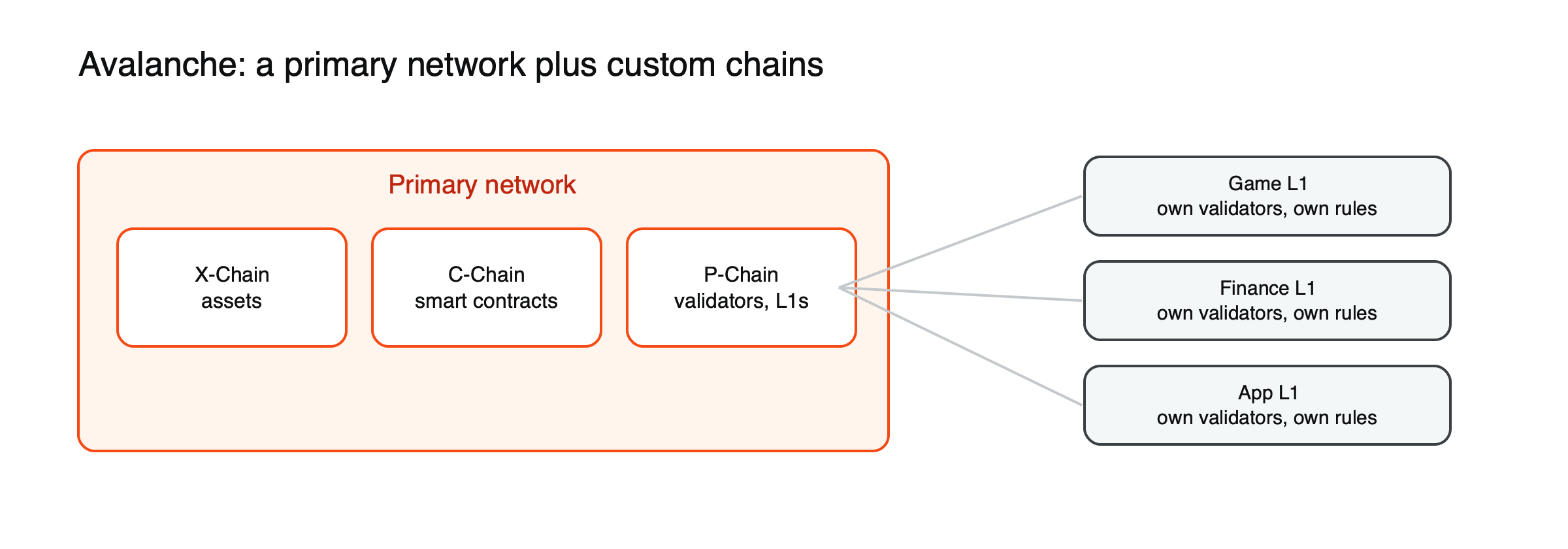
Figure: The primary network and custom Avalanche L1s.
Quick reference
| Mainnet | September 21, 2020 |
| Developer | Ava Labs (founded by Emin Gün Sirer) |
| Primary network | X-Chain, C-Chain, P-Chain |
| Maximum supply | 720 million AVAX |
| Custom chains | Avalanche L1s (formerly subnets) |
Why a project would want its own Avalanche L1
Launching a separate chain lets a project make choices that a shared network cannot. A game can set its own fees, or none, so players are not affected by congestion elsewhere. A financial institution can require that every validator and user pass identity checks to meet its regulators’ rules. An application can tune block times and capacity for its own traffic. The cost is that each chain must attract validators and users, and assets on it are separated from the main C-Chain unless bridged, which can split liquidity.
AVAX supply and uses
AVAX has a maximum supply of 720 million. It is used to pay fees on the primary network, to stake as a validator and as a shared unit across the ecosystem. Fees paid in AVAX are burned, which offsets part of the new issuance from staking rewards.
Avalanche raised $42 million in a public token sale in July 2020, before mainnet launch, after earlier private funding.
What makes Avalanche different
Its consensus family, built from academic research, samples small groups of validators repeatedly to reach agreement quickly. Its main bet, though, is on many specialized chains rather than one shared chain: each application can tune its own blockchain while connecting to the rest of the network.
Supply, staking and burning
AVAX’s supply can never exceed 720 million. New tokens enter circulation as staking rewards to validators and delegators, while fees paid on the primary network are burned. When activity is high, burns offset more of the issuance; when it is low, supply grows faster. Validators must lock a minimum amount of AVAX set by the protocol, and holders with less can delegate to a validator and share its rewards. Because there is no slashing of staked AVAX for misbehavior, the main risk for delegators is choosing a validator that is often offline and earns less.
Chains for games and institutions
Avalanche’s custom chains have been used for two very different audiences. Game studios have launched chains so that players are not affected by fees or congestion elsewhere and so that the studio controls the in-game economy. Financial firms have used permissioned chains, where every participant is identified, to test tokenized funds and settlement under regulatory rules. Both uses reflect the same idea: a dedicated chain that shares tools and infrastructure with Avalanche without sharing every rule with everyone else.
Consensus by repeated sampling
Instead of having every validator vote on every decision, Avalanche’s consensus asks small random samples of validators what they prefer, over and over. Each validator updates its view based on the answers, and the network quickly converges on one outcome. This lets blocks become final within seconds while keeping the number of messages each validator handles manageable as the network grows.
Avalanche’s history also shows how quickly attention can move between networks. Its token reached about $146 in November 2021, when decentralized finance and gaming projects flocked to new chains offering incentives, and fell far lower once those incentives ended and activity spread elsewhere. Its later focus on custom chains for institutions and games is partly a response to that experience: rather than competing only for short-term liquidity on one shared chain, it aims to become the place where organizations build networks of their own. Whether that strategy produces steady demand for AVAX depends on how many of those chains go into real production and how much value they route through the primary network. For an individual holder, that means watching announcements of new chains with caution: a launch is not the same as sustained use, and only sustained use creates lasting demand for the token over time.
Using Avalanche as an everyday user
Most users interact with the C-Chain, which works like Ethereum: the same wallet types, address format and token standards, with fees paid in AVAX. Moving assets from Ethereum or exchanges usually happens through supported withdrawals or bridges. Custom chains may use other gas tokens and require their own setup in a wallet, so checking which chain an application runs on avoids confusion.
What could go wrong
- Fragmentation: activity spread across many separate chains can thin out liquidity and users.
- Competition: Ethereum’s rollups and other networks offer similar “own chain” options.
- Token demand: custom chains can use their own gas tokens, which may limit demand for AVAX.
- Volatility: AVAX reached about $146 in November 2021 and later traded far lower.
How it compares
Avalanche sits between Solana’s single fast chain and Ethereum’s rollup model: a base network plus independent chains that share infrastructure. Our article on modular blockchains explains the design choices, and layer 1 vs layer 2 covers how different networks scale. For the wider category, see what an altcoin is.
This article is educational content and does not constitute financial, investment, legal or tax advice. Digital assets are volatile and you may lose the amount you invest.
Frequently asked questions
Do I need AVAX to use an Avalanche L1?
Not always. Each custom chain can choose its own fee token, so an application on its own chain may charge fees in a different token. On the C-Chain and the rest of the primary network, fees are paid in AVAX.
What happened to “subnets”?
The name changed. What used to be called subnets are now called Avalanche L1s, reflecting that they are independent blockchains rather than parts of the main network, and recent upgrades lowered the cost of launching them.