
What Is Dogecoin?
Dogecoin began as a 2013 joke and became one of the largest cryptocurrencies. How it works, why its supply never stops growing and the risks behind it.
Dogecoin is a proof-of-work cryptocurrency launched on December 6, 2013, as a joke about the crypto hype of the time, using the “Doge” Shiba Inu meme as its mascot. It is considered the first meme coin. Unlike bitcoin, Dogecoin has no supply cap: about 5 billion new DOGE are created every year, forever.
How it started
Software engineers Billy Markus and Jackson Palmer built Dogecoin quickly to poke fun at the many coins promising to change the world. The friendly branding and tiny unit price attracted an online community that used DOGE for tipping and charity drives. Palmer left the project in 2015 and has since been openly critical of the crypto industry.
Dogecoin’s numbers
| Launched | December 6, 2013 |
| Consensus | Proof of work (Scrypt) |
| Block time | About 1 minute |
| Block reward | 10,000 DOGE |
| New supply | About 5 billion DOGE a year |
| Maximum supply | None |
How Dogecoin works
Dogecoin uses proof-of-work mining with the Scrypt algorithm, the same algorithm Litecoin uses. Blocks arrive about every minute, and difficulty adjusts every block. Each block pays a fixed reward of 10,000 DOGE, a schedule set in 2014 after an early period of random rewards.
Why its supply never stops growing
At 10,000 DOGE per one-minute block, about 5 billion DOGE enter circulation every year. That number does not fall over time, so Dogecoin’s supply keeps rising forever. Because the amount is fixed rather than a percentage, the yearly inflation rate slowly declines as the total grows, but there is no point at which issuance stops. This is the opposite of bitcoin’s design, which halves rewards and stops issuance near 21 million coins.
Inflation in numbers
Suppose Dogecoin’s supply is about 150 billion coins. Adding 5 billion in a year is growth of about 3.3%. When the supply reaches 200 billion, the same 5 billion is 2.5%. (Illustrative figures.) The rate falls slowly but never reaches zero, which is the opposite of Bitcoin’s design. Supporters argue that steady issuance suits a coin meant to be spent rather than hoarded and replaces coins that are lost; critics see permanent dilution.
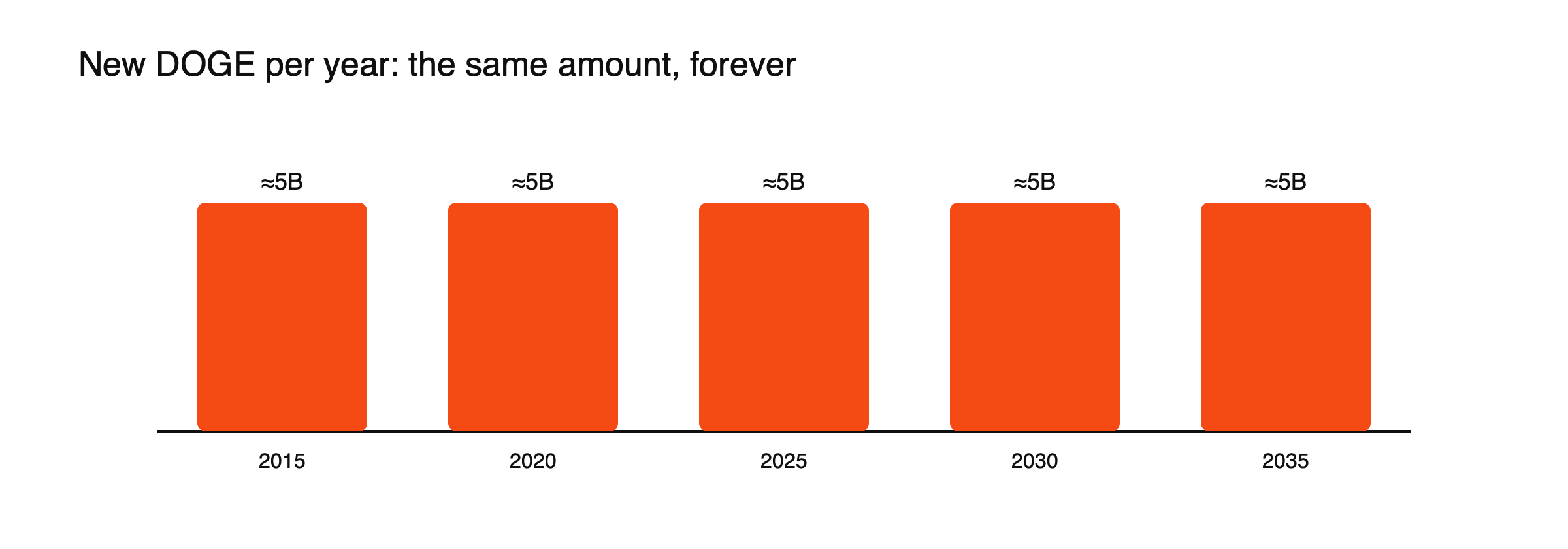
Figure: Dogecoin issuance stays at about 5 billion DOGE a year, with no end date. Contrast with bitcoin’s halvings.
Mining alongside Litecoin
Because Dogecoin uses the same Scrypt algorithm as Litecoin, miners can mine both at once through a technique called merged mining, introduced in 2014. Work done for one chain counts for the other, so Dogecoin benefits from the hashing power of Litecoin miners without asking them to choose. That arrangement has helped secure a coin whose own rewards would otherwise attract less mining.
What drives DOGE’s price
Dogecoin has no protocol upgrades of note, no large application ecosystem and no cash flows. Its price is driven mainly by attention: social media, celebrity posts, community campaigns and wider crypto sentiment. That makes it one of the clearest examples of how meme coins behave, though it has lasted far longer than most of them.
When attention moved the market
Dogecoin’s biggest price moves have come from attention rather than technology. In 2021, a wave of retail enthusiasm, amplified by social media and posts from well-known business figures, sent DOGE up many times over within months, followed by a long decline as attention moved elsewhere. The pattern has repeated on a smaller scale since. For a holder, this means news about the network matters less than the mood of social media, which can change in hours.
Paying with Dogecoin
Dogecoin works reasonably well as a payment coin: blocks arrive about every minute and fees are usually low. Some merchants and payment processors accept it, and it has long been used for online tipping. In practice, most DOGE changes hands as a speculative asset rather than as money for everyday purchases.
A network that changes slowly
Dogecoin’s software has seen relatively few major changes since its early years. Development has focused on maintenance, security fixes and keeping up with improvements in the code it shares with Litecoin and Bitcoin, rather than on new features. For some holders that stability is part of the appeal; for others it means Dogecoin depends almost entirely on community enthusiasm rather than on new capabilities.
Holding Dogecoin
DOGE is listed on most major exchanges and supported by many wallets, including hardware wallets. As with any coin, holding a meaningful amount in a wallet you control, rather than on an exchange, removes the risk of a platform failure. Because Dogecoin uses its own address format, sending it only to addresses and networks that explicitly support DOGE avoids losses.
Risks to know
- Attention-driven moves: prices can jump or collapse on posts and headlines rather than any change in the network.
- Ongoing dilution: new coins keep entering circulation every minute.
- Limited use: payments and tipping are possible, but speculation is the largest use by value.
Dogecoin compared with bitcoin
Both use proof of work, but Dogecoin’s blocks are ten times faster, its fees are low, and its supply is unlimited. Bitcoin aims to be scarce; Dogecoin never tried to be. For the asset Dogecoin was built from, see Litecoin vs Bitcoin, and for the wider category, what an altcoin is.
This article is educational content and does not constitute financial, investment, legal or tax advice. Digital assets are volatile and you may lose the amount you invest.
Dogecoin also shows how a community can outlast its founders. Both creators stepped back from the project within a few years, yet developers, miners and holders kept the network running and kept it listed on major exchanges. Few coins built as a joke survive their first market cycle; Dogecoin has now lived through several. That longevity is very unusual among coins created mainly for fun.
The meme coins that followed
Dogecoin showed that a coin with no special technology could build a lasting community and a large market value on humor and attention alone. Thousands of later meme coins copied the idea, most with far less staying power. Dogecoin’s age, its mining network and its long list of exchange listings set it apart from tokens created on launch platforms in minutes. See what meme coins are.
Frequently asked questions
Is there a limit to how many Dogecoin will exist?
No. About 5 billion new DOGE are created every year, indefinitely.
Who controls Dogecoin?
No company issues it. It is maintained by volunteer developers, with a foundation supporting the project, and secured by miners, many of whom also mine Litecoin.
Sources
- Dogecoin (initial release December 6, 2013; 10,000 DOGE block reward; 1-minute blocks; 5 billion a year) — Wikipedia
- Dogecoin price and profile (no maximum supply; fixed reward since March 2014; difficulty adjusted every block) — CoinDesk
- What Is Dogecoin? (Scrypt proof of work; Palmer left in 2015) — Banxa