
What Is Polkadot?
Polkadot links many specialized blockchains to one shared relay chain for security. Learn how it works, what DOT does, its 2026 supply cap and the main risks.
Polkadot is a proof-of-stake network in which a central relay chain secures many specialized blockchains, called parachains, that run in parallel and can exchange messages. It launched on May 26, 2020, led by Ethereum co-founder Gavin Wood. Its token, DOT, is used for staking, governance and buying blockspace, and since March 2026 its supply is capped at 2.1 billion.
The essentials
| Launched | May 26, 2020 |
| Founder | Gavin Wood (Web3 Foundation, Parity Technologies) |
| Consensus | Nominated proof of stake |
| Structure | Relay chain plus parachains |
| Supply cap | 2.1 billion DOT (since March 2026) |
How Polkadot works
The relay chain does not run applications itself. Its validators secure the whole system and finalize blocks, while parachains, each with their own rules and features, process transactions and pass their results to the relay chain. Every parachain shares the same validator set, so a new chain gets strong security without recruiting its own validators.
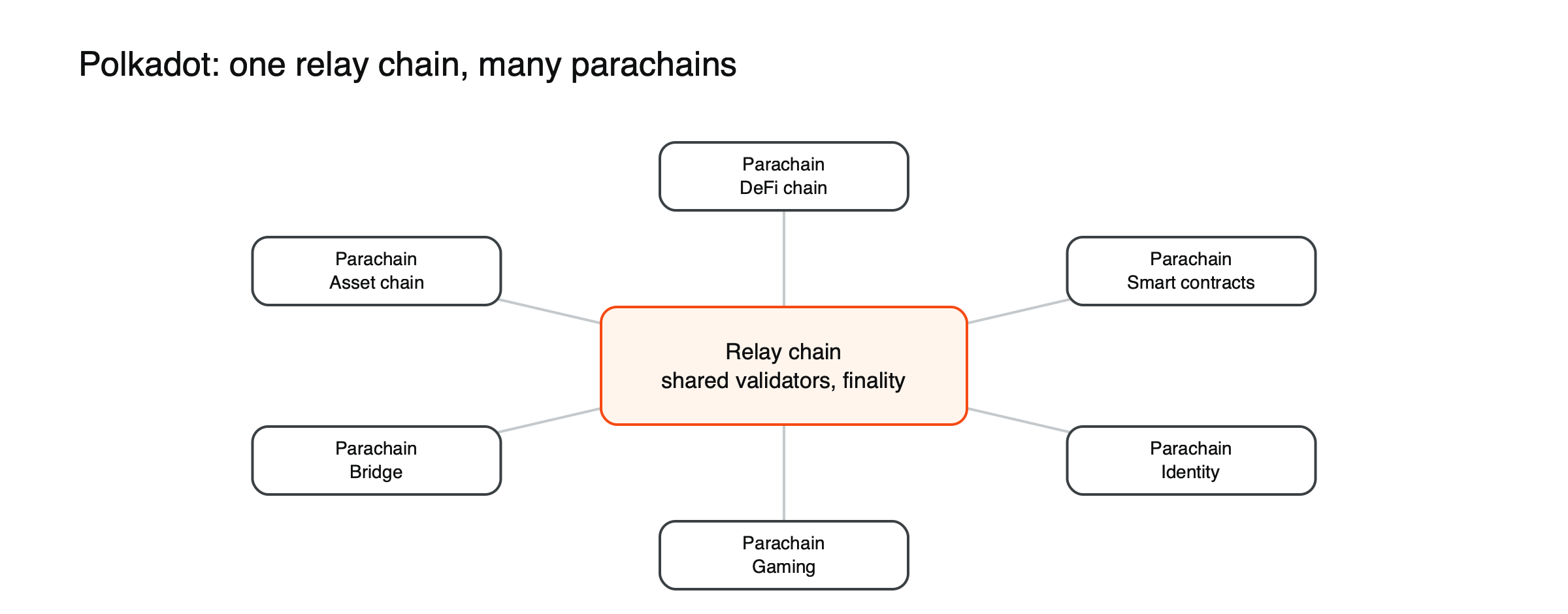
Figure: One relay chain secures many parachains through a shared validator set.
Polkadot uses nominated proof of stake: DOT holders nominate validators they trust and share in rewards and penalties. Parachains went live in December 2021, completing the network’s initial launch.
Shared security in plain terms
On most networks, a new blockchain must recruit its own validators and convince them to stake enough value to make attacks expensive, a slow and costly process for a young project. Polkadot’s model works differently: every parachain is secured by the relay chain’s validators and the DOT they stake. A small project therefore gets the same security as the whole network from the first block, much as a new shop in a large mall benefits from the mall’s guards rather than hiring its own. The trade-off is that parachains depend on Polkadot’s relay chain and must pay for their place on it.
From slot auctions to coretime
Parachains originally won access through auctions that required projects to lock large amounts of DOT. Starting in 2024, Polkadot replaced that model with Agile Coretime, which lets teams buy blockspace as needed, more like renting computing time. The change lowered the cost of launching a chain.
How coretime works in practice
Coretime treats the relay chain’s processing capacity as something to be rented. A project can buy bulk coretime covering a fixed period, much like reserving a server for a month, or buy on-demand coretime for individual blocks when it needs them. This lets small teams start without locking huge amounts of DOT, and lets larger ones plan capacity. Payments for coretime are burned, linking network usage to DOT’s supply.
DOT and its new supply cap
DOT has three main uses: staking to secure the network, voting in on-chain governance, and buying coretime. For most of its history DOT had no fixed cap. In March 2026, a governance vote introduced a hard cap of 2.1 billion DOT and cut annual issuance by roughly 54%, with part of coretime revenue burned.
One quirk for anyone reading old data: on August 21, 2020, DOT was redenominated, so every balance was multiplied by 100.
Staking DOT
DOT holders can nominate validators directly or, with smaller amounts, join nomination pools that combine stake from many holders. Rewards depend on the validators chosen and on network-wide rates, and nominators share in any penalties if their validators misbehave. Unstaking takes about 28 days, during which the DOT earns nothing and cannot be sold. Anyone who might need the funds quickly should plan for that delay before staking.
Governance on-chain
Polkadot runs much of its decision-making on-chain. Holders vote on referenda covering upgrades, treasury spending and parameter changes, and can lock tokens for longer periods to increase their voting weight. The March 2026 supply cap was itself adopted this way. On-chain governance makes changes transparent, but turnout and the influence of large holders shape the results.
Polkadot and Ethereum’s rollups compared
Both designs let many specialized chains benefit from one base network’s security, but they divide the work differently. Ethereum’s rollups run their own execution and post data and proofs back to Ethereum, which acts as a settlement layer. Polkadot’s parachains have their blocks validated directly by the relay chain’s validators as part of the protocol. Ethereum’s approach has attracted far more developers and users so far; Polkadot’s offers tighter integration between chains from the start. The competition is less about which design works and more about where builders and liquidity choose to go.
Signs of progress to watch
Useful indicators include how much coretime is being bought and by how many teams, activity and fees on the leading parachains, the share of DOT staked, governance participation and developer activity in the ecosystem. Because Polkadot’s value depends on others building on it, steady growth in these measures matters more than any single announcement. Because so many of these indicators live on public dashboards and in governance forums, a holder can follow them directly instead of relying on summaries from promoters or critics. Comparing them across several months shows trends that single announcements often tend to hide.
Where the risks sit
- Complexity: relay chains, parachains and coretime are harder to understand than single-chain networks.
- Competition: Ethereum rollups and other multi-chain designs target the same developers.
- Price history: DOT fell about 98% from its all-time high of about $55.
- Unbonding period: staked DOT takes about 28 days to unlock.
For how multi-chain designs compare, read what a modular blockchain is and layer 1 vs layer 2. For the wider category, see what an altcoin is.
This article is educational content and does not constitute financial, investment, legal or tax advice. Digital assets are volatile and you may lose the amount you invest.
Frequently asked questions
Is Polkadot a layer 2?
No. The relay chain is its own base network, and parachains are separate blockchains secured by it. It competes with layer 2 approaches on other networks rather than being one.
Why did old DOT balances suddenly increase in August 2020?
Because DOT was redenominated: every balance was multiplied by 100 and the price per token divided by 100. Nobody’s share of the network changed, but charts and records from before that date need adjusting.
Sources
- What is Polkadot? (live since May 26, 2020; NPoS; 28-day unbonding; August 21, 2020 redenomination) — Banxa
- Polkadot Launch Roadmap (parachains enabled December 2021) — Polkadot
- Polkadot overview (March 2026 hard cap of 2.1 billion DOT; issuance cut ~53.6%; Agile Coretime) — Binance Square, 2026
- Polkadot price history 2020–2026 (~98% fall from $54.87 high; coretime burns) — MEXC News, 2026