
What Is Solana?
Solana is a fast, low-fee blockchain that runs everything on a single chain. Learn how it works, what SOL is used for, its outage history and the main risks.
Solana is a proof-of-stake blockchain designed to process large numbers of transactions quickly and cheaply on a single chain. Its native coin, SOL, pays transaction fees and is staked by validators to secure the network. Solana’s speed has made it a hub for trading and memecoins, but its history includes several full network outages.
Where Solana came from
Solana was developed by Solana Labs, founded by former Qualcomm engineer Anatoly Yakovenko and Raj Gokal. Its mainnet beta went live on March 16, 2020. The goal was to show that one blockchain could handle the volume of a global payments network without splitting activity across separate layers.
Solana at a glance
| Mainnet beta | March 16, 2020 |
| Founders | Anatoly Yakovenko, Raj Gokal |
| Consensus | Proof of stake with proof of history |
| Native coin | SOL |
| Full network halts | Seven, December 2020 – February 2024 |
How Solana works
Most blockchains spend time agreeing on the order of transactions. Solana adds a timekeeping technique called proof of history, a running cryptographic record that lets validators agree on when events happened before they vote on blocks. Combined with proof of stake and software that runs many transactions in parallel, it allows fast confirmations and low fees.
The trade-off is hardware. Solana validators need powerful machines and fast internet connections, which makes running one more expensive than on Ethereum.
What a transaction costs
Solana charges a base fee of 5,000 lamports per signature, and one SOL is divided into a billion lamports, so a simple transfer costs 0.000005 SOL. At a SOL price of $150, that is less than a tenth of a cent. (Example price.) Users can add a priority fee to get ahead when the network is busy, which matters most during popular token launches, when many transactions compete for the same accounts. Even with priority fees, typical costs stay far below those on Ethereum’s main chain, which is a large part of why trading activity moved to Solana during the 2024 memecoin boom.
What SOL is used for
- Paying transaction fees, which are typically a small fraction of a cent.
- Staking, either directly or by delegating to validators, to secure the network.
- Trading and DeFi, since most Solana applications use SOL as a base asset.
The outage record
Solana’s mainnet stopped producing blocks seven times between December 2020 and February 2024. The longest halt, on September 14, 2021, lasted about 17 hours after bots flooded a token launch. The most recent, on February 6, 2024, lasted about five hours. Restarting requires at least 80% of stake to come back online. The network had no full halt between February 2024 and at least September 2026.
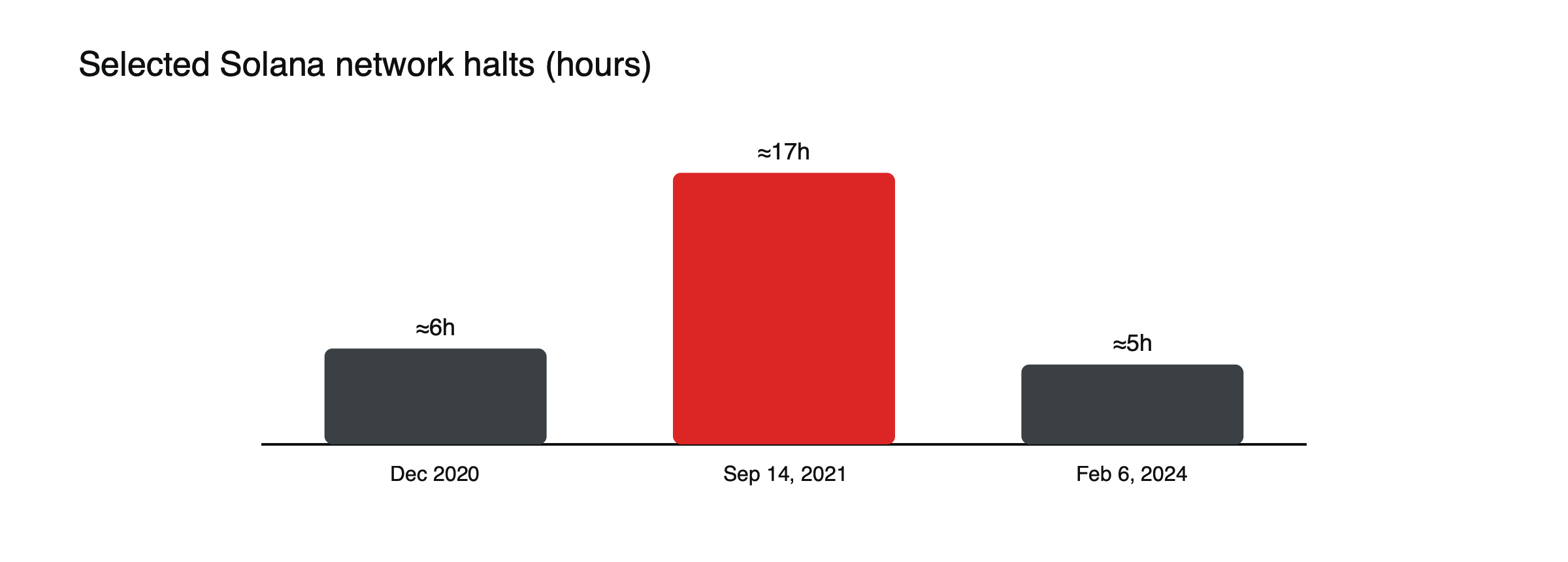
Figure: Selected Solana halts and their approximate length. Sources: Helius outage history; FXStreet, February 2024.
The memecoin era
From 2024, Solana became the main home of memecoin trading. Launch platforms let anyone create a token in seconds for almost no cost, and Solana’s low fees made trading tiny amounts practical. Activity, fees and demand for SOL rose sharply. The same boom left Solana’s usage heavily tied to speculation: when interest in new tokens faded, so did a large share of transactions. Whether Solana’s growth in payments, stablecoins and other applications can carry its activity through quieter periods is one of the open questions about the network.
Validators, hardware and decentralization
Solana’s speed depends on validators running powerful hardware with fast connections, which keeps the number of people able to run one lower than on networks with lighter requirements. For years, most validators also ran software from a single code base, so one bug could affect the whole network, a factor in several outages. Work on independent validator clients aims to reduce that risk by letting validators run different implementations. Decentralization on Solana is usually judged by how stake is spread across validators and how many independent clients are in use.
Judging the network’s health
A few measures give a clearer picture than price. Uptime since the last full halt shows whether the reliability fixes have held. The share of transactions that fail or are dropped during busy periods shows how well the network copes with demand. The number of validators and how evenly stake is spread across them, together with the number of independent client implementations in use, indicate how decentralized it is. And activity outside memecoins, such as stablecoin transfers and payments, shows whether usage is broadening. Tracking these over several months, rather than reacting to a single busy day, gives a fairer view of how the network performs under ordinary conditions.
For users, the lesson from the outage years is practical: keep some funds and trading options outside any single network, and avoid leaving large leveraged positions open on venues that depend entirely on one chain staying online. If the chain stops, so does the ability to add collateral or close a position, and prices elsewhere keep moving. Planning for that possibility costs very little and avoids the worst outcomes. The same applies to any chain, but Solana’s history makes it a sensible precaution for anyone active there, especially during periods of very heavy demand.
Other risks to know
- Ecosystem shocks: in February 2022 the Wormhole bridge between Solana and Ethereum was exploited for more than $320 million in wrapped ether.
- Concentration in speculative activity: much of Solana’s volume comes from memecoins and short-term trading, which can fade quickly.
- Price volatility: SOL moves far more than bitcoin in both directions.
How Solana compares
Solana competes most directly with Ethereum. Ethereum keeps its base layer conservative and scales through rollups; Solana keeps everything on one fast chain. Our comparison of Ethereum vs Solana covers the trade-offs in detail, and what meme coins are explains the activity that drove much of Solana’s growth. For the wider category, see what an altcoin is.
This article is educational content and does not constitute financial, investment, legal or tax advice. Digital assets are volatile and you may lose the amount you invest.
Frequently asked questions
Do I need SOL to use Solana apps?
Yes, a small amount. Every transaction pays a fee in SOL, and creating new token accounts requires a small refundable deposit, so wallets need some SOL even when trading other tokens or stablecoins.
Can I stake SOL without running a validator?
Yes. Holders can delegate SOL to a validator from most Solana wallets and earn a share of rewards, or use liquid staking tokens that represent staked SOL. Delegated SOL can be affected by the validator’s performance, so choosing a reliable validator matters.