
What Is Tron (TRX)?
Tron is a blockchain best known as the main network for USDT transfers. Learn how it works, what TRX is used for, its founder's legal history and the key risks.
Tron is a blockchain founded by Justin Sun that has become the main network for moving the stablecoin USDT. Its native coin, TRX, pays for network resources and is staked to elect the validators that run the chain. Low fees made it a popular dollar-transfer route in many emerging markets, while its founder has faced legal questions.
How Tron started
Tron launched in 2017 as a token on Ethereum after a token sale that raised about $70 million. In June 2018 it moved to its own mainnet. The same year, Tron acquired the file-sharing service BitTorrent, and later launched a separate token for it.
Tron in brief
| Token launch | 2017 |
| Own mainnet | June 2018 |
| Founder | Justin Sun |
| Consensus | Delegated proof of stake, 27 Super Representatives |
| Main use | USDT transfers (TRC-20) |
How the network works
Tron uses delegated proof of stake. TRX holders vote for 27 “Super Representatives” who produce blocks. Instead of paying a fee for every transaction, users can stake TRX to receive network resources, called bandwidth and energy, which makes frequent transfers very cheap. Tron’s smart contracts are compatible with Ethereum’s, and tokens on it follow a standard called TRC-20.
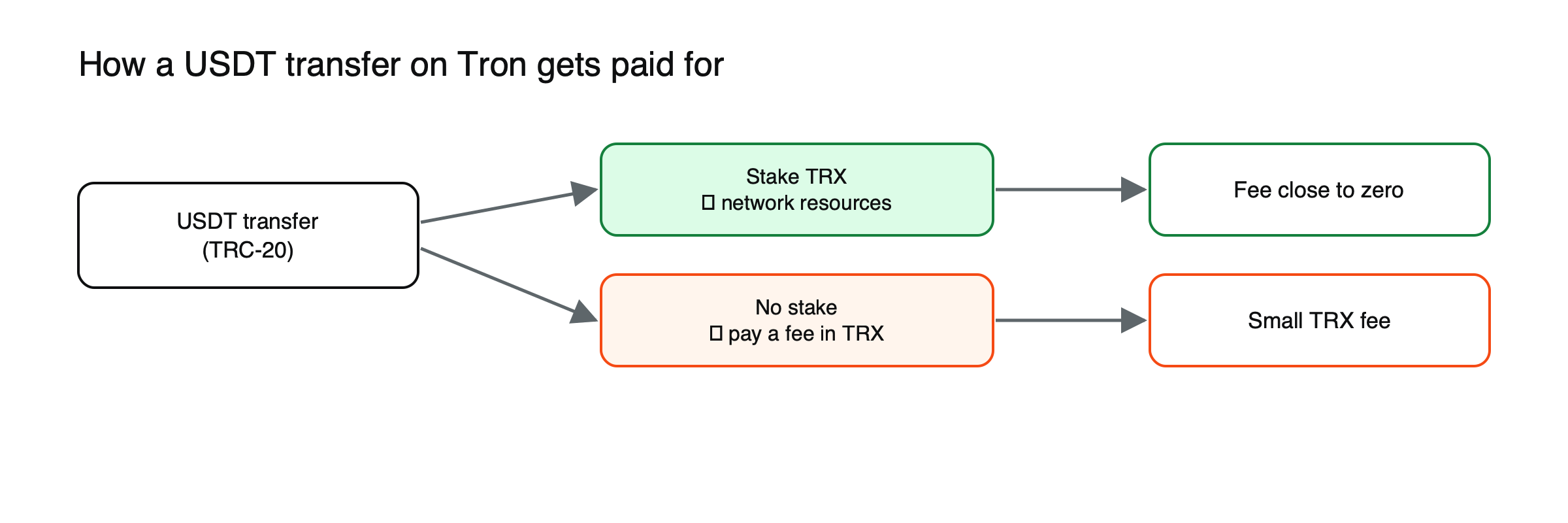
Figure: Why USDT transfers on Tron can be very cheap. Source: Ryder, 2026.
Paying for transactions with energy and bandwidth
Tron’s fee model is unusual. Every account receives a small daily allowance of bandwidth, enough for a few simple transfers. Smart-contract actions, including sending USDT, also consume energy. A user can get energy by staking TRX, by renting it from others or, if they have none, by having the network burn TRX to cover the cost. For someone who sends stablecoins often, staking or renting energy makes transfers much cheaper than paying by burning TRX each time. For an occasional user, the burn route is simpler but costs more per transfer. Many wallets and exchanges handle this in the background, which is why the model is easy to overlook.
The USDT network
Tron’s main use is stablecoin settlement. By early 2026, the network held more than $80 billion of USDT, more than any other blockchain, and it carried a large share of all USDT transfers. For people sending dollars across borders, especially in places where bank transfers are slow or restricted, USDT on Tron has become a common route. Our guide to what USDT is covers the stablecoin itself, and how to choose the correct blockchain network explains why picking the right network when sending USDT matters.
Why stablecoin users chose Tron
Tron became the leading network for USDT through a combination of low costs during the years when Ethereum fees were high, early support from exchanges and payment desks, and network effects: once traders, exchanges and over-the-counter brokers in many emerging markets used Tron-based USDT, newcomers followed. Today, many exchanges list it as a default option for USDT deposits and withdrawals, and many users treat “USDT” and “USDT on Tron” as the same thing.
Who sends money on Tron
Tron’s users include people sending remittances, traders moving funds between exchanges, businesses settling invoices in dollars and over-the-counter desks serving regions with limited access to banking. Its popularity also attracts misuse. Investigators and analytics firms have repeatedly linked Tron-based USDT to scams and sanctioned activity, and Tether has frozen addresses on Tron at the request of authorities. Tokens received from a frozen or flagged address can become unusable, which is a practical risk for anyone accepting payments from unknown parties.
Tron beyond USDT
USDT dominates Tron’s activity, but the network also hosts lending and trading applications, TRX staking for voting and resources, and tokens tied to its ecosystem. These are much smaller than the stablecoin flows and largely serve users already on Tron. For TRX holders, the main source of demand remains the resources needed to move stablecoins.
For TRX holders, the network’s fortunes are therefore tied to two things outside their control: the continued strength of USDT and Tron’s ability to stay the cheapest convenient route for moving it. If Tether, regulators or competing networks changed either, demand for Tron’s resources could fall quickly. Watching the share of USDT supply held on Tron, and how it shifts between networks over time and across exchanges, is one of the simplest ways to follow that risk.
Legal history
In March 2023, the US Securities and Exchange Commission sued Justin Sun and related companies, alleging unregistered securities offerings and market manipulation involving TRX and the BitTorrent token. The case was paused in February 2025 while the agency explored a settlement, and reports in 2026 said it was settled with a $10 million penalty.
Risks to know
- Dependence on one stablecoin: much of Tron’s activity rests on USDT; problems at Tether would hit the network hard.
- Validator concentration: a small set of 27 block producers runs the chain.
- Founder influence: decisions and reputation are closely tied to one person.
- Volatility: TRX can move sharply in market sell-offs.
Sending USDT on the right network
The most common costly mistake with Tron is a network mismatch. A USDT address on Tron looks different from one on Ethereum, and exchanges let you choose between networks when withdrawing. Sending Tron-based USDT to a platform that expects Ethereum-based USDT, or the reverse, can delay or lose the funds. Check that the sending and receiving sides have selected the same network, and send a small test amount first. See how to choose the correct blockchain network.
For how stablecoins work, read what a stablecoin is. For the wider category, see what an altcoin is.
This article is educational content and does not constitute financial, investment, legal or tax advice. Digital assets are volatile and you may lose the amount you invest.
Frequently asked questions
Do I need TRX to send USDT on Tron?
Usually, yes, at least indirectly. Sending USDT uses energy, which comes from staked or rented TRX or from burning TRX. Some wallets and exchanges cover this for you, but a personal wallet with no TRX may be unable to send USDT.
Is USDT on Tron the same as USDT on Ethereum?
Both are issued by Tether and redeemable on the same terms, but they live on different blockchains and cannot be sent directly from one to the other. Exchanges convert between them by letting you deposit on one network and withdraw on another.
Sources
- TRON (TRX) in 2026: The USDT Rail (2017 launch; mainnet June 2018; 27 Super Representatives; more than $80 billion USDT on Tron) — Ryder, 2026
- SEC sues Justin Sun (2017 sale ~$70 million; TRX and BTT allegations) — PlatoAI summary, March 2023
- Justin Sun denies fraud allegations (SEC case paused February 2025; $82.9 billion USDT on Tron) — MEXC News, February 2026
- How did Justin Sun transform from a Ripple salesman into TRON’s founder? (settlement reported March 2026, $10 million) — KuCoin Blog, 2026