
What Is a Rug Pull?
A rug pull is when a token's creators drain its liquidity or dump their holdings and vanish. The main types, a real example and the signs to check first.
A rug pull is a scam in which a project’s creators attract buyers, then drain its liquidity or dump their own holdings and disappear, leaving the token close to worthless. It is common with new tokens on decentralized exchanges, where anyone can launch a token without review. Chainalysis estimated that rug pulls took more than $2.8 billion in 2021.
How a rug pull works
- A token is launched with a story: a game, a famous name, a promise of rewards.
- A liquidity pool is created so people can buy the token with ETH, SOL or stablecoins.
- Marketing and hype bring buyers, and the price climbs quickly.
- The creators cash out, by withdrawing the pool’s funds, selling their supply or using hidden contract functions.
- The project vanishes: the website and social accounts go offline, and the token’s price collapses.
The main types
- Liquidity pull: the creators remove the ETH or stablecoins backing the pool, so the token can no longer be sold for anything of value.
- Dump: insiders who hold most of the supply sell it all into buyers’ demand.
- Honeypot: the contract lets people buy but blocks or heavily taxes selling, so only the creators can exit.
- Slow rug: the team keeps the project alive while quietly selling, then abandons it.
A real example: the Squid token
In late October 2021, a token named after the Netflix series Squid Game launched at about €0.01, promising an online game. Its price soared to about €2,472 by November 1, 2021. That day the price crashed to fractions of a cent, the website and social accounts were deleted, and a wallet linked to the creators had cashed out close to €3 million. The token had no connection to the show.
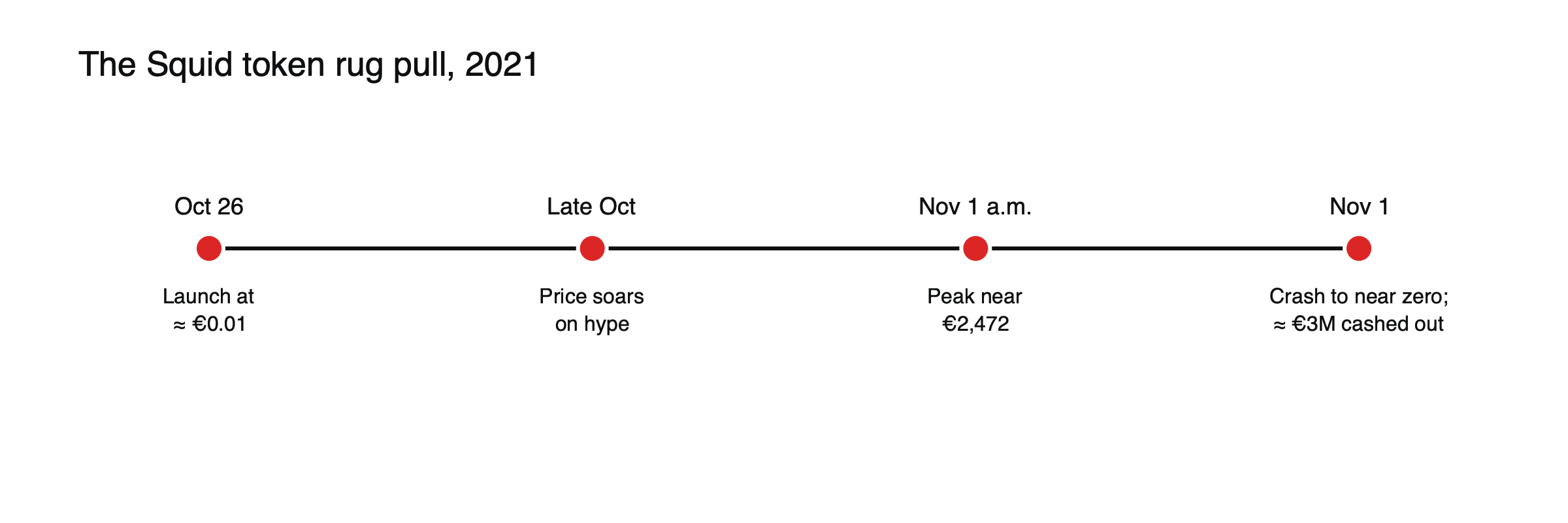
Figure: The Squid token from launch to collapse. Source: Euronews, November 2021.
What “locked liquidity” and “renounced ownership” prove
Projects often advertise that their liquidity is locked or that the contract’s ownership has been renounced, as proof they cannot rug. Both claims help, but neither is a guarantee. A liquidity lock prevents the pool’s funds from being withdrawn until a set date; it does not stop insiders who hold most of the token supply from selling it into the pool. Renouncing ownership removes the owner’s special powers in the contract, but only if the contract has no other hidden roles or upgrade paths. Checking the lock’s end date, the share of supply held by insiders and the full contract code gives a truer picture than a badge on a website.
How big the problem has been
Chainalysis found that rug pulls made up 37% of crypto scam revenue in 2021, up from 1% the year before, as decentralized finance made launching tokens easy. Since then, launch platforms have made token creation even simpler, and tens of millions of tokens now exist, most of which stop trading. Not every failed token is a rug pull, but the conditions that allow them have grown.
Rug pulls versus hacks
Not every sudden collapse is a rug pull. In a hack or exploit, an outside attacker finds a flaw in a project’s contracts and drains funds against the team’s wishes; the team may try to recover the money or compensate users. In a rug pull, the people running the project take the money themselves. The difference matters for what happens next: hacked projects sometimes recover or repay users, while rugged projects simply disappear. On-chain evidence, such as whether funds went to wallets linked to the team, usually shows which one happened.
Why rug pulls are hard to punish
Many rug pulls are run by anonymous teams who move funds across blockchains and through mixing services within hours, often from countries where investigators have little reach. Some projects, especially slow rugs, can argue that they simply failed rather than deliberately misled buyers, which makes cases harder to bring. Authorities have prosecuted some high-profile schemes, but most victims of small rug pulls never see their money again.
Rug pulls also leave a trail that can warn future buyers. The same wallets often launch one token after another, moving funds from each collapsed project into the next. Analytics services and community trackers flag addresses linked to earlier scams, and checking whether a new token’s deployer or largest holders appear in that history takes only a few spare minutes. A clean history proves nothing on its own, but a deployer that has already abandoned several tokens is about as clear a warning as on-chain data alone can give. It is worth checking carefully before every single purchase.
Warning signs before you buy
- Unlocked liquidity: the pool’s funds are not locked in a time-locked contract, so creators can withdraw them at any time.
- Concentrated supply: a few wallets hold most of the tokens.
- Hidden powers in the contract: owner functions that can mint tokens, pause trading or change taxes.
- Selling problems: failed sell transactions or very high sell taxes reported by other buyers.
- Anonymous team, urgent marketing: countdowns, guaranteed returns and pressure to buy now.
A small test sale before committing more, and a check of holders on a blockchain explorer, catch many of these.
For the broader list of scams, read crypto scam warning signs. For the tokens most often involved, see what meme coins are, and for context, what an altcoin is.
This article is educational content and does not constitute financial, investment, legal or tax advice. Digital assets are volatile and you may lose the amount you invest.
If you have been caught in a rug pull
Act quickly but calmly. Record the token’s contract address, the transactions you made, the project’s website and social accounts, and any messages from its team. Revoke any token approvals you gave to the project’s contracts so they cannot take more. Report the scam to the platforms involved and, where possible, to the police; in the United States, the FBI’s Internet Crime Complaint Center accepts reports at ic3.gov. Expect approaches from “recovery services” promising to get your money back for a fee; they are almost always a second scam.
Frequently asked questions
Is a falling price the same as a rug pull?
No. Prices of new tokens fall for many reasons, including ordinary selling and fading interest. A rug pull involves the creators deliberately draining liquidity, dumping concentrated holdings or trapping buyers with the contract.
Can a rug pull happen on a large exchange?
It is much rarer, because large exchanges review listings and hold tokens in their own systems. But a project can still collapse after insiders sell their holdings, which looks very similar to buyers.
Sources
- The 6 Biggest Crypto Failures of 2021 (Chainalysis: rug pulls over $2.8 billion, 37% of scam revenue) — The Motley Fool, 2021
- Squid Game cryptocurrency loses all value in minutes in possible €2.8 million rug pull scam — Euronews, November 2021
- $7.7 billion lost to crypto-scams, but how serious have rug pulls been (37% in 2021, up from 1%) — AMBCrypto, 2021