
What Is Chainlink?
Chainlink is a decentralized oracle network bringing outside data and cross-chain messages to smart contracts. What LINK does, its supply and the risks.
Chainlink is a decentralized oracle network that delivers outside data, such as asset prices, to smart contracts and carries messages between blockchains. Its token, LINK, pays node operators for their services and can be staked. Chainlink’s price feeds are used by many lending and trading applications, which makes it core infrastructure rather than a blockchain of its own.
The problem Chainlink solves
Smart contracts can only read data that is already on their own blockchain. A lending protocol that needs to know the price of ether, or an insurance contract that needs to know the weather, must get that information from outside. A single data source would be a single point of failure. Chainlink spreads the job across many independent node operators and combines their answers. Our guide to blockchain oracles explains the general problem.
How it works
- Node operators fetch data from several sources, such as exchanges and data providers.
- Each node reports a value on-chain or to an aggregation process.
- The reports are combined, typically taking the median, into a single feed.
- Smart contracts read the feed to set prices, trigger liquidations or settle trades.
In 2023 Chainlink added the Cross-Chain Interoperability Protocol (CCIP), which lets applications send messages and tokens between blockchains using the same network of node operators. It has since been integrated with more than 30 blockchains.
More than price feeds
Chainlink began with price feeds, but the same network of node operators now offers several services:
- Verifiable randomness for games, NFT launches and draws, with proof that results were not manipulated.
- Automation that triggers smart-contract actions on a schedule or when conditions are met.
- Proof of reserve feeds that report the assets backing wrapped tokens, stablecoins and tokenized funds.
- Cross-chain messaging through CCIP, which moves tokens and instructions between networks.
Each service extends the same idea: bringing information or actions that a blockchain cannot produce on its own, through a group of independent operators rather than a single company. See what a blockchain oracle is.
LINK supply
LINK has a fixed maximum supply of 1 billion tokens, all created at launch. In a token sale in September 2017, 350 million LINK, 35% of supply, were sold for about $32 million. A further 35% was set aside for node operators and ecosystem incentives, and 30% went to the company developing Chainlink. The mainnet launched in May 2019.
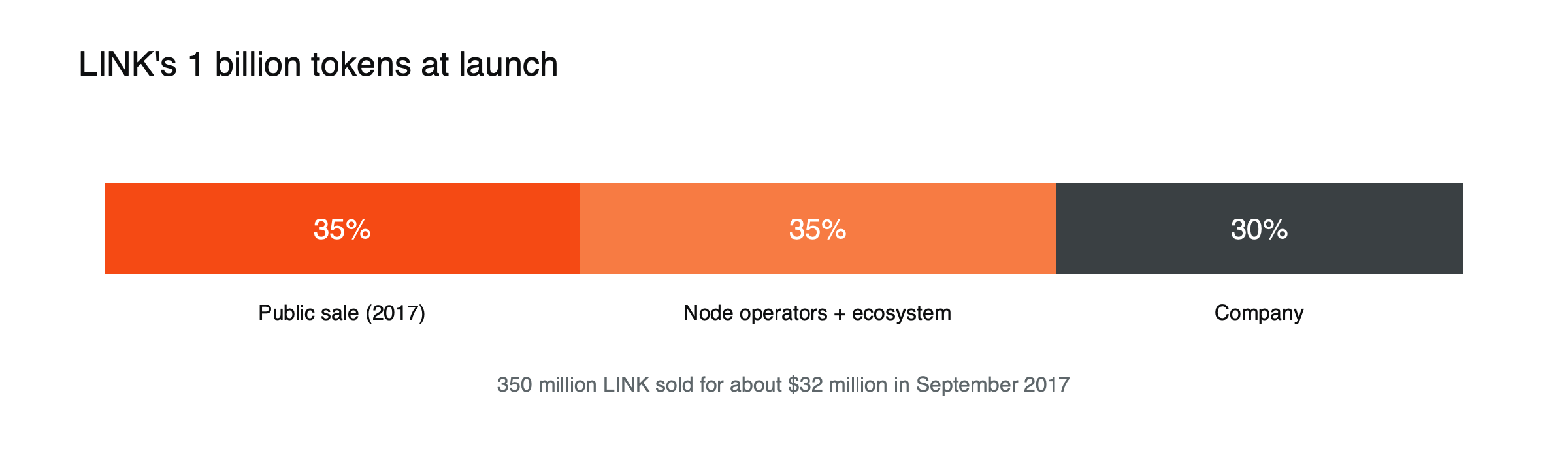
Figure: How the 1 billion LINK were allocated at launch in 2017.
How node operators are paid and held accountable
Applications pay for Chainlink services, and node operators earn fees, typically in LINK, for the work they do. Staking, introduced in phases from late 2022, lets LINK holders and operators lock tokens as a backstop for service quality, with the possibility of penalties if operators fail to perform. The goal is a system in which operators have something to lose, not just fees to gain. How much staking strengthens security in practice depends on how much LINK is staked relative to the value the feeds protect.
Why one feed can matter so much
Large parts of decentralized finance read the same Chainlink price feeds. That shared reliance is efficient, since one well-run feed serves many applications, but it also means a fault or delay in a widely used feed can affect lending markets, derivatives and stablecoins at the same moment. Protocols often add safeguards, such as circuit breakers or fallback sources, precisely because of that concentration. Extreme market moves have also exposed edge cases in how feeds behave, such as preset minimum or maximum prices, which applications need to understand and plan for rather than assume the feed will always reflect the market.
Chainlink and traditional finance
Chainlink has worked to position itself as a bridge between blockchains and established financial institutions, offering cross-chain messaging and data services for tokenized funds, bonds and payments. Banks, market infrastructure providers and asset managers have tested such services in pilots, often focused on moving tokenized assets between different networks. If tokenization of traditional assets grows, that kind of connectivity could become a significant source of demand, though pilots do not always lead to production use.
Risks to know
- Value capture: applications rely on Chainlink, but demand for its services does not translate directly into demand for LINK in every case.
- Supply releases: tokens held by the company and reserved for incentives can enter the market over time.
- Concentration of trust: if many protocols depend on the same feeds, a fault in one feed can affect many applications at once.
- Competition: other oracle and cross-chain messaging networks compete for the same users.
Where Chainlink fits
Chainlink is infrastructure that other applications build on, more like a data utility than a payments coin. Its value depends on how much the rest of the on-chain economy, especially DeFi and tokenized assets, keeps growing. For the programs that use oracles, read what a smart contract is. For the wider category, see what an altcoin is.
This article is educational content and does not constitute financial, investment, legal or tax advice. Digital assets are volatile and you may lose the amount you invest.
How to evaluate LINK
Useful questions include how many applications and how much value depend on Chainlink services, whether the fees those applications pay are growing, how much of the supply is staked and how much is still held by the company and reserved for incentives, and how Chainlink’s cross-chain service compares with competitors in adoption. Because Chainlink is infrastructure, its success shows up in usage by others more than in activity on any one chain. Comparing that adoption with how much LINK is unlocked each year gives a much clearer view of supply and demand together.
Frequently asked questions
Do applications have to pay in LINK?
Not always directly. Some services accept payment in other tokens, which may be converted, and some feeds are sponsored by the protocols that use them. This is part of the long-running debate about how much application demand translates into demand for LINK.
Is Chainlink a blockchain?
No. It is a network of independent node operators that serves many blockchains, delivering data and messages to smart contracts on each of them.
Sources
- Chainlink (LINK) profile (founded 2017; September 2017 sale, 350 million LINK, ~$32 million; 1 billion supply; 35/35/30 allocation; mainnet May 2019) — MEXC
- ChainLink Token (CCIP launched in 2023) — Matcha
- Qu’est-ce que Chainlink (LINK) ? (integrated with more than 30 blockchains) — Journal du Coin, 2026