
What Is Polygon (POL)?
Polygon runs a low-fee, Ethereum-compatible chain and is building a network of connected chains. Learn how it works, why MATIC became POL and the risks.
Polygon is a network built to make Ethereum-style applications cheaper and faster, best known for the Polygon PoS chain. Its token was MATIC until September 4, 2024, when POL replaced it as the token for gas fees and staking. Polygon is now trying to connect many chains through a shared layer, the AggLayer, which POL is designed to help secure.
Timeline at a glance
| Original token launch | MATIC, April 2019 |
| Rebrand | Matic Network became Polygon in 2021 |
| Token migration | MATIC to POL on September 4, 2024 (1:1) |
| Main chain | Polygon PoS, Ethereum-compatible |
| Next layer | AggLayer, connecting multiple chains |
How Polygon started
Polygon began as Matic Network, a project to scale Ethereum by running transactions on a faster, cheaper chain that periodically checks in with Ethereum. In 2021 it rebranded as Polygon and its main network became the Polygon PoS chain, which uses its own validators staking the network’s token. Because it runs Ethereum-compatible smart contracts, many applications deployed copies there to offer users lower fees.
Why MATIC became POL
MATIC was designed for one chain. Polygon’s plan, often called Polygon 2.0, is a family of connected chains, so it needed a token that could serve all of them. A proposal published in September 2023 set out the upgrade, and on September 4, 2024 POL replaced MATIC as the gas and staking token of Polygon PoS at a 1:1 ratio. MATIC held on Polygon PoS converted automatically; holders on Ethereum or exchanges used a migration contract or their platform’s process.
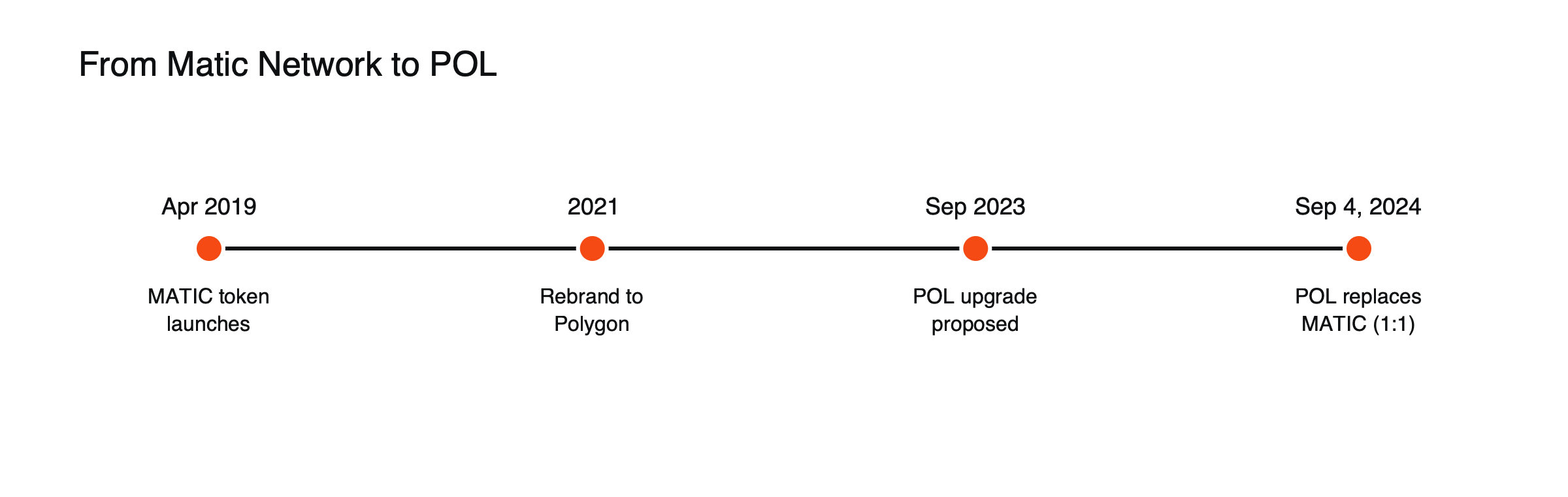
Figure: From MATIC to POL.
The AggLayer
The AggLayer aims to let separate chains share liquidity and pass assets and messages between each other as if they were one network. POL is meant to secure and reward the validators that provide services across these chains, not just the original PoS chain.
Polygon and Ethereum’s layer 2s
Polygon PoS is often described alongside Ethereum’s layer 2 networks, but it is a sidechain with its own validator set rather than a rollup that inherits Ethereum’s security. Polygon has announced plans to upgrade it with zero-knowledge technology to move closer to a rollup design. Our guide to Ethereum rollups explains the difference.
From Matic to Polygon to POL
| Date | Milestone |
|---|---|
| April 2019 | MATIC token launches with Matic Network |
| 2021 | Rebrand to Polygon; Polygon PoS becomes the flagship chain |
| September 2023 | Proposal published for the move from MATIC to POL |
| September 4, 2024 | MATIC replaced by POL on Polygon PoS, one for one |
Each step widened the project’s scope: from one scaling chain for Ethereum, to a family of networks, to a token meant to serve all of them.
What the AggLayer could change for users
Today, moving assets between separate chains usually means bridges, waiting times and wrapped tokens. The AggLayer aims to make chains connected to it feel like one network, so a user could hold assets on one chain and use them in an application on another without manual bridging. If it works as intended, it would reduce one of the biggest frictions of a multi-chain world. Its value depends on how many chains connect to it and how well its security holds up as more value flows through it.
Sidechain or rollup: why the difference matters
A rollup posts its data and proofs to Ethereum, so users can rely on Ethereum to enforce withdrawals even if the rollup’s operators fail. A sidechain like Polygon PoS has its own validators, and its security depends on them, with Ethereum acting as a settlement point for bridged assets rather than a guarantee for every transaction. For everyday use, the difference may not be visible. For large balances, it decides whom you ultimately rely on. See layer 1 vs layer 2.
Using Polygon today
Polygon PoS remains a busy, low-fee network, used for payments, stablecoin transfers, games and NFTs. Fees are paid in POL and are usually a small fraction of a cent. Wallets that support Ethereum can add Polygon as a network, and many exchanges allow direct deposits and withdrawals, which avoids bridging. As with any multi-network token, choosing the correct network on both sides is essential.
Checking old MATIC
On Polygon PoS, the change from MATIC to POL happened automatically. Elsewhere, especially on Ethereum, old MATIC tokens may still need converting through the official migration contract, and exchanges handled conversions for their users on their own schedules. Anyone finding old MATIC in a wallet should use only the official migration route and treat unsolicited “upgrade” offers as scams.
For holders, the main question is whether demand for POL will grow with the network family it is meant to serve. On Polygon PoS, POL pays fees and secures the chain through staking. In the wider plan, it is also meant to reward validators who provide services across many connected chains. If those chains launch and route activity through the AggLayer, POL could become a token used across a large ecosystem; if they do not, its demand will rest mainly on one sidechain competing with many rollups. Watching how many chains actually connect, how much value moves between them and how fees on Polygon PoS develop gives a clearer view than announcements alone. As with other tokens tied to a long roadmap, the gap between plans and delivered features is where most of the risk sits. A practical approach is to judge Polygon by what is live rather than what is promised: transaction counts, fees, stablecoin activity and the number of independent teams building on it are all visible today, and none of them requires trusting future promises.
What could go wrong
- Competition: many rollups now offer Ethereum-compatible, low-fee chains.
- Execution risk: the multi-chain plan depends on upgrades that are still being delivered.
- Migration mistakes: old MATIC on some networks still needs to be converted; sending the wrong token to the wrong network can lose funds.
For how scaling layers compare, read layer 1 vs layer 2. For the wider category, see what an altcoin is.
This article is educational content and does not constitute financial, investment, legal or tax advice. Digital assets are volatile and you may lose the amount you invest.
Frequently asked questions
Is POL the same as MATIC?
POL replaced MATIC at a one-to-one rate on September 4, 2024, as the token for gas and staking on Polygon PoS. MATIC that has not been migrated still exists on some networks, so the two can appear side by side in older wallets.
Is Polygon a layer 2?
Polygon PoS is a sidechain with its own validators rather than a rollup, though Polygon has developed zero-knowledge technology and plans to bring rollup-style security to more of its chains.
Sources
- Polygon’s MATIC Becomes POL: What to Know (MATIC launched April 2019; rebrand 2021; PIP-17 September 2023; migration September 4, 2024; AggLayer; zkEVM Validium plans) — GetBlock, 2024
- Polygon Team Sets Date for MATIC to POL Conversion (1:1 ratio; automatic for Polygon PoS holders) — ForkLog, July 2024