
What Is the Bitcoin Halving?
The Bitcoin halving cuts the block subsidy in half every 210,000 blocks. See every halving date, what changes for miners and when the next one is due.
The Bitcoin halving is the scheduled moment when the number of new BTC paid to miners for each block is cut in half. It happens every 210,000 blocks, roughly every four years. The most recent halving took place on April 20, 2024, reducing the block subsidy from 6.25 to 3.125 BTC.
Why Bitcoin has halvings at all
Bitcoin has no central issuer deciding how much new money to create. Instead, the issuance schedule is part of the consensus rules. Every block can pay its miner a fixed amount of newly created BTC, called the block subsidy, and that amount drops by half at fixed block heights.
The design has two effects. New supply shrinks over time in a way anyone can calculate in advance, and the total amount that can ever exist is capped just under 21 million BTC. Our guide on what happens when all 21 million bitcoin are mined explains why the real cap is slightly lower than the round number.
Every halving so far
| Halving | Date | Block height | Subsidy after |
|---|---|---|---|
| Launch | January 2009 | 0 | 50 BTC |
| 1st | November 28, 2012 | 210,000 | 25 BTC |
| 2nd | July 9, 2016 | 420,000 | 12.5 BTC |
| 3rd | May 11, 2020 | 630,000 | 6.25 BTC |
| 4th | April 20, 2024 | 840,000 | 3.125 BTC |
| 5th (expected) | Around April 2028 | 1,050,000 | 1.5625 BTC |
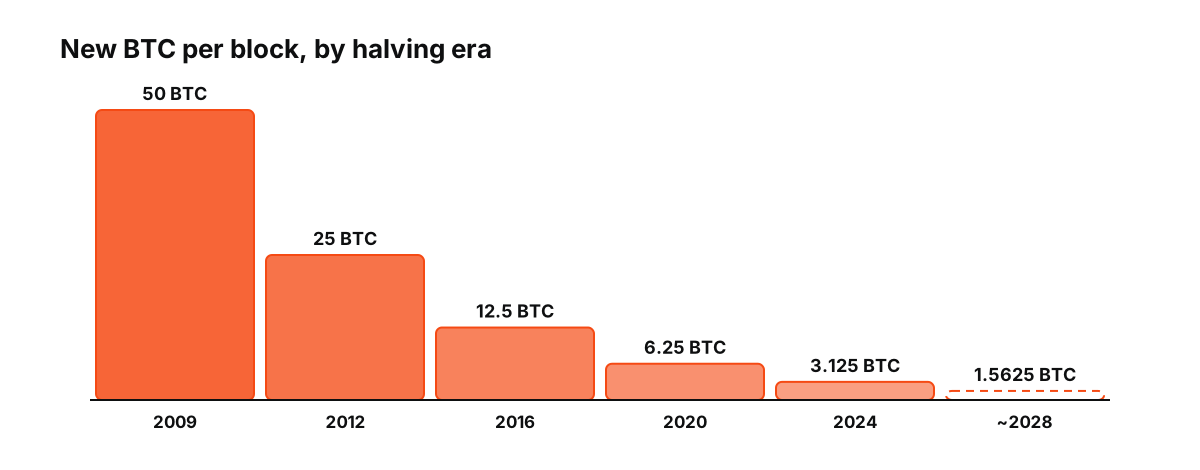
Figure: Block subsidy per halving era. 2028 is an estimate based on block timing. Source: Bitcoin Core subsidy rules.
The dates are not set on a calendar. The halving happens when the chain reaches the right block height, and because blocks arrive every 10 minutes only on average, the exact day can drift by days or weeks from early estimates.
By the time block 840,000 was mined, 19,687,500 BTC had been issued, which is 93.75% of the 21 million total. Every halving after that adds less and less.
What changes on halving day
Miner revenue in BTC halves. Fees aside, every block pays half as much new BTC as it did the block before. A miner earning 1 BTC a day from the subsidy suddenly earns 0.5 BTC for the same work and the same electricity bill.
The least efficient machines get squeezed. Older hardware that was barely covering its power costs can become unprofitable overnight. Some of it switches off, hash rate dips, and the next difficulty adjustment eases the puzzle for those that remain. Our explainer on Bitcoin mining difficulty shows how that adjustment works.
Fees matter more. With each halving, transaction fees make up a bigger share of what miners earn. The halving block itself is a good example: block 840,000 paid about 37.6 BTC in fees against a new subsidy of 3.125 BTC, as demand for space in that particular block was unusually high. Our guide to blockchain transaction fees covers how fees are set.
Nothing changes for users sending BTC. Transactions, wallets and addresses work exactly as before. The halving only affects how much new BTC a block can create.
Does the halving move the price?
This is the question most people actually want answered, and the honest answer is that nobody knows how much of any price move to credit to the halving.
The case for an effect is simple: miners sell part of their new BTC to pay bills, so halving their income in BTC reduces a steady source of selling. The case against is just as simple: the schedule has been public since 2009, so markets have every chance to price it in, and four past events are far too few to separate the halving from everything else going on at the time, such as interest rates, regulation and investment flows. Our guide to what moves the Bitcoin price covers those other drivers.
A fixed schedule in a world of flexible money
The halving is the clearest example of how Bitcoin differs from money managed by a central bank. A central bank can change how much money it creates at any meeting, in response to inflation, unemployment or a crisis. Bitcoin’s issuance was set in the software at launch and has followed the same path ever since, regardless of price, demand or economic conditions. Supporters see that predictability as the point; critics argue that a currency whose supply cannot respond to the economy is better suited to being held than spent. Either way, anyone can calculate how much bitcoin will exist at any future block.
Tracking the next halving
Halvings happen at fixed block heights, every 210,000 blocks, not on calendar dates. The fifth is due at block 1,050,000. Countdown sites estimate the date by assuming blocks keep arriving about every ten minutes, so the forecast drifts by days or weeks as mining speeds up or slows down. The block height, which you can check on any block explorer, is the number that actually decides when it happens.
How the halving fits into Bitcoin mining
The halving is one part of a larger system: miners compete to produce blocks, the network adjusts difficulty to keep block times steady, and the subsidy schedule controls how much new BTC that competition releases. Our pillar guide to how Bitcoin mining works puts the pieces together, and our worked example on Bitcoin mining profitability shows what the next halving does to one machine’s numbers.
Common questions about the Bitcoin halving
When is the next Bitcoin halving?
The fifth halving happens at block 1,050,000, which is expected around April 2028. The exact date depends on how quickly blocks are produced between now and then.
How many halvings will there be?
The subsidy reaches zero at the 33rd halving, around the year 2140. Four had happened as of 2024. After the last one, miners will be paid through transaction fees alone.
Does the halving affect the BTC I already hold?
No. Existing balances are unchanged. The halving only reduces the amount of new BTC created in each future block.
This article is educational content and does not constitute financial, investment, legal or tax advice. Digital assets are volatile and you may lose the amount you invest.
Does the halving change how fast blocks are found?
Not directly. Block timing is governed by the difficulty adjustment, which aims for about ten minutes per block. If some miners switch off after a halving because their machines are no longer profitable, blocks can arrive a little more slowly for a while, until the next adjustment lowers the difficulty and restores the usual pace.
Sources
- Breaking: Bitcoin Halving Is Sealed After Mining of Block 840,000 (dates of all four halvings) — Finance Magnates, April 2024
- Block 840,000 (subsidy change and fees) — Blockchain.com Explorer
- Bitcoin Core source, validation.cpp (block subsidy halves every 210,000 blocks) — Bitcoin Core, GitHub
- Bitcoin Core source, chainparams.cpp (210,000-block halving interval) — Bitcoin Core, GitHub