
What Is Bitcoin Mining Difficulty?
Bitcoin mining difficulty resets every 2,016 blocks to keep blocks near 10 minutes. See the formula, the 4x limit and a worked adjustment example.
Bitcoin mining difficulty is a number that tells miners how hard it currently is to find a valid block. The network recalculates it every 2,016 blocks so that, no matter how many machines join or leave, a new block arrives about every 10 minutes on average. More hashing power leads to higher difficulty, and less leads to lower.
Target and difficulty are two views of the same thing
Every block header must hash to a number at or below a threshold called the target. A lower target means fewer possible winning hashes, so the puzzle gets harder.
Difficulty is just a friendlier way to express that target. It compares the current target with the easiest target the protocol allows, which is defined as difficulty 1. A difficulty of 86 trillion, the level at the April 2024 halving block, means finding a block was about 86 trillion times harder than at difficulty 1.
The two move in opposite directions: when the target goes down, difficulty goes up.
How the adjustment works
Bitcoin Core checks the timing every 2,016 blocks. At 10 minutes per block, that period should take 20,160 minutes, which is exactly two weeks. The new difficulty is:
New difficulty = old difficulty × (20,160 minutes ÷ actual minutes the last 2,016 blocks took)
Two details keep the system stable:
- The 4x limit. A single adjustment can make mining at most four times harder or four times easier. Even if the period took a day or two months, the change is capped.
- Every node does the math itself. No one announces the new difficulty. Each node computes it from the block timestamps it already has, and blocks that claim the wrong difficulty are invalid.
A worked example
The numbers are illustrative.
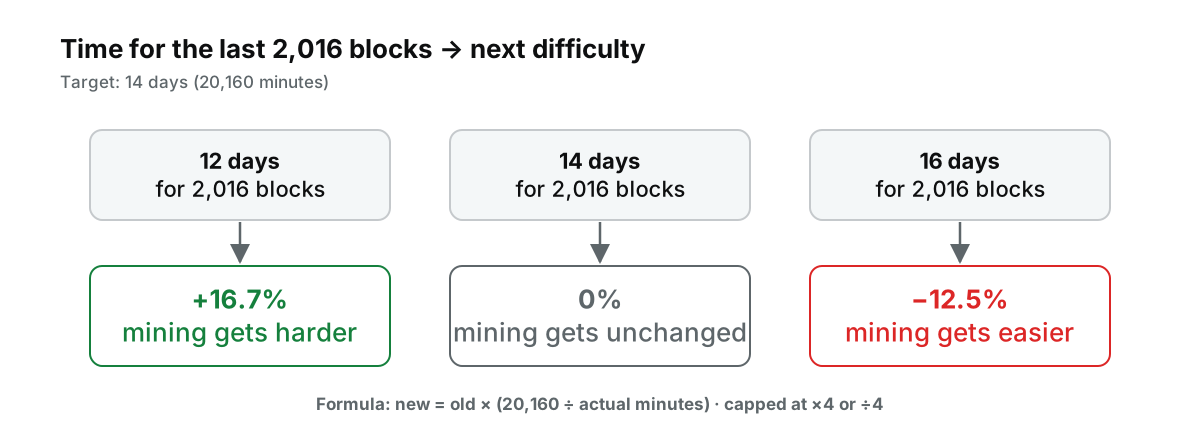
Figure: How long the last 2,016 blocks took decides the next difficulty. Illustrative periods; each change is capped at 4x either way.
Suppose the last 2,016 blocks took 12 days instead of 14, because new machines came online during the period.
- Expected time: 14 days (20,160 minutes)
- Actual time: 12 days (17,280 minutes)
- Ratio: 20,160 ÷ 17,280 = 1.1667
Difficulty rises by about 16.7%. In the next period, the same total hashing power needs about 16.7% more time per block, which brings the average back to roughly 10 minutes.
Now the reverse. If a large group of miners shuts down and the period takes 16 days (23,040 minutes), the ratio is 20,160 ÷ 23,040 = 0.875, and difficulty falls 12.5%.
Why 2,016 blocks, and why the lag matters
Two weeks is long enough to smooth out the luck in block timing. Blocks arrive randomly; a few fast or slow ones in a row say little about the real hashing power. Averaging over 2,016 blocks gives a far more reliable reading.
The cost is lag. If hashing power drops sharply in the middle of a period, blocks come slowly until the period ends, and transactions take longer to confirm in the meantime. The network corrects itself, just not instantly. That delay is one reason exchanges and wallets show confirmation times as estimates. Our guide to why network confirmations matter explains how platforms handle it.
What difficulty means for miners
Difficulty is the denominator in every miner’s income. Your expected share of block rewards is your hash rate divided by the network’s, and the network’s hash rate is what pushes difficulty up. When difficulty rises 5% while your setup stays the same, your expected BTC income drops about 5%.
That is why miners plan around a rising difficulty curve, not a flat one. A machine that is comfortably profitable today can slide toward break-even as the network grows, even if the BTC price stays exactly where it is. Our worked example on Bitcoin mining profitability puts numbers on that.
Halvings add a second shock. When the block subsidy is cut in half, the least efficient machines can become unprofitable overnight. If enough of them switch off, hash rate falls and the next adjustment lowers difficulty, giving the remaining miners a slightly larger share. Our guide to the Bitcoin halving covers the schedule.
Why difficulty matters if you do not mine
For ordinary users, difficulty works in the background. It is the reason blocks keep arriving roughly every ten minutes, and therefore the reason confirmation times stay predictable, even as the amount of mining hardware changes enormously. It is also a rough public signal of how much work secures the network: a difficulty that keeps rising means miners are committing more machines and electricity.
How other networks handle difficulty
Bitcoin’s two-week adjustment is slow by design. Many smaller proof-of-work networks adjust difficulty with every block, using a moving average of recent block times, so they can react quickly when miners arrive or leave. That matters most on chains that share a mining algorithm with a larger network, where hash power can flood in or disappear within hours. Fast adjustment keeps block times steady but can make difficulty swing sharply, and a slow adjustment like Bitcoin’s leaves blocks running fast or slow for days after a big change in hash rate. Each approach trades stability against responsiveness.
Common misreadings
“Higher difficulty means slower transactions.” Not over time. Difficulty rises because more hashing power has joined; after each adjustment, blocks return to about ten minutes apart.
“Difficulty sets the fees.” It does not. Fees are set by how much demand there is for space in each block. Difficulty affects miners’ costs, not what users pay.
“A falling difficulty is a sign of trouble.” Sometimes, but often it simply reflects older machines being switched off after a halving or a seasonal change in power prices, and the network adjusts as designed.
Difficulty and hash rate on a chart
Charts of difficulty look like staircases: flat for two weeks, then a step up or down. Charts of hash rate look jagged, because hash rate is estimated from difficulty and recent block times and moves with luck. The two track each other over months. If you want to understand where the hash rate number comes from, see what Bitcoin hash rate is.
For the full block-production process that difficulty regulates, start with our pillar guide on how Bitcoin mining works.
This article is educational content and does not constitute financial, investment, legal or tax advice. Digital assets are volatile and you may lose the amount you invest.
For the bigger picture of the network these rules protect, see what Bitcoin is.
Sources
- Bitcoin Core source, pow.cpp (retarget calculation and the factor-of-four limit) — Bitcoin Core, GitHub
- Bitcoin Core source, chainparams.cpp (two-week target timespan, 10-minute spacing) — Bitcoin Core, GitHub
- Block 840,000 (difficulty at the 2024 halving) — Blockchain.com Explorer
- Bitcoin: A Peer-to-Peer Electronic Cash System — Satoshi Nakamoto, October 2008