
Bitcoin Pizza Day: The Story of the First Real Bitcoin Purchase
On May 22, 2010, Laszlo Hanyecz paid 10,000 BTC for two pizzas, the first well-documented purchase of a real-world good with Bitcoin. Here is the full story.
Bitcoin Pizza Day marks May 22, 2010, when programmer Laszlo Hanyecz in Jacksonville, Florida, paid 10,000 BTC for two large pizzas. The coins were worth about $41 at the time. It is widely recognized as the first documented purchase of a physical good with Bitcoin, and the crypto community celebrates it every year on the same date.
Bitcoin in the spring of 2010
It is hard to picture how small Bitcoin was in 2010. The network had been running for little more than a year. The first known attempt to put a dollar value on a bitcoin came in October 2009, when a site called New Liberty Standard priced it at $0.000764 based on the cost of the electricity used to mine it. The first exchange, Bitcoin Market, opened in February 2010 with almost no trading. Mt. Gox, which later dominated the market, did not exist yet.
Most coins were created by people mining on ordinary home computers and sent to one another as an experiment. There were no shops, almost no price history and no obvious way to turn bitcoin into anything you could hold in your hand.
Who Laszlo Hanyecz was
Hanyecz was not a casual participant. In April 2010 he released the first version of the Bitcoin software for Mac computers. Weeks later he found that a computer’s graphics card could mine bitcoin far faster than its main processor, and in a forum post on May 10, 2010, he shared how well it worked. His setup, a computer with two graphics cards, let him mine thousands of bitcoins a day at the network’s difficulty at the time, which is why he later described the pizza trade as getting pizza for free.
GPU mining spread quickly once others learned of it, and the network’s total computing power multiplied many times over by the end of the year. That shift, more than the pizza, changed Bitcoin’s history: mining began moving from hobbyists’ home computers toward specialized hardware.
How the deal happened
On May 18, 2010, Hanyecz posted an offer on the BitcoinTalk forum: 10,000 BTC to anyone who would get two large pizzas delivered to him. He did not mind whether they were homemade or ordered from a restaurant; the point was to trade bitcoin for something real.
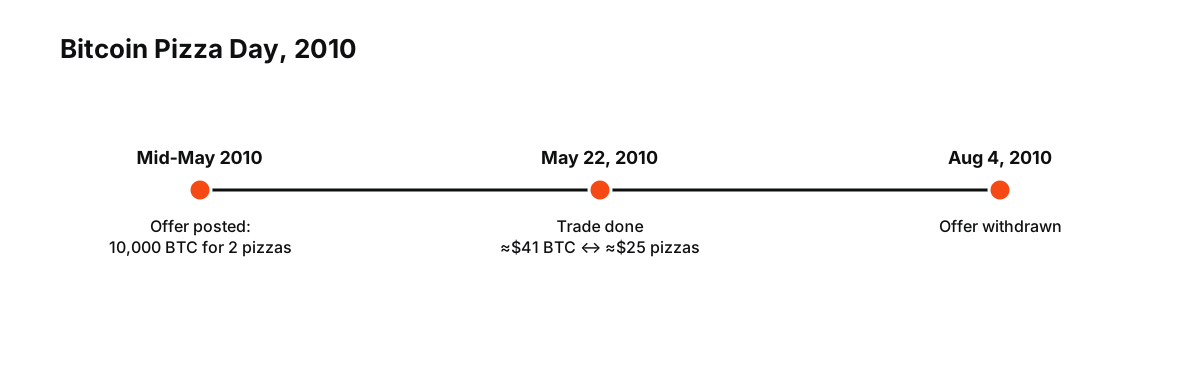
Figure: The pizza trade in three dates. Values at the time: about $41 in BTC for pizzas costing about $25.
A forum user named Jeremy Sturdivant, known online as “jercos,” took the deal. He ordered two Papa John’s pizzas, paid about $25 for them and had them delivered to Hanyecz’s home. Hanyecz sent him 10,000 BTC, and on May 22 posted that the trade was done, with photos of the pizzas.
The pizzeria never handled bitcoin. The trade was between two people, with an ordinary card payment to the restaurant in the middle. That detail matters, because it shows how bitcoin was first used: as a way for strangers online to swap value without a bank between them.
The price it implied
Ten thousand bitcoins for pizzas that cost about $25, and coins valued at around $41, put a price of roughly $0.004 on each bitcoin. That was one of very few real-world data points at the time. Within weeks, things started to move. After news of a new software release spread on the technology site Slashdot in July 2010, the value rose from about $0.008 to $0.08 in five days, and Mt. Gox opened on July 17. Bitcoin was beginning to have a market.
Why it mattered
It created a reference value. Before the pizzas, there was almost nothing to anchor what a bitcoin was worth. Afterward, people could point to a trade for something everyone understood.
It proved the idea could work outside a screen. Someone accepted bitcoin in return for spending real money, which is what any new currency needs at the start.
It showed that value comes from acceptance. The coins were worth something because another person was willing to take them. That principle still underlies Bitcoin’s price today. See what gives cryptocurrency its value.
Hanyecz kept the offer open and bought more pizzas the same way. He withdrew it on August 4, 2010, saying he could no longer generate enough bitcoin to keep paying. Blockchain records show that an address he published received and spent more than 81,000 BTC between April and November 2010, and he later wrote that he had spent his bitcoin on pizza long ago.
What 10,000 BTC would have been worth
Every May 22, someone works out what those coins would be worth at the latest price. At three of Bitcoin’s later peaks, the answer looks like this:
| Moment | Approximate BTC price | Value of 10,000 BTC |
|---|---|---|
| May 2010 | about $0.004 | about $41 |
| Late 2017 peak | about $20,000 | about $200 million |
| November 2021 peak | about $69,000 | about $690 million |
| October 2025 peak | about $126,000 | about $1.26 billion |
Each of those peaks was followed by a fall of roughly half or more, so the “value” of the pizza coins has swung by hundreds of millions of dollars in both directions.
Hanyecz has said in interviews that he does not regret the trade. At the time there was no meaningful market for the coins, and he could mine thousands more in a day. The purchase arguably did more for Bitcoin’s value than holding those coins would have.
Spend it or hold it? The debate the pizzas started
Pizza Day also sits at the center of a long argument inside the Bitcoin community. If bitcoin is meant to be money, people need to spend it, and the pizza trade is the model of what that looks like. If bitcoin’s supply is fixed and its value tends to rise over time, every coin spent today looks like a costly mistake tomorrow, which encourages holding rather than spending.
Economists have a name for one side of this: Gresham’s law, the observation that when people can choose, they tend to spend the money they value less and keep the money they value more. In practice, most bitcoin owners today treat it as something to hold, and everyday payments in many places run through stablecoins or local currency instead. Whether that changes depends on bitcoin’s price becoming steadier, which has not yet happened.
The lesson people draw, and the one they miss
The usual lesson is about missed fortunes. The more useful one is about how rare that outcome is. Bitcoin is the survivor of a period in which thousands of other coins were created and later disappeared. Treating the pizza story as proof that any coin bought today will follow the same path ignores how many early projects went to zero. See why most cryptocurrencies fail and the Bitcoin halving history.
How Pizza Day is celebrated
Bitcoin users around the world mark May 22 by ordering pizza, sharing photos and, in some places, paying in bitcoin, often over the Lightning Network, which handles small payments faster and more cheaply than on-chain transactions.
For newcomers, the story is a simple way into a less obvious idea: a currency’s value comes from people being willing to accept it. To start from the basics, read what Bitcoin is, and to see how small amounts are counted today, how to convert between satoshis and bitcoin.
This article is educational content and does not constitute financial, investment, legal or tax advice. Digital assets are volatile and you may lose the amount you invest.
Sources
- First Commercial Bitcoin Transaction — Guinness World Records
- Bitcoin Pizza Day, a Day of Celebration — Bitcoin Magazine
- Happy Bitcoin Pizza Day — Nasdaq
- May 22 Is Bitcoin Pizza Day — TechCrunch, May 2014
- 2010 (Bitcoin Market launched February 6, 2010; value rose from $0.008 to $0.08 after July 12; Mt. Gox established July 17) — Bitcoin Wiki
- Bitcoin Pizza Day (New Liberty Standard rate of $0.000764 in October 2009; Hanyecz first GPU miner) — Spark
- What you didn’t know about Laszlo Hanyecz (first macOS client April 2010; GPU mining post May 10, 2010; 81,432 BTC received and spent April–November 2010) — Bitcoin Magazine
- Bitcoin down 47% from $126,000 peak (2017 peak about $20,000; November 2021 about $69,000; October 2025 about $126,000) — Analytics Insight, February 2026