
What Is a Cross-Chain Bridge and Why Do Bridges Get Hacked?
A cross-chain bridge moves assets between blockchains by locking and minting tokens. Learn how bridges work, why they get hacked and how to stay safe.
A cross-chain bridge moves assets or messages from one blockchain to another, usually by locking tokens on the original chain and issuing an equivalent token on the destination chain. Bridges get hacked often because those locked pools hold large sums, and whatever approves withdrawals from them becomes a single point of failure.
Why bridges are needed
Blockchains are built as separate systems with their own rules. Bitcoin cannot natively read Ethereum, and Ethereum cannot natively read Solana. If you hold ETH on Ethereum and want to use it on a layer-2 network or another chain, something has to carry it across. Our guide to layer 1 vs layer 2 blockchains explains why so many networks exist in the first place.
How bridges move assets
Lock and mint. You send tokens to a contract on chain A, where they are locked. The bridge then mints the same amount of a “wrapped” version on chain B. To go back, the wrapped tokens are burned and the originals are released. The wrapped token is only worth what it claims as long as the locked originals are really there.
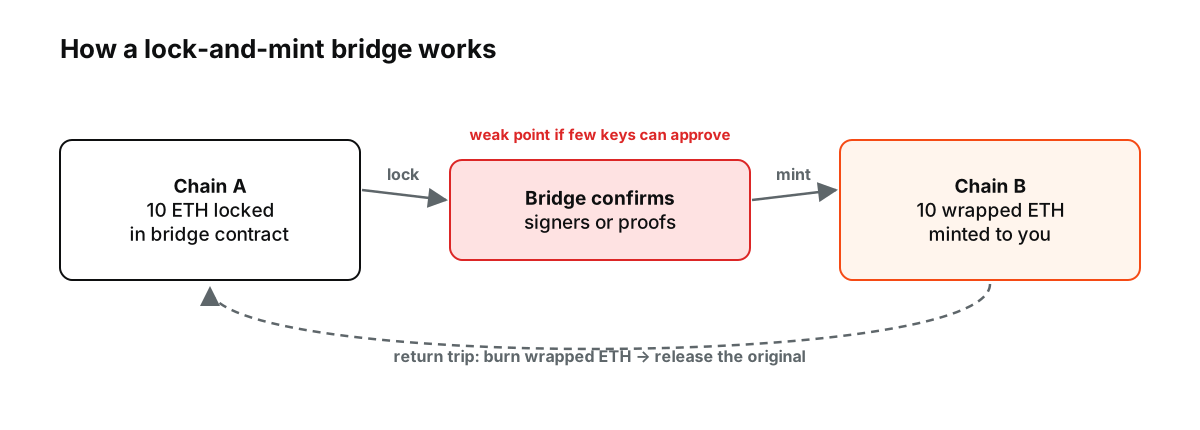
Figure: The lock-and-mint model. The wrapped token is only as good as the locked collateral and whoever approves withdrawals.
Burn and mint. For tokens the issuer controls on several chains, the token is destroyed on one chain and created on another, with no pool of locked assets in between.
Liquidity networks. The bridge holds pools of the same asset on both sides. You deposit on chain A and receive tokens from the pool on chain B, usually faster, with the bridge rebalancing in the background.
Native rollup bridges. Layer-2 rollups have their own bridges to Ethereum that rely on Ethereum’s security rather than an outside group of signers. They are generally considered the safest route, but withdrawals from optimistic rollups can take about a week.
What happens when you bridge, step by step
Using a typical lock-and-mint bridge to move a token from chain A to chain B looks like this:
- Approve and deposit. Your wallet approves the bridge contract to take the token and sends it, paying a network fee on chain A.
- Wait for confirmation. The bridge waits until the deposit is final enough on chain A, which can take from seconds to many minutes depending on the network.
- Verification. The bridge’s operators or its verification system confirm the deposit and authorize a matching amount on chain B.
- Mint and receive. A wrapped version of the token is minted to your address on chain B. You may need a little of chain B’s native coin to pay for transactions there.
Fees can apply at each step, and the wrapped token you receive is a claim on the locked originals, not the originals themselves.
Trusted vs trust-minimized bridges
The key question about any bridge is who decides that a deposit on chain A really happened.
- Trusted bridges rely on a group of operators, often a small multisignature set, to confirm transfers. They are fast and simple, but if enough of those keys are stolen, the attacker can approve fake withdrawals.
- Trust-minimized bridges rely on code and cryptographic proofs that the destination chain can verify itself. They reduce reliance on any single group but add technical complexity, and smart-contract bugs remain a risk.
Why bridges get hacked
They hold large pools. Every locked token sits in one place, which makes bridges among the most valuable targets in crypto.
Few keys can control a lot. In March 2022, attackers gained control of five of the nine validator keys securing the Ronin bridge and withdrew about $620 million in ETH and USDC. Our article on the Ronin bridge hack walks through what happened. The previous record theft, about $611 million from Poly Network in August 2021, also involved a cross-chain protocol.
Complex code across two systems. Bridges have to interpret events on one chain correctly on another. Bugs in that logic, such as accepting a forged message, can let attackers mint tokens with nothing locked behind them.
Slow detection. A malicious withdrawal can look like a normal one. In the Ronin case, the theft went unnoticed for about six days.
Ways to move assets between networks compared
| Route | Speed | Who you trust | Main risk |
|---|---|---|---|
| Native rollup bridge | Deposits fast; withdrawals can take about a week | Ethereum and the rollup’s code | Smart-contract bugs; long exit time |
| Third-party multisig bridge | Minutes | A small group of signers | Stolen or colluding keys |
| Liquidity network | Fast | Pool operators and contracts | Pool shortfalls; contract bugs |
| Centralized exchange | Depends on the platform | The exchange | Platform failure or frozen withdrawals |
Wrapped bitcoin: a familiar example
Bitcoin cannot run Ethereum’s smart contracts, so to use bitcoin in Ethereum applications, users hold wrapped bitcoin tokens on Ethereum. Each token is meant to be backed by real bitcoin held by a custodian or a group of signers. The token tracks bitcoin’s price only as long as that backing exists and can be redeemed. Holding wrapped bitcoin therefore adds custodian or bridge risk on top of bitcoin’s own price risk, a trade-off worth understanding before treating it as the same thing as holding bitcoin.
What happens to wrapped tokens after a hack
If the locked collateral is stolen, the wrapped tokens on the other chain may no longer be backed. Their market price can fall sharply, and whether holders are made whole depends on the project’s response. That risk is separate from the price risk of the asset itself.
How to use a bridge more safely
- Prefer native or official bridges recommended by the network you are moving to.
- Check the address of the bridge website carefully; fake bridge sites are a common phishing trap. Our guide to spotting fake crypto exchange websites applies here too.
- Send a small test before a large transfer.
- Understand what you will receive. A wrapped token is a claim on locked assets, not the original asset.
- Consider a centralized route. For many users, depositing on one network and withdrawing on another through a regulated platform avoids bridge contracts altogether, provided both networks are supported. Our guide to choosing the correct blockchain network covers that process.
This article is educational content and does not constitute financial, investment, legal or tax advice. Digital assets are volatile and you may lose the amount you invest.
For how bridges fit alongside wallets, oracles and nodes, see what Web3 is.