
Layer 1 vs Layer 2 Blockchains
Layer 1 vs layer 2: base chains secure and settle, while layer 2s process transactions faster and cheaper and post results back. See the trade-offs.
Layer 1 vs layer 2 comes down to where transactions are processed and where they are secured. A layer 1, such as Bitcoin or Ethereum, orders and secures transactions itself. A layer 2 processes them more cheaply and quickly, then posts the results back to a layer 1 and relies on it for security.
Side by side
| Layer 1 | Layer 2 | |
|---|---|---|
| What it is | The base chain with its own consensus | A network built on top of a layer 1 |
| Security | Its own miners or validators | Inherited, to varying degrees, from the layer 1 it settles to |
| Fees | Rise when blocks fill up | Usually much lower, because many transactions share one layer-1 posting |
| Speed | Bound by the layer 1’s block times | Often near-instant confirmation by the layer 2’s operator |
| Final settlement | On the chain itself | When the layer 2’s data or proof is accepted on the layer 1 |
| Examples | Bitcoin, Ethereum | Lightning on Bitcoin; rollups such as Arbitrum on Ethereum |
Why layer 2s exist
Base chains limit how many transactions fit in each block, on purpose: smaller blocks keep it possible for ordinary users to run nodes and verify the chain. When demand outgrows that space, fees rise. Our guide to blockchain transaction fees explains that auction.
Layer 2s move most of the work off the base chain while keeping its security as the final backstop. Bitcoin’s Lightning Network does this with payment channels. On Ethereum, the dominant approach is rollups.
How rollups work
A rollup collects many transactions, executes them off the main chain, and posts a compressed record of them back to Ethereum. There are two main designs:
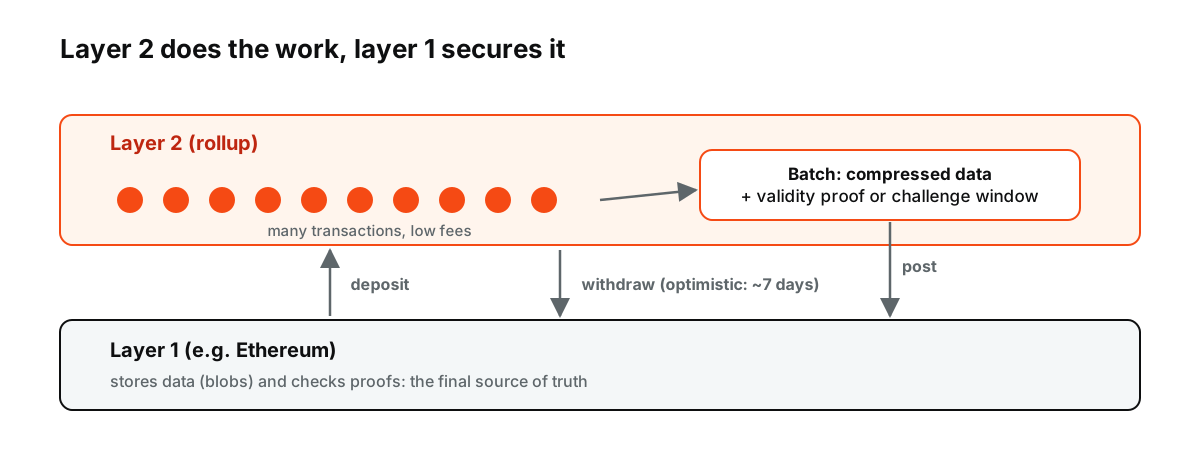
Figure: How a rollup uses layer 1 for security. Optimistic rollup withdrawals wait out a challenge period of roughly seven days.
Optimistic rollups assume batches are correct and allow a challenge period during which anyone can submit a fraud proof. The catch is withdrawals: moving funds back to Ethereum through the rollup’s native bridge means waiting out that period, roughly seven days.
Zero-knowledge (ZK) rollups post a cryptographic proof that each batch was executed correctly. Withdrawals can be faster because there is nothing to wait for once the proof is verified, at the cost of more complex technology.
Since an Ethereum upgrade in 2024, rollups can post their data in “blobs,” a cheaper type of data that Ethereum keeps for about 18 days. That made fees on many layer 2s fall to a small fraction of mainnet fees. Our guide to data availability explains why that data matters at all.
The same payment on each layer
Suppose you send a stablecoin payment to a friend. On Ethereum’s main chain, your wallet broadcasts the transaction, it waits to be included in a block, and once a block or two has been added on top it is effectively settled; the fee depends on how busy the chain is at that moment. On a rollup, the same payment is accepted and confirmed by the rollup’s sequencer almost immediately, usually for a much smaller fee. Behind the scenes, it is later bundled with many other transactions and posted to Ethereum, and only then is it settled with Ethereum’s full security.
For everyday use, the rollup’s quick confirmation is usually enough, and most users never notice the later settlement step. For large amounts, it helps to know that “confirmed” on a layer 2 and “final” on the layer 1 are not the same moment. In the rare case that a sequencer misbehaves or fails before posting its batch, transactions it confirmed may need to be resubmitted, which is why some businesses wait for layer 1 settlement before treating large layer 2 payments as complete.
How mature is a rollup?
Many rollups launched with safety controls that their teams still hold: keys that can upgrade the contracts quickly, sequencers run by a single company, or fraud-proof systems that are not yet open to everyone. These “training wheels” let teams fix problems fast but mean users rely partly on the team’s good behavior. Independent trackers now rate rollups by how far they have moved away from such controls, and checking that rating says more about a network’s real security than its marketing does.
Layer 2s on Bitcoin
Bitcoin’s scaling story looks different. Its best-known layer 2, the Lightning Network, uses payment channels: two parties lock bitcoin in a shared on-chain contract and then exchange many payments off-chain, settling only the final balance on Bitcoin. Other systems built alongside Bitcoin, such as sidechains, run their own consensus and rely on their own operators to move coins in and out, so they do not inherit Bitcoin’s security in the same way. See how the Lightning Network works.
Choosing a network as a user
- Check where your destination supports deposits. An exchange or app may accept a token on one layer 2 but not another.
- Look at how withdrawals work. Know whether moving back to the layer 1 is fast, slow or depends on a third-party bridge.
- Keep a little of the right gas token. Each network needs its own native coin, often ETH on Ethereum rollups, to pay fees. Without it, tokens can sit in your wallet with no way to move them.
- Prefer mature networks for large balances. Rollups with fewer team-held controls carry less trust in the operator.
- Do a small test first. A test transfer costs little and catches network mismatches before they become expensive, especially when sending to an exchange.
The trade-offs to understand
Security varies by design. Rollups that post their data and proofs to Ethereum inherit much of its security. Sidechains and other designs that run their own consensus do not, even if they are often marketed alongside layer 2s.
Operators can be centralized. Many layer 2s rely on a single sequencer, a server operated by the project that orders transactions. If it goes down or misbehaves, users may face delays, even if their funds remain recoverable through the layer 1.
Moving between layers takes care. Assets on a layer 2 are separate from the same assets on the layer 1. Sending ETH to an exchange on the wrong network is a common and costly mistake. Our guide to choosing the correct blockchain network covers how to avoid it, and our explainer on cross-chain bridges covers moving assets between networks.
Fragmentation. With many layer 2s, liquidity and users are spread out, and applications on one may not talk to another easily.
For how base chains themselves are evolving to support this layered model, see our guide to modular blockchains. For the basics of networks and native coins, start with what a blockchain network is.
Frequently asked questions
Is a layer 2 safer than a sidechain?
Generally, a rollup that posts its data and proofs to Ethereum offers stronger guarantees than a sidechain, because users can rely on Ethereum to enforce withdrawals. A sidechain’s safety depends on its own validators. How much of that advantage a given rollup delivers depends on its maturity and controls.
Can I lose funds if a layer 2 shuts down?
On a well-designed rollup, users should be able to withdraw through the layer 1 even if the operator disappears, though it may be slow and technical. On sidechains, validiums or immature rollups, that escape route may be weaker or missing, so it is worth checking before holding large amounts on any layer 2.
This article is educational content and does not constitute financial, investment, legal or tax advice. Digital assets are volatile and you may lose the amount you invest.
For the applications these layers carry, see what Web3 is.
Sources
- Scaling (layer 2, sidechains and other approaches) — ethereum.org Developer Docs
- Optimistic Rollups (challenge period of roughly seven days) — ethereum.org Developer Docs
- Danksharding (blobs pruned after about 18 days) — ethereum.org
- EIP-4844: Shard Blob Transactions — Ethereum Improvement Proposals, GitHub