
What Is a Modular Blockchain?
A modular blockchain splits execution, settlement, consensus and data availability across layers. See how it differs from monolithic chains.
A modular blockchain splits a blockchain’s core jobs across specialized layers instead of having one chain do everything. One layer runs transactions, another settles results, another orders blocks and another publishes the data. The goal is to scale by letting each layer focus on one job.
The four jobs every blockchain does
| Job | What it means |
|---|---|
| Execution | Running transactions and smart contracts to update balances and state |
| Settlement | Being the final reference point: verifying proofs, resolving disputes, finalizing results |
| Consensus | Agreeing on the order of transactions and blocks |
| Data availability | Publishing the data so anyone can check what happened |
A monolithic blockchain does all four on the same network. Bitcoin and, originally, Ethereum work this way: every full node executes every transaction, agrees on order, and stores the data. That design is simple and secure, but every node has to keep up with everything, which caps how much the chain can process.
How the modular approach splits the work
In a modular setup, different systems take on different jobs:
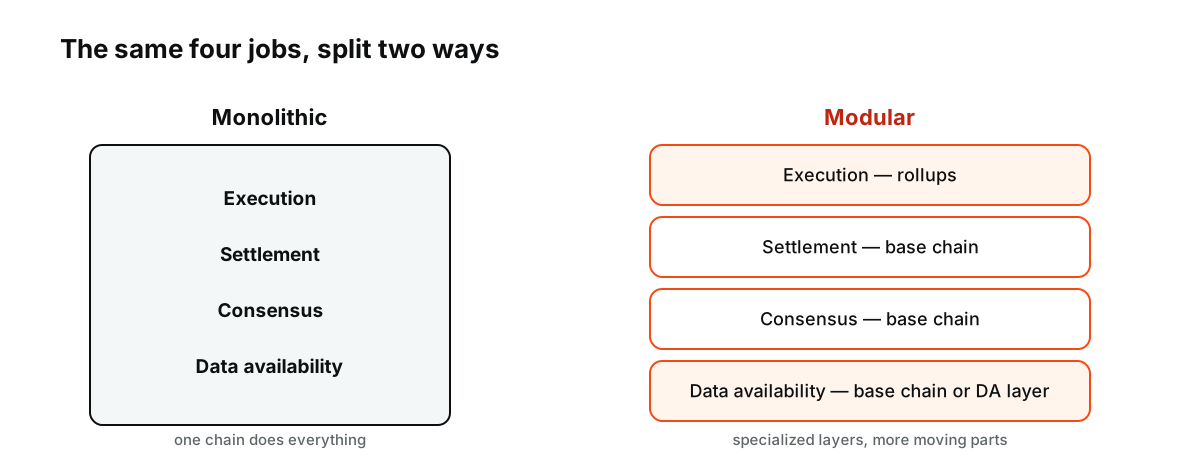
Figure: Monolithic vs modular. The same four jobs, handled by one chain or by specialized layers.
- Rollups handle execution. They process transactions off the main chain. Our guide to layer 1 vs layer 2 blockchains explains how.
- A base chain handles settlement and consensus. On Ethereum’s rollup-centric roadmap, rollups post proofs and commitments to Ethereum, which acts as the final judge.
- A data availability layer publishes the data. That can be the base chain itself, using blobs, or a separate network built for this one job. Our guide to data availability covers why this layer matters so much.
Ethereum’s own developers chose this path: rather than making the main chain do vastly more execution, the roadmap focuses on making it a strong settlement and data layer for rollups.
Why the idea gained ground
The modular approach grew out of a practical limit. Making every node do more work raises the cost of running a node, which pushes ordinary users out of verification. Splitting the jobs lets each layer grow without that trade-off.
One transaction, four layers
Following a single swap on a rollup shows how the pieces fit together:
- Execution. You submit the swap to the rollup. Its sequencer orders it with other transactions and executes it, and your balance updates within seconds.
- Data availability. The rollup bundles many transactions and publishes their data, today often as a blob on Ethereum, so that anyone can reconstruct the rollup’s state.
- Settlement. The rollup posts a commitment to its new state on the base chain. A zero-knowledge rollup attaches a proof that the state is correct; an optimistic rollup assumes it is correct unless someone challenges it during a waiting period.
- Consensus. The base chain’s validators order and finalize the block containing that data and commitment, which is when the result becomes as hard to reverse as anything else on the base chain.
Each step happens on a different system, and each carries its own assumptions. Your swap felt instant, but it became final only when the last layer finished its job.
Advantages and trade-offs
Advantages
- Scale. Execution can grow across many rollups without every base-chain node processing every transaction.
- Specialization. Each layer can be optimized for its job, such as cheap data publishing or fast execution.
- Flexibility. A project can launch its own execution environment without building a whole new set of validators.
Trade-offs
- More moving parts. Each additional layer adds code, operators and assumptions that can fail.
- Security depends on the weakest layer. A rollup that settles on a strong base chain but publishes its data to a weaker network is only as safe as that weaker link.
- Fragmented experience. Assets and users are spread across many execution layers, so moving between them often needs bridges. Our guide to cross-chain bridges explains the risks.
- Centralized operators, for now. Many rollups still depend on a single sequencer run by the project.
Why the design shows up in your fees
The modular approach is not only an engineering choice; it changes what users pay. On a rollup, a large part of the cost of each transaction is the cost of publishing its data to the base chain. Ethereum’s roadmap introduced “blobs,” a cheaper type of data space designed specifically for rollups, so that publishing data no longer competes with ordinary transactions for the same block space. Cheaper data means cheaper rollup transactions, which is why fees on many layer 2 networks are a small fraction of those on Ethereum’s main chain. The trade-off is that rollup fees now depend on demand for blob space, which can rise when many rollups need it at once.
Questions to ask about a modular network
- Where is the data published? On the base chain itself, or on a separate data network with its own security?
- Who runs the sequencer? A single company, or a decentralized set of operators?
- How long do withdrawals take? Optimistic designs can need a challenge period before funds can leave.
- Can the system be upgraded by a small group? Upgrade keys controlled by a few people can override many other protections.
Monolithic vs modular: which is better?
Neither design is better in every situation. Monolithic chains keep everything in one place, which makes them simpler to reason about and avoids cross-layer risk; some newer monolithic chains aim to scale by asking more of each node’s hardware. Modular systems aim to scale without raising the bar for running a node on the base chain, at the cost of complexity.
For users, the practical takeaway is to understand where the network you are using executes, settles and publishes its data, because that determines what you are relying on. For the basics of how networks and native coins work, see what a blockchain network is, and for the applications these layers support, what Web3 is.
This article is educational content and does not constitute financial, investment, legal or tax advice. Digital assets are volatile and you may lose the amount you invest.
Frequently asked questions
Is a modular blockchain less secure than a monolithic one?
Not necessarily, but its security is spread across more parts. A rollup that executes off-chain while posting its data and proofs to Ethereum can inherit much of Ethereum’s security. One that relies on a weaker data layer, a single sequencer or upgrade keys held by a small team is only as strong as those pieces. The question to ask is which layer you are trusting for each job.
Does modular mean cheaper?
Usually, for users of the execution layers, because the expensive work is shared and data publishing is priced separately. The base layer itself may become busier and more valuable as a settlement and data service rather than cheaper. For users, the saving shows up mainly on layer 2 networks, while transactions on the base chain itself can remain expensive at busy times, which is one reason so much everyday activity has moved off it.