
Proof of Work vs Proof of Stake
Proof of work vs proof of stake: how each secures a blockchain, what an attack costs, energy use, finality and decentralization trade-offs, side by side.
The core difference in proof of work vs proof of stake is what an attacker has to spend. In proof of work, used by Bitcoin, miners compete by burning electricity on computation. In proof of stake, used by Ethereum since 2022, validators lock up the network’s own coins and risk losing them if they cheat.
Side by side
| Proof of work | Proof of stake | |
|---|---|---|
| Who produces blocks | Miners with specialized hardware | Validators with staked coins |
| How the next producer is picked | Whoever finds a valid hash first | Chosen at random, weighted by stake |
| What secures the chain | Ongoing spending on electricity and hardware | Capital at risk of being slashed |
| Energy use | High | Low; Ethereum’s dropped by an estimated 99.95% after switching |
| Punishment for cheating | Wasted electricity on blocks the network rejects | Loss of part of the stake (“slashing”) |
| Finality | Probabilistic: reversal gets harder with each block | Many designs add explicit finality checkpoints |
| Barrier to entry | Hardware and cheap power | Minimum stake, or a pool or provider |
| Best-known example | Bitcoin | Ethereum |
How each one keeps the chain honest
Proof of work. To rewrite history, an attacker has to redo the computation for the blocks they want to change and outpace the honest network that keeps adding new ones. The cost is external to the system: electricity and machines. Our pillar guide on how Bitcoin mining works explains the race, and our explainer on Bitcoin hash rate shows how its scale is measured.
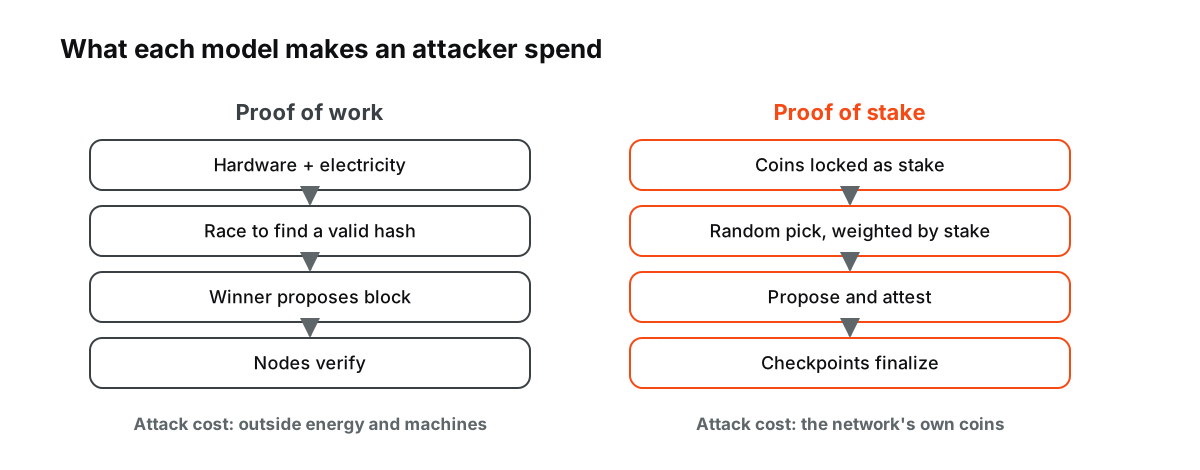
Figure: The two security models. What an attacker must spend differs: energy and hardware versus staked coins.
Proof of stake. To control which blocks are finalized, an attacker needs a large share of all staked coins. Provable misbehavior can be punished by destroying part of that stake, so the attack can be costly even if it fails. The cost is internal to the system: the network’s own coins. Our guide to what proof of stake is covers validators, slashing and finality in detail.
The trade-offs people argue about
Energy. This is the clearest difference. Ethereum’s switch on September 15, 2022 cut its energy use by an estimated 99.95%. Supporters of proof of work reply that the energy is precisely what makes the ledger expensive to attack, and that it ties security to the physical world rather than to the coin itself.
Decentralization. Proof of work concentrates in places with cheap power and in large mining pools. Proof of stake tends to concentrate among large holders and big staking providers. Both models face the same question in different forms: how much influence ends up with a few large operators.
Recovering from an attack. In proof of work, an attacker’s hardware still exists after an attack and could be used again. In proof of stake, the protocol can destroy an attacker’s stake, but recovering from an attack that controls a majority of stake may require social coordination among node operators. Each side considers its own recovery path the stronger one.
Simplicity and track record. Proof of work is simpler to reason about and has secured Bitcoin since 2009. Proof of stake systems are more complex, with more rules for selection, voting and penalties, and their large-scale track record is shorter.
Finality. Proof-of-stake chains like Ethereum can mark blocks as final within minutes, which some applications value. Proof-of-work chains rely on waiting for enough confirmations. Our guide to why network confirmations matter shows how exchanges set those waits.
After an attack: two different recoveries
Imagine an attacker briefly gains majority control on each kind of network.
On a proof-of-work chain, the attacker controls hardware. Once the attack ends, the machines still exist and could be used again, and the honest community has limited options beyond waiting, raising confirmation requirements or, in extreme cases, changing the mining algorithm to make the attacker’s hardware useless, which would also strand honest miners’ equipment.
On a proof-of-stake chain, the attacker controls staked coins. Provable misbehavior can be punished by slashing, which destroys part of that stake automatically. If the attack is the kind the rules cannot punish on their own, such as refusing to include certain transactions, the community can coordinate to fork away and leave the attacker’s stake behind. That option is powerful but depends on social agreement among node operators, exchanges and users.
Where the money goes
The two models also differ in their economics. Miners have large ongoing costs for electricity and hardware, so they tend to sell a substantial share of the coins they earn, creating steady selling pressure, and the network has to issue enough new coins to keep them in business. Validators’ costs are mostly the opportunity cost of locking up capital, so a proof-of-stake network can pay much less in new issuance for a comparable level of security. Ethereum’s new issuance fell sharply after the Merge for that reason. In both cases, transaction fees are expected to make up a growing share of rewards over time.
What it means for you as a user
For most people, the consensus model shows up in three practical ways: how long until a payment is final, how much energy the network uses, and whether you can earn rewards by staking. Proof-of-stake chains offer staking and faster formal finality; proof-of-work chains offer a long track record and a simpler security story. Fees, network choice and custody decisions usually matter more to everyday experience than either model.
When each design makes more sense
Proof of work suits networks whose top priority is a simple, conservative design with security tied to physical cost, which is the path Bitcoin has kept. Proof of stake suits networks that want lower energy use, faster finality and more flexibility to evolve the protocol, which is why most newer smart-contract platforms use it.
In practice, the choice is made once, early, and changing it later is a major undertaking. Ethereum’s switch took years of preparation. For most users, what matters day to day is less the consensus model and more the network you send funds on; our guide to what a blockchain network is covers that side.
This article is educational content and does not constitute financial, investment, legal or tax advice. Digital assets are volatile and you may lose the amount you invest.
For how both models fit into the wider world of blockchains and applications, see what Web3 is.
Sources
- Bitcoin: A Peer-to-Peer Electronic Cash System — Satoshi Nakamoto, October 2008
- The Merge (date and ~99.95% energy reduction) — ethereum.org
- Ethereum consensus specifications, Phase 0 beacon chain — Ethereum, GitHub
- Proof-of-stake attack and defense (social coordination after majority attacks) — ethereum.org Developer Docs