
What Is Web3?
Web3 means internet services built on blockchains, where users hold their own assets and identity. How it differs from Web2, uses and limits.
Web3 is a name for internet services built on blockchains, where users can hold their own money, assets and identity in a wallet instead of an account controlled by a company. The idea is a web that people can read, write and own. In practice, Web3 today means crypto wallets, tokens, decentralized finance and applications that run on smart contracts.
Where the term came from
The word was popularized by Ethereum co-founder Gavin Wood, who used it in 2014 to describe an internet in which applications run on decentralized networks rather than on servers owned by a few companies. It stayed a niche term for years, then spread widely during the crypto boom of 2021, when it became shorthand for everything from NFTs to decentralized finance. Its meaning is still debated: for supporters it describes a shift in who owns the internet’s value, while critics see it as a rebranding of crypto speculation.
From Web1 to Web3
The term makes most sense as the third step in a story about who controls the internet.
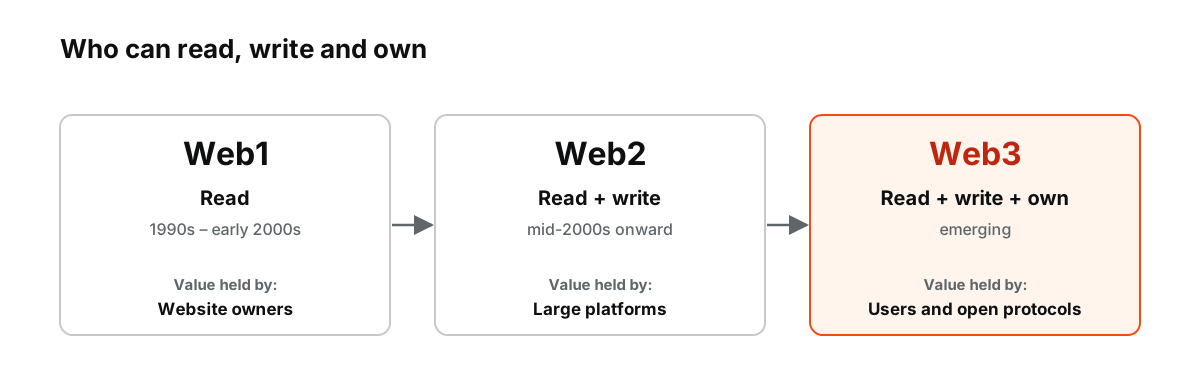
Figure: The Web1 → Web2 → Web3 framing used throughout this guide.
| Era | Rough period | What users could do | Who controlled value |
|---|---|---|---|
| Web1 | 1990s to early 2000s | Read mostly static pages | Website owners |
| Web2 | Mid-2000s onward | Read and write: post, share, comment | Large platforms that host the content and sell the advertising |
| Web3 | Emerging | Read, write and own: hold assets and data in a personal wallet | Users and open protocols, at least in principle |
Web2 made the internet interactive, but most of the value flowed to a handful of platforms that own the accounts, the data and the relationship with users. Web3 tries to move ownership of key pieces, such as money, digital items and identity, from those platforms to users.
Ownership vs access: a concrete example
Consider an item bought inside a video game. In a typical Web2 game, the item exists as an entry in the publisher’s database. You have a license to use it, the publisher can change or remove it, and if the game shuts down, the item disappears. You usually cannot sell it outside the game.
In a Web3 version, the item is a token held in your wallet. The game reads your wallet to see what you own. You can move the token to another wallet or sell it on an open marketplace, and the record of ownership survives even if the game’s company does not. The item may be useless without a game that recognizes it, which is an important limit, but the ownership itself is no longer at the publisher’s discretion. That shift, from access granted by a company to ownership recorded on a public ledger, is the core of what Web3 claims to offer.
The building blocks
Blockchains. Shared ledgers that no single company controls. See what blockchain is and what a blockchain network is.
Wallets. Instead of a username and password stored by a company, you hold keys that prove ownership. The same wallet can work across many applications. See what a crypto wallet is.
Smart contracts. Programs that run on a blockchain and follow their rules automatically, so applications can hold and move funds without a company in the middle. See what a smart contract is.
Tokens. Units of value or ownership created on a blockchain, from stablecoins to governance tokens to NFTs. See what a crypto token is and what an NFT is.
Infrastructure. Nodes that keep copies of the chain, oracles that bring outside data on-chain, and bridges that move assets between networks: see blockchain nodes, oracles and cross-chain bridges.
What happens when you use a Web3 app
From the outside, a Web3 application often looks like an ordinary website. The difference is in what happens when you act:
- The website is only a front end. It displays information and builds transactions, but it does not hold your funds.
- You connect a wallet. Instead of logging in with a password, you let the site see your public address.
- You sign, the wallet asks. When you trade, deposit or mint, the site prepares a transaction and your wallet asks you to approve it. Nothing moves without that signature.
- A smart contract executes. The transaction is sent to the blockchain, where the application’s contract carries out the action according to its code.
- The result is public. Balances update on-chain, and anyone can verify what happened on a block explorer.
The practical consequence is that the moment of signing is where most of the risk sits. A malicious site can ask you to approve something very different from what it shows. See what a wallet drainer is.
What people actually use Web3 for
- Holding and moving money without a bank in the middle, including stablecoins sent across borders.
- Decentralized finance (DeFi): trading, lending and borrowing through smart contracts rather than companies. See what DeFi is.
- Digital ownership, where a token records who owns an in-game item, a collectible or a ticket.
- Tokenized traditional assets, such as government bonds and funds represented on a blockchain. See RWA tokenization.
- Community governance, where token holders vote on how a protocol changes, often through a DAO.
How Web3 projects make money
Web2 platforms are mostly free to use and earn money by selling advertising based on user data. Web3 projects usually take a different route. Many charge small fees on transactions that flow through their smart contracts, such as a share of each trade on a decentralized exchange. Others issue tokens, keeping a portion for the team and early investors, which is why token supply and unlock schedules matter so much. Some charge for a convenient front end while the underlying contracts remain free to use directly.
None of these models is free of conflicts. Fees can rise, insiders can sell their tokens, and a project funded by its own token depends on that token’s price. Knowing how an application earns its money is a good guide to whose interests it serves. See what tokenomics is.
Identity in Web3
In Web2, your identity on a site is an account the company creates and controls. In Web3, the wallet address acts as a portable identity: the same address can sign in to many applications, carry a history of activity and hold credentials or memberships issued as tokens. That portability is powerful, and it cuts both ways. Because the record is public, using one address everywhere can link activities you would rather keep separate, and losing the keys means losing the identity along with the assets.
What Web3 changes for users
You hold your own keys. That removes the need to trust a platform with your assets, and also removes the platform’s ability to help if you lose them.
Applications are composable. Because smart contracts are public, one application can build on another, the way a website can link to another site. A token from one app can be used in many others.
Records are public. Transactions on most blockchains are visible to anyone, which helps verification and hurts privacy.
Rules are in code. A smart contract does what its code says, including when the code has a bug.
Web3, blockchain and crypto: the terms
The three words are often used interchangeably, but they describe different layers. Blockchain is the underlying technology, a shared ledger maintained by a network. Crypto usually refers to the assets that live on those ledgers, from bitcoin to stablecoins and tokens. Web3 is the broader idea of building internet services on top of them, with users owning assets and identity directly. You can hold crypto without using Web3 applications, and some blockchains are used for purposes that have nothing to do with Web3.
The limits and the criticism
Web3 is not finished, and its critics have fair points.
- Usability. Seed phrases, network fees, choosing the right network and signing transactions are still hard for most people.
- Security. Scams, phishing sites, bridge hacks and smart-contract exploits have cost users heavily; the Ronin bridge hack alone took about $620 million. See crypto scam warning signs.
- Centralization in practice. Many “decentralized” services still rely on a few companies for wallets, data access or front-end websites.
- Speculation. A large share of activity has been trading tokens rather than using applications.
- Regulation. Rules for tokens, platforms and stablecoins are still being written and differ by country.
Web3 and scaling
Early blockchains could process relatively few transactions, which made fees high when demand rose. Much of today’s Web3 activity happens on faster networks or on layer 2 systems that settle back to a main chain. See layer 1 vs layer 2 blockchains, data availability and modular blockchains.
Questions to ask before using a Web3 app
- Where did I find the link? Use bookmarked or verified addresses, not links from messages or ads.
- What exactly am I signing? Read the wallet prompt, not just the website’s button.
- Who controls the contract? Check whether a team can change it or move funds, and whether it has been audited.
- What happens if it fails? There is usually no insurance or customer support to fall back on.
- Am I using a separate wallet? Keeping a small “hot” wallet for new apps protects your main holdings.
Frequently asked questions
Do I need cryptocurrency to use Web3?
Usually, yes, at least a small amount. Most blockchains charge fees in their native coin, so a wallet needs some of it to sign transactions, even if the app itself deals in stablecoins or NFTs.
Is Web3 the same as the metaverse?
No. The metaverse refers to shared virtual worlds. Some of them use Web3 components, such as tokens for items or land, but many do not, and most Web3 applications have nothing to do with virtual worlds.
Can a Web3 app be shut down?
The smart contracts usually keep running as long as the blockchain does, because no single party can switch them off. The website most people use to reach them is different: it is hosted by a company or individual and can be taken down, blocked or changed. Regulators have generally focused on the people and companies behind front ends rather than on the contracts themselves.
Is Web3 safe?
The underlying blockchains are generally secure; the risks sit in applications, bridges and, above all, in what users sign. Treat every new app as untrusted until you have checked it, and never share a seed phrase.
Where to start
If you are new, learn the wallet basics before anything else, practice with small amounts and treat every unexpected message or link with suspicion. See how to build a crypto security routine.
This article is educational content and does not constitute financial, investment, legal or tax advice. Digital assets are volatile and you may lose the amount you invest.