
How to Convert Crypto to Cash
Turn crypto into money in your bank account: choose a route, send coins on the right network, sell, withdraw and keep records. Plus the checks that stop losses.
By the end of this guide you will know how to convert crypto to cash in your bank account: pick a route, move the coins safely, sell for your local currency, withdraw to an account in your own name and record the sale for taxes. Checking the network before you send prevents the most losses.
Step 1: Choose your route
| Route | How it works | Best for | Watch out for |
|---|---|---|---|
| Exchange | Sell on the exchange, withdraw to your bank | Most people; lowest cost | Withdrawal limits and verification |
| Broker app | Sell inside the app that holds your crypto | Simplicity | Wider spreads than an exchange |
| Peer-to-peer | Sell directly to another person | Places with limited exchange access | Payment fraud and fake receipts |
| Crypto ATM | Send crypto to the machine, take cash | Small amounts, cash needed now | High fees; few machines buy crypto |
For most people, a regulated exchange in their own country is the cheapest and simplest route. Broker apps can look free but often build their charge into the price they quote, which shows up as a wider gap between buy and sell prices.
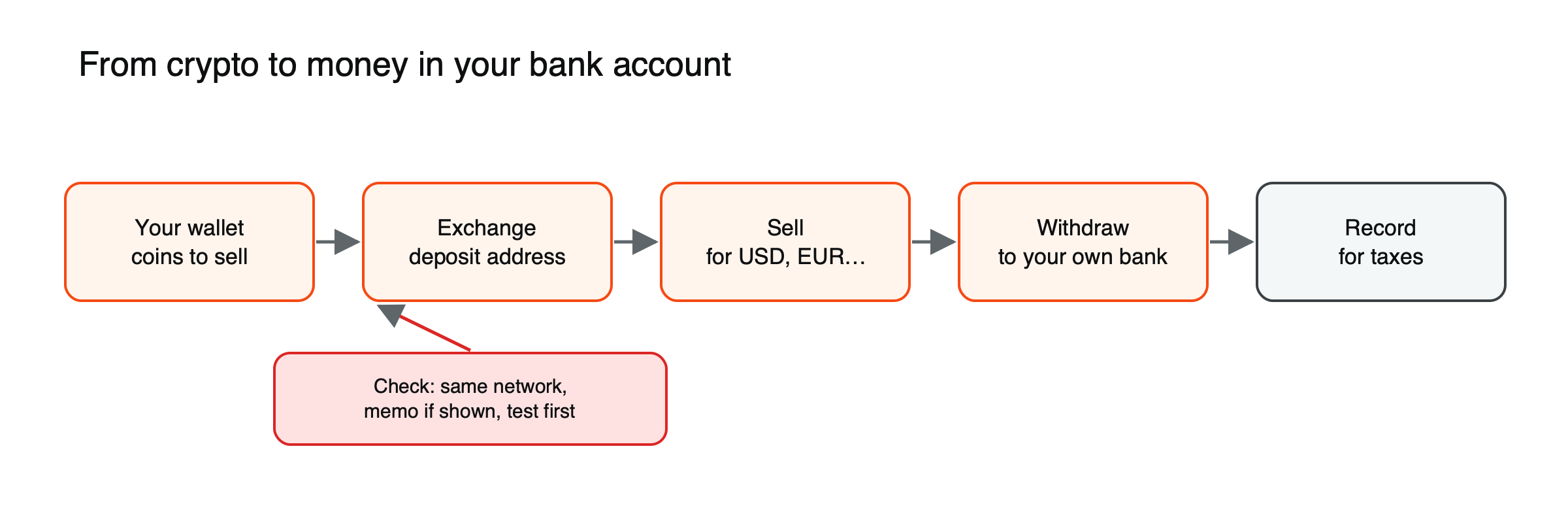
Figure: The usual exchange route from crypto to money in the bank, with the check that prevents the most losses.
Step 2: Get your account ready before you need the money
Complete identity verification well in advance, because it can take days. Link a bank account in your own name; withdrawals to third-party accounts are usually blocked. Check the platform’s daily and monthly withdrawal limits so a large sale is not stuck for weeks. If you are using OTCN, verifying your OTCN account covers this step.
Step 3: Move your crypto to the platform
If the coins are in a personal wallet, send them to the deposit address the platform shows.
- Pick the same network on both sides. A token such as USDT exists on several networks; sending it on one the platform does not support can lose the funds.
- Add the memo or destination tag if one is shown. Some coins need it to credit your account.
- Send a small test first when moving a large amount, and wait for it to arrive.
Our guide to depositing crypto safely walks through each check.
Step 4: Sell for your local currency
Sell into the currency your bank uses, such as USD or EUR. A market order fills immediately at the best available prices; a limit order waits for the price you set. On large amounts, a limit order or several smaller sales can avoid moving the price against you. See market order vs limit order.
If you hold a less common coin, there may be no direct market against your currency. You may need to sell it first for bitcoin or a stablecoin and then sell that, paying fees twice.
What the costs look like on one sale
Suppose you sell 0.1 BTC when bitcoin trades at $100,000, so the sale is worth $10,000. (Example values; check your platform’s actual fees.)
| Route | Trading cost | Spread | Bank withdrawal | You receive |
|---|---|---|---|---|
| Exchange, limit order | 0.2% fee: $20 | Close to market | $5 | about $9,975 |
| Broker app, “free” sale | No stated fee | Price 1% below market: $100 | $5 | about $9,895 |
The broker’s sale looks free, but the price it offers you is lower than the market, and that gap is the real fee. On larger sales, the difference grows in proportion.
Timing a large sale
Selling a large amount all at once can move the price against you, especially for less liquid coins or during quiet hours and weekends. Splitting the sale into several limit orders over hours or days, and checking the depth of the order book before you sell, usually gets a better average price. Decide in advance whether you are selling to a fixed schedule or at set price levels, so the decision is not made under pressure.
Stablecoins as a halfway step
Some people sell into a dollar stablecoin first, either to step out of a volatile asset quickly or to wait for a better moment to cash out. That removes crypto price risk but not all risk: a stablecoin is a claim on its issuer’s reserves, and in many countries swapping a coin for a stablecoin is itself a taxable sale. It is a parking place, not cash in the bank. See what a stablecoin is.
Step 5: Withdraw to your bank
Request the withdrawal to your verified bank account. Check the fee and expected arrival time, which can range from minutes to a few business days depending on the payment method. Keep the confirmation.
Large or unusual withdrawals can trigger extra checks from the platform or your bank, such as questions about where the funds came from. Having your transaction history ready makes these checks quicker.
Step 6: Record the sale for taxes
Selling crypto for cash is a taxable event in many countries. Record the date, amount sold, price received, fees and what you originally paid. In the United States, brokers report the gross proceeds of crypto sales on Form 1099-DA starting with sales made in 2025, but they are not required to report what you paid for sales that year. Your own records fill that gap. In the European Union, the DAC8 rules extend reporting by crypto service providers to tax authorities; see DAC8 crypto reporting. Wherever you live, assume the sale will be visible to your tax authority and keep the evidence that supports the figures you report. See how to keep records of your crypto transactions.
If something goes wrong
- Deposit not showing up: check the transaction on a blockchain explorer, then contact support with the transaction ID.
- Withdrawal delayed or held: the platform may need extra verification; respond only through the official app or website.
- Someone contacts you offering to “release” your funds: it is a scam. Real support never asks for your seed phrase, passwords or an upfront fee.
For the basics, see what cryptocurrency is.
This article is educational content and does not constitute financial, investment, legal or tax advice. Digital assets are volatile and you may lose the amount you invest.