
Beginner Crypto Mistakes That Cost Real Money
The crypto mistakes that cost beginners the most, from investment scams and shared seed phrases to wrong networks and early leverage, and what to do instead.
Among crypto beginner mistakes, the most expensive is sending money to a fake investment opportunity. The FBI recorded about $5.8 billion in losses from crypto investment scams in 2024 alone. The other mistakes below are smaller one by one, but each can wipe out a balance just as permanently.
Why crypto mistakes are so hard to undo
In traditional finance, many errors have a safety net. A bank can reverse a fraudulent card payment, a forgotten password can be reset, and a broker’s failure may be covered by an investor protection scheme. Crypto removes most of those nets. A confirmed transaction cannot be reversed, whoever holds the private key controls the funds, and there is often no one to call. That is why the same small slip costs far more here, and why prevention is the only reliable defense.
The mistakes below are grouped by when they usually happen.
Before you buy
Trusting an “investment opportunity” from a stranger
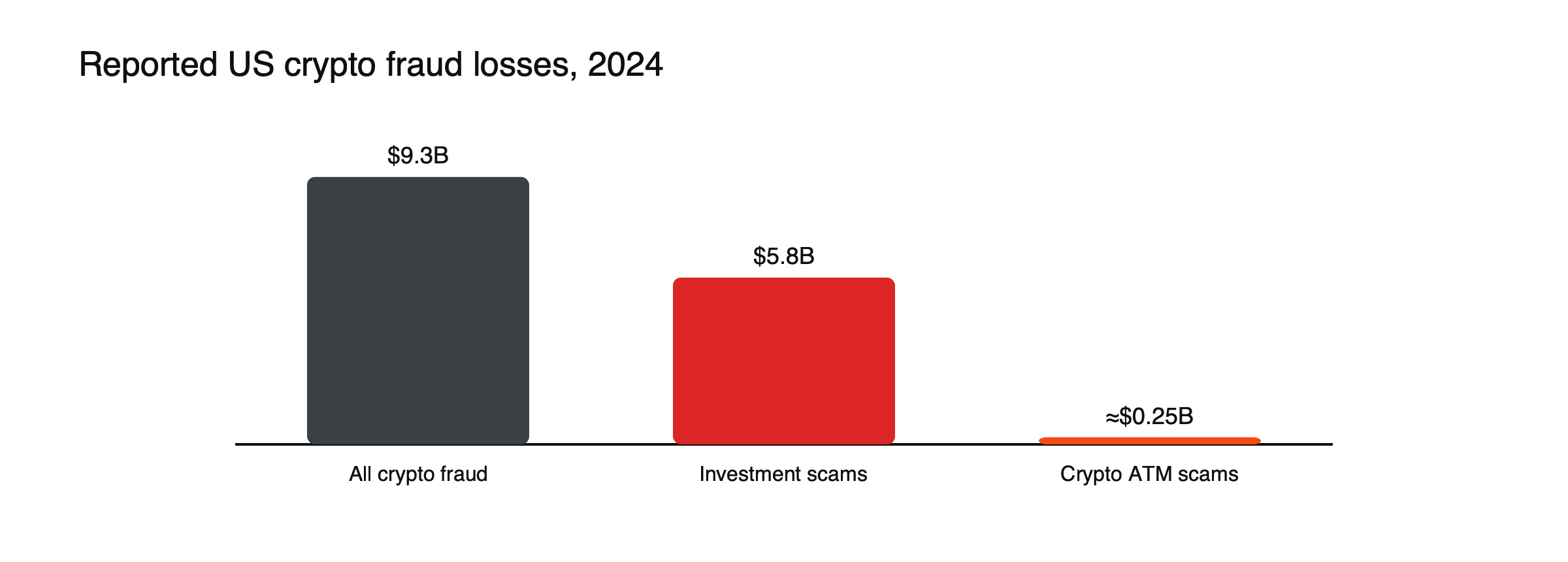
Figure: Investment scams are the largest share of reported crypto fraud losses. Source: FBI IC3 2024 report via The Block.
This is the single largest source of losses. The pattern is consistent: someone met online, through a dating app, a wrong-number text or social media, builds a friendly relationship over days or weeks. Eventually they mention their own trading success and guide the victim to a platform where an account shows impressive profits. The victim deposits more. When they try to withdraw, the platform demands “taxes” or “fees” first, which are stolen too. The site was fake from the start.
Use only platforms you found yourself and can verify, and treat anyone who contacts you first about investing as a likely scammer, however long you have been talking. Real investment professionals do not recruit clients through dating apps or wrong-number texts. See crypto scam warning signs.
Buying what is trending without research
A token rising fast and talked about everywhere feels like a chance not to miss. Late buyers in these surges often end up holding the losses when attention moves on. More than half of the tokens CoinGecko tracked since 2021 had stopped trading by the end of 2025. Before buying, check liquidity, supply, who holds the tokens and whether anything actually needs them, and decide in advance what would make you sell. See why most cryptocurrencies fail.
Ignoring how a platform holds your assets
Leaving all your crypto on one platform without reading how customer assets are safeguarded exposes the whole balance if that platform fails or freezes withdrawals. Crypto that is not a security is not covered by SIPC in the United States. Understand custodial vs non-custodial wallets and decide how much to keep where.
When you move coins
Sending on the wrong network or without a memo
Many tokens exist on several networks. Sending on one the receiving platform does not support, or skipping a required memo or destination tag, can lose funds or leave them stuck for weeks. Match the network on both sides, add any memo shown and send a small test first. See how to choose the correct blockchain network.
Copying an address from your history
Scammers send tiny transactions from addresses that look almost identical to ones you use, hoping you will later copy the wrong one from your transaction history. Always copy addresses from the source, check the full string rather than the first and last few characters, and use an address book for regular destinations. See what address poisoning is.
Sharing a seed phrase or private key
Recovery phrases get typed into fake “wallet validation” forms, websites and chats with fake support staff. Whoever has the phrase controls the funds, and the theft cannot be reversed. Never share a seed phrase or enter it anywhere except the wallet itself when restoring it. See seed phrase mistakes.
When you trade
Using leverage before understanding it
Trading with borrowed money multiplies a small balance and its losses. A move of a few percent against a leveraged position can trigger liquidation and lose the whole margin, and crypto’s swings make that happen quickly. Learn on unleveraged positions first and size any trade so that a large move is survivable. See what a liquidation price is.
Paying more than you need to
Convenient routes, such as crypto ATMs and instant-buy buttons, often carry markups far above an exchange’s fees, and frequent trading multiplies every cost. Compare the total cost with the market price before each purchase, and check whether the price you are quoted includes a hidden spread.
Chasing losses
After a losing trade, the urge to win it back quickly leads many beginners to trade larger, more often or with leverage. That turns one manageable loss into a series of bigger ones. Setting a maximum loss for a day or a week, and stopping when you reach it, breaks the cycle. See how to keep a trading journal.
After you buy
Not keeping records
Trading across several apps and wallets without saving histories makes it impossible to prove what you paid when you sell. That can mean overpaying tax or struggling to answer questions from a tax authority. A simple quarterly routine is enough; see how to keep records of your crypto transactions.
Skipping the backup
People who move to their own wallet sometimes store the recovery phrase only as a screenshot or on a single piece of paper. A lost phone, a fire or a cloud account breach can then mean losing everything. Keep the phrase offline, in more than one secure place, and never in photos or email.
Falling for a recovery scam
People who have already lost money are targeted again. Fake “recovery agents,” lawyers or investigators offer to trace and return stolen crypto for an upfront fee, sometimes claiming to work with law enforcement. They are usually part of the same networks that ran the original fraud. Real authorities do not charge victims to investigate, and no legitimate service can guarantee recovery of crypto sent on a blockchain. Report losses to the police and, in the United States, to the FBI’s Internet Crime Complaint Center instead.
Leaving tax until the end of the year
Many beginners trade all year and only think about tax when a form arrives. By then, platform histories may be incomplete and the values of old swaps hard to rebuild. In many countries, swapping one coin for another counts as a sale, so even someone who never cashed out can have taxable gains. Recording transactions as you go is far easier, and far cheaper, than reconstructing them later.
A short checklist before every crypto action
- Did I find this platform or opportunity myself?
- Is the network, address and memo checked against the source?
- Would I be fine if this position fell by half?
- Do I know the total cost, including spread?
- Have I recorded the transaction?
For the beliefs behind many of these mistakes, read crypto myths beginners still believe. For the basics, see what cryptocurrency is.
This article is educational content and does not constitute financial, investment, legal or tax advice. Digital assets are volatile and you may lose the amount you invest.