
Crypto Myths Beginners Still Believe
The crypto myths that cost beginners most, from "my exchange balance is insured" to "it always comes back": what people believe, why it hurts and what is true.

The costliest of the crypto myths is that coins held on a platform are protected the way bank deposits or brokerage accounts are. In most cases they are not, and that belief shapes how much people keep where. The other myths below each lead to a specific, avoidable loss.
Where these myths come from
Most crypto myths are borrowed from somewhere else. People bring assumptions from banking, where deposits are insured and payments can be reversed, or from stock investing, where listed companies are vetted and broad markets tend to recover. Crypto looks similar on a screen, with balances, charts and buy buttons, but the rules underneath are different. Other myths come from the industry’s own marketing, and a few from its critics. Sorting them by theme makes it easier to see which instinct each one exploits.
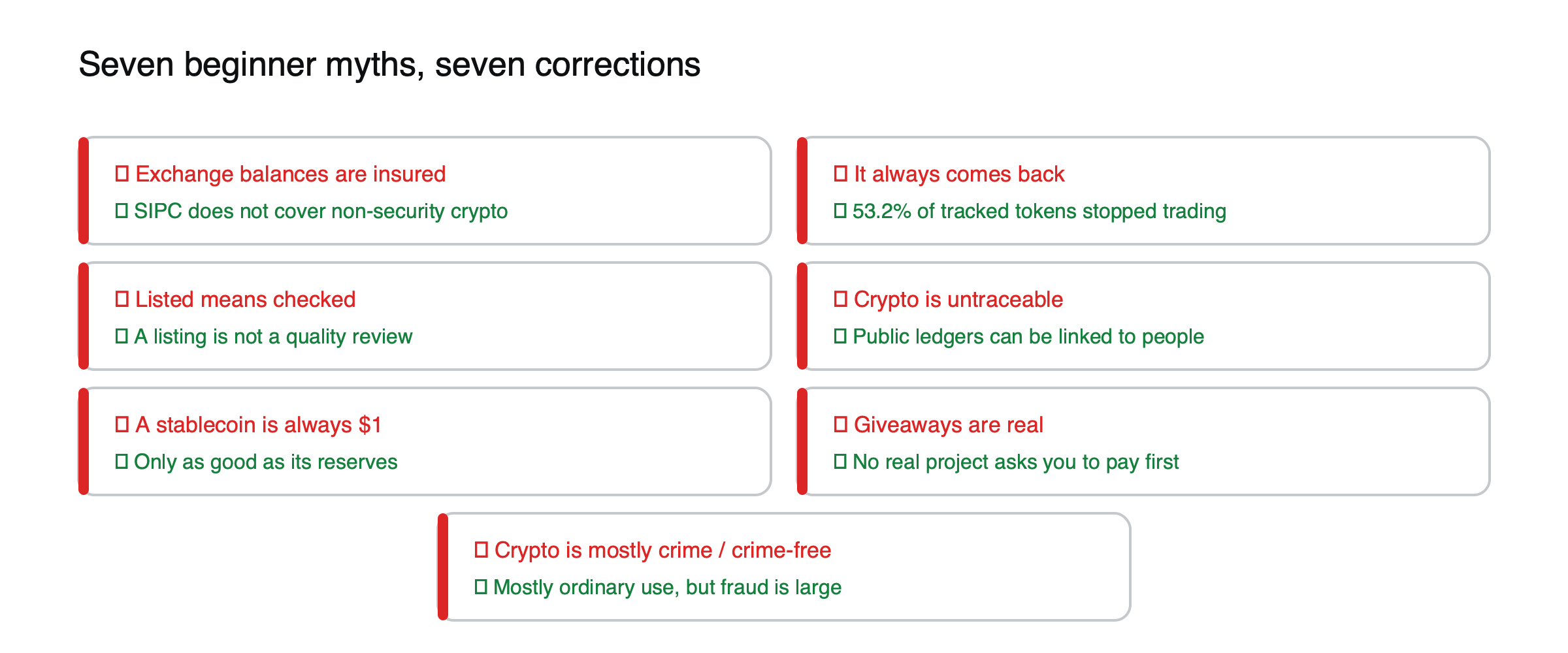
Figure: The seven myths in this article and the short version of what is true.
Myths about safety
“My crypto on an exchange is insured like a bank account”
Bank deposit insurance covers bank deposits. In the United States, the Securities Investor Protection Corporation (SIPC) protects securities and cash at failed member brokers, and it states plainly that crypto assets that are not securities are not covered, even when held at a member firm. Some exchanges hold reserves or buy private insurance, but the terms vary and usually cover specific events such as hacks, not the exchange itself going under. No scheme anywhere protects against a fall in price.
The practical consequence is simple: a balance on an exchange is a claim on that company. How much you keep there should depend on how much you trust its safeguards, which is why understanding custodial vs non-custodial wallets matters.
“If an exchange lists it, it has been checked”
A listing means a token can be traded on that platform, not that its team, code or token supply has been examined. Standards vary widely, and some platforms list new tokens within days of launch. Treat a listing as access, not approval, and do your own checks using a guide such as how to research a crypto asset.
“A stablecoin is always worth exactly $1”
A stablecoin is only as stable as its reserves, its issuer and its redemption process. Several have traded below $1, some for hours and some permanently. In March 2023, USDC briefly fell to about $0.87 when part of its reserves was caught up in a bank failure; TerraUSD, which relied on an algorithm instead of reserves, collapsed entirely in May 2022. See stablecoin risks.
Myths about price
“It always comes back”
Bitcoin has recovered from declines of 77% and 84%, which is where this belief comes from. But bitcoin is one asset with a long record. CoinGecko classed 53.2% of the tokens it tracked since 2021 as failed by the end of 2025, meaning they had stopped trading altogether. For small tokens, recovery is the exception. Even for large ones, a recovery can take years, and a 77% fall needs a gain of about 335% just to get back to where it started.
“You need to buy a whole coin”
Many beginners think a bitcoin priced at tens of thousands of dollars is out of reach. In fact, cryptocurrencies are divisible: one bitcoin is made up of 100 million units called satoshis, and most platforms let you buy a small fraction. The price per coin says nothing about whether an asset is cheap or expensive. What matters is the total value of all coins and how much of it you hold.
“A low price per coin means more room to grow”
This is the mirror image of the previous myth. A token priced at a fraction of a cent can have trillions of units, giving it a total value as high as much larger projects. Comparing prices per coin across different tokens is meaningless; comparing market values and supply schedules is not.
Myths about holding your own coins
“A hardware wallet keeps me safe from everything”
A hardware wallet protects your private keys from malware on your computer, which is a real and important benefit. It does not protect you from approving a malicious transaction, sending funds to a scammer, or typing your recovery phrase into a fake website. Most thefts from self-custody happen through those routes, not through someone breaking the device. The wallet signs whatever you confirm, so the final check is still yours. See how to set up a hardware wallet.
“If I lose my phone, my crypto is gone”
Your coins are recorded on the blockchain, not stored in the phone. A self-custody wallet can be restored on a new device from its recovery phrase, which is why that phrase matters so much. The real risk is the reverse: losing the phrase, or letting someone else see it, while the phone itself is easily replaced. See how to back up a seed phrase.
Myths about privacy and crime
“Crypto is untraceable”
Most blockchains are public ledgers. Every transaction is visible, and addresses can be linked to identities through exchange records, reused addresses and transaction patterns. Tax authorities and investigators routinely trace funds this way. See is Bitcoin anonymous.
“Crypto is mostly used for crime” and “crypto is crime-free”
Both extremes are wrong. Most crypto activity is ordinary trading and transfers, but fraud is large and growing. The FBI’s complaint center recorded about $9.3 billion in crypto-related fraud losses in 2024, a 66% increase on the year before. Believing the first myth leads people to dismiss the technology; believing the second leads them to drop their guard.
Myths about free money
“Giveaways and doubling offers are real”
A video or post shows a famous person or project promising to send back twice what you send. The money sent is gone. No legitimate project asks you to send crypto in order to receive more, and real token distributions, such as airdrops, never require a payment or your seed phrase.
Testing a claim before you believe it
When a new claim sounds convincing, three questions usually expose a myth. Who carries the risk if this goes wrong: you, a company or a government scheme? Can the claim be checked on the blockchain or in a company’s published terms? And who benefits if you believe it? A claim that cannot survive those questions is not worth acting on.
For the questions behind these myths, start with what cryptocurrency is. For myths specific to Bitcoin, read Bitcoin myths, and for the practical errors these beliefs lead to, beginner crypto mistakes.
This article is educational content and does not constitute financial, investment, legal or tax advice. Digital assets are volatile and you may lose the amount you invest.
Sources
- What SIPC Protects (crypto assets that are not securities are not protected) — SIPC
- Over Half of All Crypto Tokens Are Now Dead: CoinGecko Report (53.2% failed) — CryptoPotato via KuCoin, January 2026
- Bitcoin Down 47% From $126,000 Peak (2018 −84%, 2022 −77%) — Analytics Insight, February 2026
- FBI says Americans over 60 lost nearly $3 billion to crypto scams in 2024 ($9.3 billion total, +66%) — The Block, April 2025
- USDC regained its dollar peg (low of $0.87, March 2023) — FXStreet
- How an algorithmic stablecoin wiped out $40 billion (TerraUSD, May 2022) — Netcoins