
How to Keep Records of Your Crypto Transactions
Track every crypto buy, sale, transfer and reward with the right details so tax time and disputes are easy: a step-by-step routine, what to record and where.
Good crypto transaction records let you work out your gains and losses, answer questions from a tax authority and prove ownership if something goes wrong. By the end of this guide you will have a routine that captures every buy, sale, swap, transfer and reward, with the value in your local currency at the time it happened.
What counts as a transaction
Record anything that changes what you own or where it is held:
- Buying crypto with money, and selling crypto for money.
- Swapping one coin for another, including stablecoins.
- Paying for goods or services with crypto.
- Receiving crypto as income, staking rewards or an airdrop.
- Moving crypto between your own wallets and accounts.
- Fees paid in crypto, including network fees on transfers.
Transfers between your own wallets are usually not taxable, but they must be recorded. Without them, a later sale can look as if it came from coins you never bought, and coins arriving in a wallet can look like income.
The details to capture
| Field | Example |
|---|---|
| Date and time, with time zone | 2026-03-14 09:42 UTC |
| Type | Sale, swap, transfer, reward |
| Asset and amount | 0.25 ETH |
| Value in your currency at the time | $812.40 |
| Fees | 0.0004 ETH plus $2.10 |
| Platform or wallet | Exchange account, hardware wallet |
| Transaction ID | The hash shown on a blockchain explorer |
| Note | “Moved to cold storage” |
The example values are illustrative. The time zone matters more than it seems: a trade made late in the evening in one country can fall on a different date, or even a different tax year, in UTC.
Why cost basis decides your tax
Your cost basis is what you paid for an asset, including fees. When you sell, the gain or loss is the sale value minus that basis, and the method you use to match sales with purchases can change the result a great deal.
Suppose you buy 1 ETH at $2,000 and later another 1 ETH at $3,000, then sell 1 ETH for $3,500. (Example values.)
| Method | Which purchase is matched | Gain |
|---|---|---|
| First in, first out | The $2,000 purchase | $1,500 |
| Specific identification | The $3,000 purchase | $500 |
Same trade, same price, a threefold difference in the taxable gain. Which methods are allowed, and what records you need to use them, depends on your country’s rules. Specific identification in particular usually requires records showing exactly which units were sold, which is only possible if you kept them at the time.
Where records come from
Platforms. Download the full transaction history from every exchange and app at least once a quarter, and again before closing any account. Platforms change export formats, limit how far back you can go and occasionally shut down. Keep the original files unchanged and work from copies.
Your own wallets. Self-custody wallets have no account statement. Save the transaction ID for every send and receive, and use a blockchain explorer to confirm dates and amounts. Label your own addresses so transfers between them are easy to recognize later.
Bank statements. Deposits to and withdrawals from exchanges confirm the money side of each purchase and sale.
Reconciling with the forms you receive
Tax authorities increasingly receive data directly from platforms. In the United States, brokers report the gross proceeds of crypto sales on Form 1099-DA starting with sales in 2025, and must also report cost basis for covered assets on sales from 2026. Because basis is missing from the 2025 forms, your own records decide the gain you report for that year. In the European Union, the DAC8 rules extend reporting by crypto service providers; see DAC8 crypto reporting.
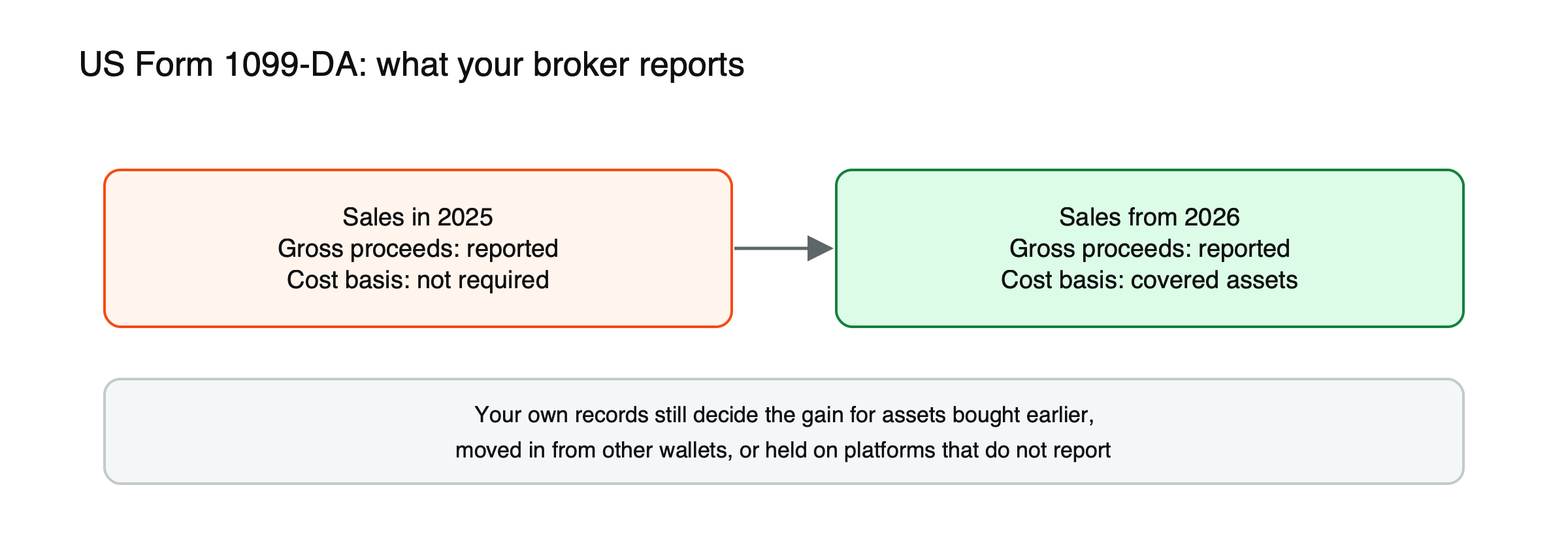
Figure: What the broker reports versus what you must track yourself. Source: IRS instructions for Form 1099-DA.
When a form and your records disagree, the usual causes are transfers in from another wallet, which the platform sees as coins with no known cost, and fees counted differently. Your records are what let you explain the difference.
The gaps that cause the most trouble
- Swaps in decentralized apps, which leave only a blockchain trail and no statement.
- Bridges between networks, where the same coins appear to leave one chain and arrive on another.
- Staking rewards and airdrops, which are often small, frequent and easy to miss.
- Closed or failed platforms, whose histories cannot be downloaded after the fact.
Records for DeFi and NFT activity
Activity in decentralized apps leaves more entries than most people expect. Providing liquidity to a pool, for example, can involve depositing two tokens, receiving a pool token, earning fees and later withdrawing a different mix of the two original tokens. Minting or buying an NFT involves a payment, a network fee and the token itself, and selling it later creates a gain or loss against that total cost. Network fees paid along the way are part of what an asset cost you, so record them alongside each action rather than as a separate expense. Labeling each transaction hash with what you were doing at the time saves hours of reconstruction later.
Choosing a tool
A spreadsheet works for a few buys and sells a year. Beyond that, crypto tax software saves time. Useful features include importing histories from exchanges by file or API, importing wallet addresses directly from blockchains, recognizing transfers between your own accounts, supporting the cost-basis methods your country allows and producing reports with a clear trail back to each transaction. Whatever you use, keep the original exports, because software can misclassify transactions and you will need the raw data to correct it.
How long to keep records
Keep records at least as long as your tax authority can review a return. In the United States, the IRS generally advises keeping records for three years from filing, six years if income was substantially underreported and seven years for certain losses, and longer for records that establish the cost of assets you still hold. For crypto bought years ago and still held, that means keeping the purchase records until several years after you finally sell.
A simple quarterly routine
- Export histories from every platform you used.
- Add wallet transactions from your own records and a blockchain explorer.
- Mark transfers between your own accounts.
- Check that balances in your records match what you actually hold.
- Store one copy offline and an encrypted copy in the cloud.
Records should never include seed phrases or private keys. Many tax authorities can review returns several years back, so keep records at least as long as your local rules require. Spreadsheets work for a handful of trades; crypto tax software helps once you have many wallets or frequent swaps.
If your records have gaps
Start from what you can prove: exchange exports, bank statements and blockchain explorers. Rebuild missing transactions with dates and amounts, use historical prices from a reputable data source for values, and note where you estimated. A documented reconstruction is far better than none, and a tax professional familiar with crypto can help with complex histories.
For the selling side, read how to convert crypto to cash. For the basics, see what a crypto transaction is and what cryptocurrency is.
This article is educational content and does not constitute financial, investment, legal or tax advice. Digital assets are volatile and you may lose the amount you invest.
Sources
- Instructions for Form 1099-DA (2025: gross proceeds mandatory, basis voluntary; 2026 and beyond: basis for covered securities) — IRS
- What to Expect From Form 1099-DA in 2026 and How to Prepare — Gordon Law Group
- How long should I keep records? (three, six and seven years; records relating to property kept until the period of limitations expires for the year of disposal) — IRS