
DeFi Lending vs Centralized Crypto Lenders
DeFi lending runs on smart contracts; centralized lenders like Celsius took custody of deposits. Compare transparency, control, risks and what happened in 2022.
The core difference in DeFi vs CeFi lending is who controls the money. In DeFi, smart contracts hold deposits and anyone can check loans on-chain. Centralized lenders, such as Celsius, held customer crypto and lent it as they chose. In 2022, several froze withdrawals and went bankrupt while the main DeFi protocols kept running.
How centralized crypto lenders worked
Customers deposited crypto with a company and were promised interest. The company decided where to put the money: loans to trading firms, DeFi strategies or its own investments. Customers could not see these positions, and their deposits sat on the company’s balance sheet.
How DeFi lending works
Deposits go into public smart contracts. Every loan is overcollateralized and visible on-chain, rates are set by formulas, and undercollateralized positions are liquidated automatically. Our guide to how DeFi lending works explains the mechanics.
Side by side
| Centralized lender | DeFi lending protocol | |
|---|---|---|
| Who holds funds | The company | Smart contracts |
| Transparency | Company disclosures | Every position on-chain |
| Loans | Company’s choice, sometimes uncollateralized | Overcollateralized, by rule |
| When stress hits | Company can freeze withdrawals | Liquidations run automatically |
| Main risks | Mismanagement, fraud, bankruptcy | Code bugs, oracles, liquidations |
| Support and recourse | Customer service; bankruptcy claims | Usually none |
What 2022 showed
- June 13, 2022: Celsius, which had about $12 billion in assets and around 2 million customers in May, paused withdrawals, citing extreme market conditions.
- Late June: trading firm Three Arrows Capital defaulted, including on a loan of about $720 million from Voyager Digital.
- July 6: Voyager filed for bankruptcy.
- July 13: Celsius filed for bankruptcy. In the month before, it had repaid more than $900 million it owed to DeFi protocols Aave, Compound and MakerDAO to recover its collateral.
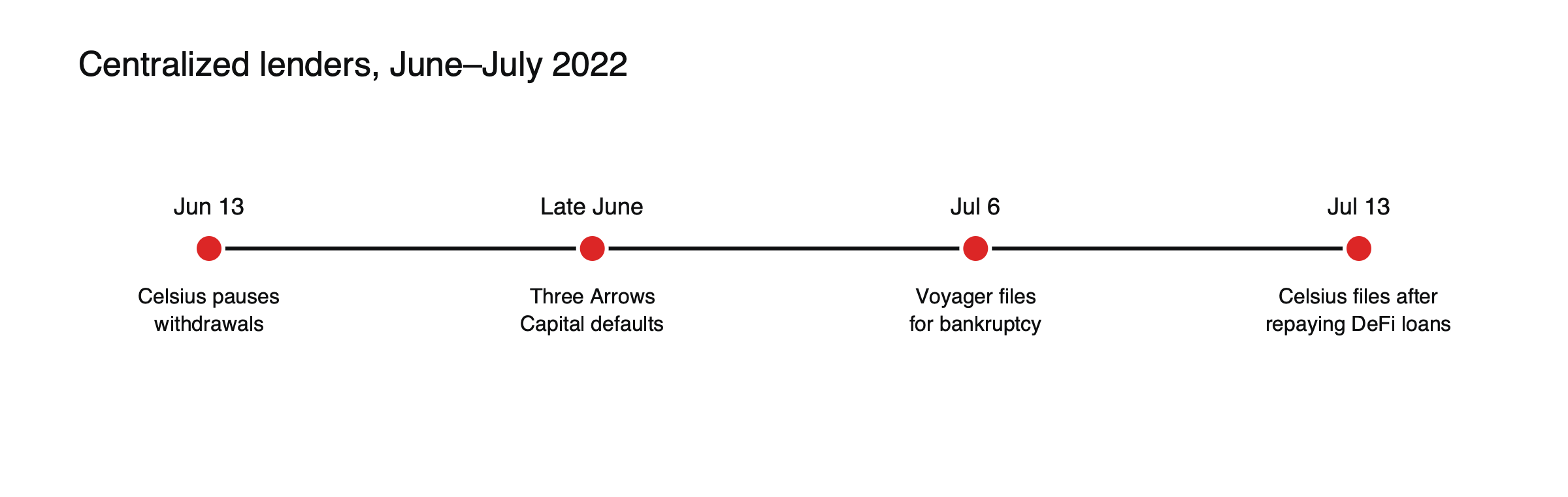
Figure: How centralized lenders failed in mid-2022.
The same month, two outcomes
The contrast in mid-2022 was stark. Celsius held about $12 billion of assets and served around 2 million customers in May. In the weeks before its bankruptcy, it repaid more than $900 million to the DeFi protocols Aave, Compound and MakerDAO to recover the collateral it had posted there, because those loans were enforced automatically and would otherwise have been liquidated. Its own customers, whose deposits had funded the company’s activities, were left waiting in bankruptcy proceedings. The same company was, at the same moment, a borrower that had to repay DeFi in full and a lender that could not repay its customers.
Why the DeFi lenders were repaid
The DeFi protocols were repaid in full because their loans were overcollateralized and enforced by code. Celsius’ own customers became creditors in a bankruptcy.
Where DeFi carries its own risks
“DeFi is safer” holds for custody and transparency, but DeFi has its own failures: smart contract hacks, oracle errors and governance attacks can drain funds with no one to appeal to. Centralized platforms can offer customer support, recovery of lost access and, where regulated, legal protections. Neither model is risk-free; they fail in different ways.
Why centralized lenders paid more
Centralized lenders often advertised higher rates than DeFi protocols, and the reason explains their failures. To pay those rates, they lent customer deposits to trading firms with little or no collateral, invested in risky strategies and sometimes reused the same collateral several times. These choices earned more when markets were rising and lost far more when they fell. A rate noticeably above what overcollateralized DeFi lending paid was, in hindsight, a sign of risk being taken somewhere customers could not see.
What customers went through afterwards
When a centralized lender freezes withdrawals and files for bankruptcy, customers become creditors. Their claims are sorted, valued and paid out according to court-approved plans, a process that took years for the lenders that failed in 2022 and often returned only part of what customers believed they had. Some customers also faced attempts to claw back withdrawals made shortly before the collapse. By contrast, DeFi borrowers who were liquidated lost their collateral immediately, but the lenders in those pools were repaid by the protocol’s rules.
Hybrid options today
The line between the two models has blurred. Some exchanges and regulated firms offer earn products that publish proof of reserves, segregate customer assets or invest only in short-term government securities. Some DeFi protocols add permissioned pools for verified institutions. Each hybrid shifts the balance between trusting a company and trusting code, so the same questions about who holds the funds and what you could recover still apply.
A checklist for a centralized earn product
- Is the company licensed where you live, and by whom?
- Does it say what it does with your deposit, and does it lend to related parties?
- Are customer assets held separately from its own?
- Does it publish independent reports on its reserves and liabilities?
- What do the terms say about your rights if it becomes insolvent?
Questions that apply to both
Whichever model you use, a few simple questions cover most of the risk. Where exactly is my money right now, and who could move it? What would have to go wrong for me to lose it, and how likely is that? Can I check the answer myself, or am I relying on someone’s word? How quickly could I get my funds back if I wanted them tomorrow, and what would stop me? A centralized lender answers these through disclosures, regulation and its own reputation; a DeFi protocol answers them through public code, on-chain data and its track record. Neither answer is automatically better. The right choice depends on which kind of trust you are more comfortable placing, and on how much of your money you are prepared to place there at all. Splitting funds between the two, and keeping both amounts modest, is a reasonable way to avoid depending entirely on either one of them.
How to choose
Ask who holds your funds, whether you can verify their position, what happens if they stop withdrawals and what legal protections apply. For broader warnings, read crypto scam warning signs and what proof of reserves is. For the bigger picture, see what DeFi is.
This article is educational content and does not constitute financial, investment, legal or tax advice. Digital assets are volatile and you may lose the amount you invest.
Frequently asked questions
Are centralized crypto lenders still operating?
Some are, often with more disclosure and regulation than before 2022. Their terms and protections vary widely, so reading what happens to your deposit, and what happens if the company fails, matters more than the advertised rate.
Is DeFi lending protected by any deposit insurance?
No government deposit insurance applies. Some protocols keep reserve funds to cover shortfalls, and private cover products exist, but neither works like a bank guarantee.
Sources
- Crypto lender Celsius files for bankruptcy (paused withdrawals mid-June; repaid more than $900 million to Aave, Compound and MakerDAO) — Fortune, July 13, 2022
- Celsius files for bankruptcy after closing DeFi loans (halted June 13; ~$12 billion AUM, ~2 million customers) — Forkast, July 2022
- 3AC and Celsius timeline (Voyager’s ~$720 million loan to 3AC; Voyager bankruptcy July 6, 2022) — Future Nexus