
How to Use a DEX for the First Time
Swap tokens on a decentralized exchange safely: set up a wallet, verify the site and token, check price impact and slippage, approve carefully, then revoke.
To use a DEX safely, connect a self-custody wallet to the exchange’s real website, confirm the exact token contract, check price impact and slippage, approve only what you need and review the transaction before signing. Start with a small amount. Most first-time losses come from fake sites, fake tokens and unlimited approvals, not from the swap itself.
Before you start
- A self-custody wallet on the network you plan to use, with its recovery phrase stored offline.
- A small amount of the network’s coin for fees, such as ETH on Ethereum.
- The DEX’s official web address, typed yourself or taken from its official documentation.
Your first swap
Open the real site
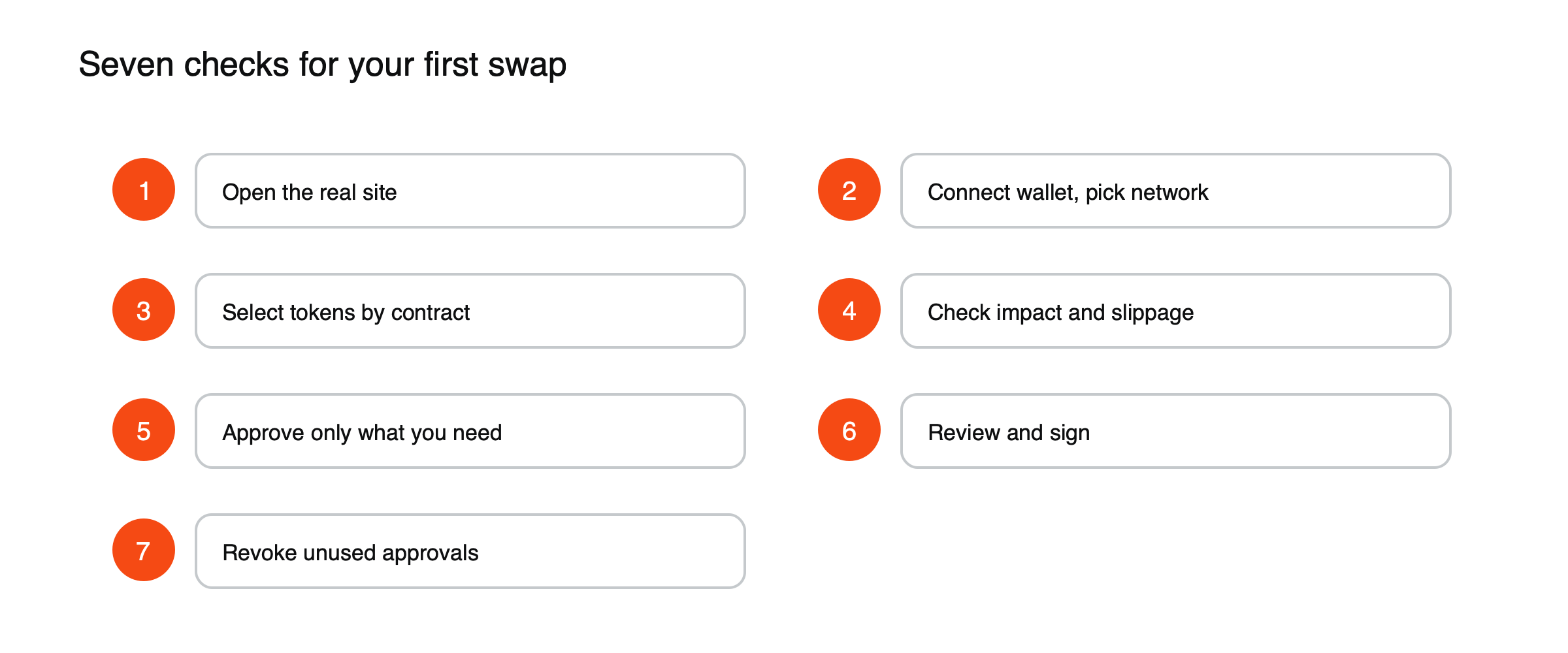
Figure: The seven checks for a first swap.
Fake exchange sites copy real ones and are promoted through ads and social media. Type the address yourself or use a saved bookmark. Our guide to spotting fake crypto exchange websites covers the warning signs.
Connect your wallet and pick the network
Connect your wallet and check that the DEX and your wallet are on the same network. Tokens on one network are not visible on another.
Select tokens by contract address
Anyone can create a token with any name. Copy the token’s contract address from the project’s official site or a trusted data page, and check that it matches exactly in the DEX before you swap.
Check the numbers
Before confirming, look at the price impact, slippage tolerance, minimum amount received and network fee. A high price impact means the pool is small for your trade size. Keep slippage tolerance low unless a token needs more; a high setting gives bots room to trade against you. See what slippage is.
Approve carefully
The first time you sell a token, the DEX asks for an approval that lets its contract move that token. Many interfaces default to unlimited approval. Where you can, approve only the amount you are swapping.
Review and sign
Read the wallet’s confirmation screen: the contract you are interacting with, the tokens and the amounts. Then sign and wait for confirmation. If the new token doesn’t appear, add it to your wallet using the same contract address.
Revoke approvals you no longer need
Approvals do not expire. Use your wallet’s settings or a block explorer’s token approval checker to remove ones you no longer use.
After the swap
Once the transaction is confirmed, check it on a block explorer using the link your wallet provides, and confirm that the tokens arrived. If a new token does not show in your wallet, add it using the same contract address you checked before buying, never one sent to you by someone else. Keep the receipt link.
Using a DEX on a layer 2 network
Many people make their first swaps on layer 2 networks, where fees are a fraction of Ethereum’s. The steps are the same, but your wallet must be set to that network and hold its fee token, and moving funds there means withdrawing from an exchange directly to the network or using a bridge.
Reading the swap screen
| What it shows | What it means |
|---|---|
| Price impact | How much your trade moves the pool’s price; high values mean the pool is small for your trade |
| Slippage tolerance | How far the price may move against you before the trade is cancelled |
| Minimum received | The least you will get if the price moves up to your tolerance |
| Route | Which pools or exchanges the trade passes through |
| Network fee | What you pay the blockchain to process the transaction |
A swap, worked through
Suppose you swap 500 USDC for ETH when ETH is worth $3,000, in a pool charging a 0.30% fee. (Illustrative figures.) Before fees, 500 USDC buys about 0.1667 ETH. The pool fee, about $1.50, leaves roughly 0.1662 ETH. With slippage tolerance set at 0.5%, the screen would show a minimum received of about 0.1653 ETH: if the price moves further than that before your transaction is included, the swap fails instead of filling at a worse price. Add the network fee, which can be a few cents on a layer 2 network or several dollars on Ethereum’s main chain at busy times.
Aggregators and single exchanges
A single decentralized exchange routes your trade through its own pools. An aggregator checks many exchanges and pools and may split your trade between them for a better overall price. For larger trades or less common tokens, aggregators often save money; for small swaps of major tokens, the difference is usually minor. Either way, the same checks on contract addresses, approvals and the swap screen apply.
When a transaction fails
Swaps fail for a few common reasons: the price moved beyond your slippage tolerance, the network fee was too low for a busy moment, or the token has unusual rules such as transfer taxes. On many networks you still pay the network fee for a failed transaction, because validators did the work of processing it. Raising slippage tolerance can make a swap go through, but high tolerance also invites bots to trade around your order, so raise it only when you understand why it is needed.
Protecting against front-running
Automated bots watch pending transactions and can buy just before a large swap and sell just after it, profiting from the price movement you cause, an attack known as a sandwich. Low slippage tolerance limits how much they can take. Some wallets and exchanges also offer protected transaction routing, which sends your swap privately so bots cannot see it before it is included. See what MEV is.
Common mistakes
- Buying a copycat token with the right name but the wrong address.
- Signing a request from a site you reached through a link.
- Leaving unlimited approvals on contracts you used once.
For the risks behind DEX trading, read centralized vs decentralized exchanges and what DeFi is.
This article is educational content and does not constitute financial, investment, legal or tax advice. Digital assets are volatile and you may lose the amount you invest.
Frequently asked questions
Do I need an account to use a DEX?
No. You connect a self-custody wallet and trade directly from it. Some websites restrict access by country, but the underlying contracts accept any compatible wallet.
Why did I receive less than the quoted amount?
The quote is an estimate at the moment you open the swap screen. Price movement before your transaction is included, within your slippage tolerance, and fees taken by the pool can reduce what you receive.
Sources
- Smart Contract Interaction Security (verify contract addresses; approval hygiene; revoke unused approvals; slippage) — Security Alliance
- Token Approval (how approvals work; unlimited approval risk; fake frontends) — Spark
- How to Swap with Uniswap (check contract address; price impact, slippage, minimum received; limited approvals) — GTS