
What Is DeFi?
DeFi is financial services run by smart contracts on public blockchains: trading, lending and more without a bank. How it works, what it is for and the risks.
DeFi, short for decentralized finance, means financial services such as trading, lending and borrowing that run on smart contracts on public blockchains instead of through banks or brokers. Anyone with a compatible wallet can use them, at any hour. In exchange, users take on risks such as code bugs and hacks.
A short history
Decentralized finance grew out of Ethereum’s smart contracts. MakerDAO launched the DAI stablecoin in 2017, backed by crypto locked in contracts rather than by a bank. Uniswap followed in 2018 with a way to trade tokens through liquidity pools instead of order books. In the summer of 2020, protocols began paying users in their own tokens for lending, borrowing and providing liquidity, and money poured in. That period, known as DeFi Summer, set the template for much of what followed. Deposits peaked in late 2021, collapsed in the 2022 bear market amid failures and hacks, and later recovered partly through liquid staking and tokenized real-world assets. See what DeFi Summer was.
How DeFi works
A DeFi application is a set of smart contracts: programs on a blockchain, mostly Ethereum and its layer 2 networks, that hold funds and follow fixed rules. You connect a self-custody wallet, approve the contract to use your tokens and send a transaction. The contract executes the trade or loan automatically. No employee approves it, and no company holds your funds in between.
What a first DeFi transaction looks like
Suppose you want to swap $500 of USDC for ether on a decentralized exchange. You open the exchange’s website and connect your wallet, which only shares your address. Because USDC is a token, the exchange’s contract first needs your permission to move it, so your wallet asks you to sign an approval. Then you enter the swap; the site shows the expected amount of ether, the price impact and the network fee, and you choose how much the price may move before the trade fails, called slippage tolerance. You confirm in your wallet, the transaction is included in a block and the ether arrives in your wallet, minus fees. (Illustrative example.) No account was opened and no one approved you, but no one can reverse the trade either. See how to use a DEX.
Why DeFi apps connect to each other
Because the contracts are public, other applications can plug into them. A lending protocol can use a trading protocol’s prices, and a savings product can deposit into both. This is why DeFi apps are often called “money legos.”
What people use DeFi for
- Trading on decentralized exchanges, which use liquidity pools instead of order books. See what an automated market maker is.
- Lending and borrowing against crypto collateral, with interest rates set by supply and demand.
- Stablecoins, both as the main currency of DeFi and, in some cases, created by DeFi protocols themselves.
- Staking and liquid staking, such as liquid staking tokens that can be reused in other apps.
- Tokenized real-world assets, such as tokenized Treasury bills.
The main building blocks
Decentralized exchanges
Most decentralized exchanges use liquidity pools: users deposit pairs of tokens, and a formula sets prices as traders swap against the pool. Liquidity providers earn a share of fees but face impermanent loss when prices move. See what an automated market maker is and what impermanent loss is.
Lending markets
Lenders deposit tokens into a pool and earn interest; borrowers post more collateral than they borrow and pay interest set by demand. If collateral falls too far in value, it is sold automatically to repay the loan. See how DeFi lending works and what a health factor is.
Stablecoins and synthetic dollars
Dollar-pegged tokens are DeFi’s main unit of account. Some are issued by companies holding reserves; others are created by protocols against crypto collateral or through hedged positions. See centralized vs decentralized stablecoins.
Derivatives and structured products
Protocols also offer perpetual futures, options and vaults that run automated strategies. These add leverage and complexity, and with them, more ways to lose money quickly.
Where DeFi returns come from
Interest and rewards in DeFi come from somewhere. Lenders earn what borrowers pay. Liquidity providers earn trading fees. Stakers earn network rewards. On top of these, many protocols pay incentives in their own tokens, which can make advertised yields look far higher than the underlying activity supports. When the incentives end, those yields usually fall sharply. Knowing which part of a return comes from real activity and which from token emissions is one of the most useful habits in DeFi. See where DeFi yield comes from.
How big it is
The value deposited in DeFi protocols, called total value locked, peaked near $177 billion in late 2021, then fell more than 70% by July 2022. In 2026 it fell from about $115 billion in January to around $70 billion by late June, as crypto prices dropped and hacks hit confidence.
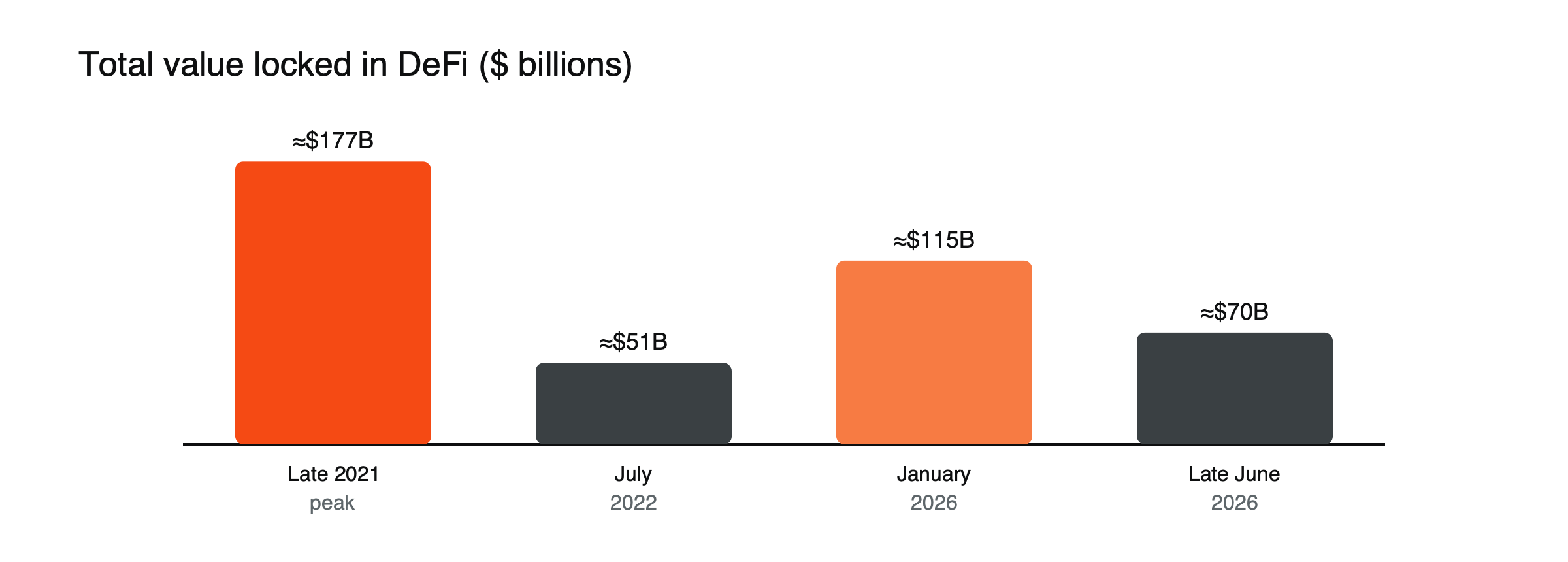
Figure: DeFi total value locked at selected dates. Sources: CryptoRank via Cointelegraph and The Cryptonomist, June 2026.
DeFi vs traditional finance
| Traditional finance | DeFi | |
|---|---|---|
| Access | Accounts, identity checks, opening hours | Any compatible wallet, any time |
| Who holds funds | Banks and brokers | Smart contracts; you hold your keys |
| Rules | Company policies and regulation | Code, plus governance votes |
| Mistakes and fraud | Reversals and protections sometimes possible | Transactions usually final |
The main risks
- Smart contract bugs and hacks: CryptoRank counted 121 hacks and about $942 million in losses in the first half of 2026.
- Price and liquidation risk when borrowing against volatile collateral.
- Oracle risk: wrong price data can trigger wrong liquidations. See what a blockchain oracle is.
- Governance and admin keys: a small group may be able to change the rules.
- User error: wrong approvals or fake sites can drain a wallet.
What total value locked does and does not tell you
Total value locked, the headline measure of DeFi’s size, adds up the value of tokens deposited in protocols. It rises and falls with crypto prices even when no one moves any funds, and the same tokens can be counted more than once when deposited in one protocol and then reused in another. It is a useful rough gauge of activity, but fees paid, active users and borrowing demand say more about whether protocols are actually being used. See what TVL is.
Costs of using DeFi
Using DeFi costs more than the advertised rates suggest. Every transaction pays a network fee, which can be a fraction of a cent on some networks and several dollars on Ethereum’s main chain at busy times. Swaps lose a little to price impact and slippage, and protocols take their own fees. Moving funds between networks adds bridge fees and risk. For small amounts, these costs can outweigh the yield, which is why many people use DeFi on lower-fee networks or only for larger, less frequent transactions.
DeFi beyond Ethereum
Ethereum still hosts the largest share of DeFi, but many applications run on its layer 2 networks and on other blockchains such as Solana and BNB Chain, often with lower fees. Each network has its own versions of exchanges, lending markets and stablecoins. Using several networks widens your options but adds the risks of bridges and of keeping track of assets in different places. See layer 1 vs layer 2.
Lessons from DeFi’s failures
DeFi’s history includes painful lessons. In 2022, the collapse of TerraUSD and its high-yield savings protocol wiped out tens of billions of dollars and spread losses across the industry. Bridges between blockchains became prime targets for hackers, and some of the largest crypto thefts on record involved them. Lending protocols have suffered when price feeds failed or collateral could not be sold fast enough. The common thread is that complexity, leverage and connections between protocols can turn a single failure into many. See what happened in the TerraUSD collapse and the Ronin bridge hack.
Who actually runs DeFi
Smart contracts run automatically, but people still shape them. Development teams write and upgrade the code, often through contracts with admin keys. Many protocols hand control over parameters and treasuries to token-holder votes, usually through a DAO. Websites, which most users rely on, are run by companies or individuals who can change or restrict them. And oracles, bridges and stablecoin issuers outside the protocol can all affect it. “Decentralized” therefore describes a spectrum: it is worth asking, for any protocol, who can change what and how quickly. See what a DAO is.
Rules and regulation
Regulators have taken different approaches. Many focus on the businesses around DeFi, such as companies that run front ends, issue stablecoins or operate centralized on-ramps, rather than on the contracts themselves. In the European Union, services provided in a fully decentralized way are generally outside the main crypto-asset framework, but where a person or company controls the service, rules can apply. The boundary between a decentralized protocol and a business offering it is still being defined in many places.
A safer first setup
- Use a separate wallet for DeFi, holding only what you plan to use.
- Start with small amounts and large, established protocols.
- Check every approval your wallet asks for, and revoke ones you no longer need.
- Bookmark official sites and avoid links from ads and messages.
- Know how to exit before entering, including fees and any lock-up periods.
How DeFi compares with exchanges
Centralized exchanges hold your funds and run order books; DeFi lets you trade from your own wallet. Our comparison of centralized vs decentralized exchanges covers the trade-offs, and what Web3 is explains the wider idea. For the network most DeFi runs on, see what Ethereum is.
This article is educational content and does not constitute financial, investment, legal or tax advice. Digital assets are volatile and you may lose the amount you invest.
Frequently asked questions
Do I need to register or pass identity checks to use DeFi?
Usually not for the protocols themselves, which accept any compatible wallet. Some websites restrict access by country, and moving money between DeFi and a bank still goes through regulated platforms with identity checks.
Is DeFi safer than a centralized exchange?
It removes the risk of a company misusing customer deposits, but adds smart-contract, oracle and user-error risks. Neither is automatically safer; the risks are different.
Can I lose more than I put in?
Generally no, but borrowing can lose your entire collateral through liquidation, and leveraged positions built across several protocols can fall faster than expected.