
What Was the Ethereum Merge?
On September 15, 2022, Ethereum swapped mining for proof of stake without stopping the chain. Learn how the Merge worked, what it changed and what it did not.
The Ethereum Merge was the upgrade on September 15, 2022, that switched Ethereum from proof-of-work mining to proof of stake. The original chain joined the Beacon Chain, a proof-of-stake network that had run alongside it since December 2020, at block 15,537,393. Ethereum’s energy use fell by an estimated 99.95%, and new ether issuance dropped sharply.
Why it was called a merge
Ethereum did not start a new chain. Its existing transaction history, balances and contracts, the execution layer, were attached to the Beacon Chain, which became the consensus layer. From that moment, validators staking ether rather than miners running hardware decided which blocks were added. Users did not need to do anything; their ether and tokens stayed where they were.
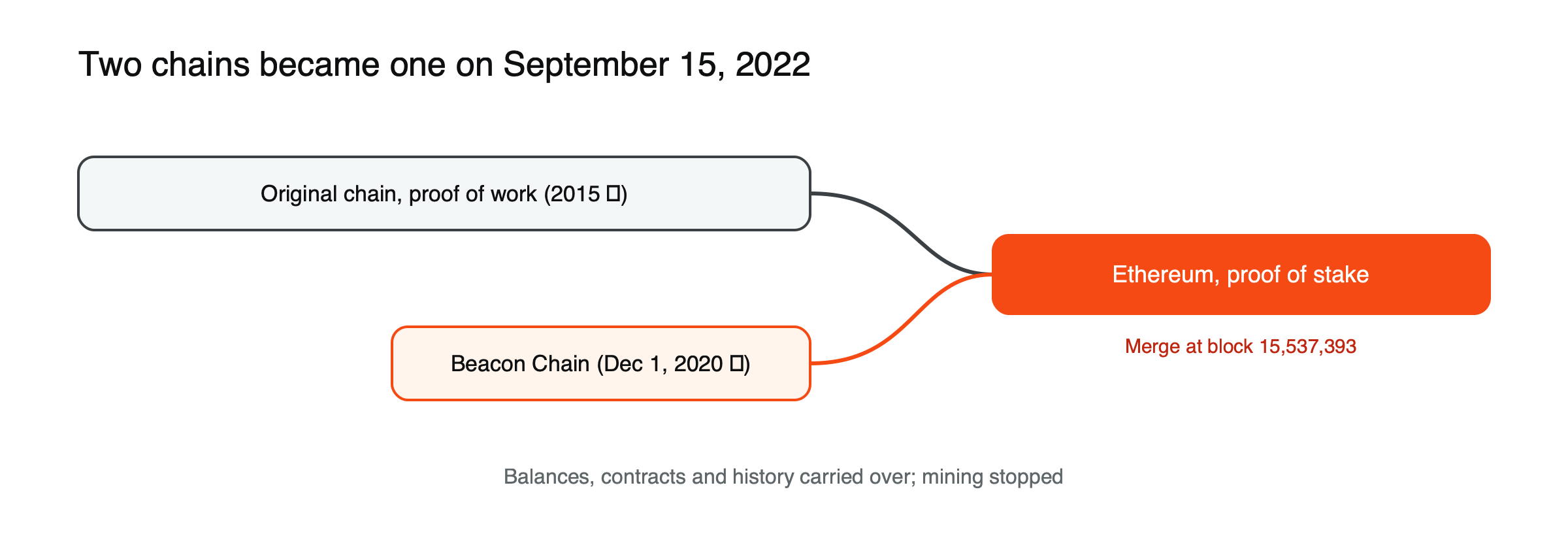
Figure: The execution layer (original chain) joined the consensus layer (Beacon Chain) without restarting.
Timeline
- December 1, 2020: the Beacon Chain launches as a separate proof-of-stake chain after receiving the 16,384 deposits of 32 ETH it needed. It does not yet process user transactions.
- August 5, 2021: the London upgrade introduces EIP-1559, which burns part of every fee.
- 2022: test networks complete their own merges as rehearsals.
- September 15, 2022: the Merge activates once the proof-of-work chain reaches a preset total difficulty, at block 15,537,393.
- After the Merge: a later upgrade, Shanghai-Capella, lets stakers withdraw their ether, which had been locked since 2020.
A switch planned for years
Proof of stake had been part of Ethereum’s plans almost from the start, and the change was repeatedly delayed as researchers worked through the design. To keep pressure on the transition, Ethereum’s mining rules included a “difficulty bomb,” a mechanism that would gradually make mining slower and less attractive. Several upgrades before the Merge pushed the bomb back while the proof-of-stake system matured. The Beacon Chain itself ran for almost two years, from December 2020, with real ether at stake but without processing user transactions, effectively a long live test before the switch.
The switch happened in two steps
The Merge was delivered as two coordinated upgrades. Bellatrix upgraded the consensus layer on September 6, 2022, at epoch 144,896, preparing Beacon Chain validators to take over block production. Paris upgraded the execution layer, the original Ethereum chain, and was set to trigger when the proof-of-work chain reached a terminal total difficulty of 58,750,000,000,000,000,000,000. That threshold was crossed at 06:42:42 UTC on September 15, 2022, and the next block was produced by a validator rather than a miner.
Developers used a total difficulty threshold rather than a block number for a security reason. A block number could be reached by a malicious miner building a separate, weaker chain; a difficulty threshold ensured the switch happened on the chain with the most accumulated work, the one honest miners were building.
The day itself
On September 15, the transition happened without any pause in the network. The last proof-of-work block was mined, the next block was proposed by a validator, and transactions kept flowing. Some exchanges briefly paused ether deposits and withdrawals as a precaution, and most users noticed nothing. Developers had defined success in advance: the Merge would be considered complete once the Beacon Chain finalized the first proof-of-stake block, which happened within minutes. Block production immediately settled into the new rhythm of one slot every 12 seconds, replacing the irregular timing of mining.
Rehearsals first
Before touching the main network, developers ran the same transition on Ethereum’s public test networks: Ropsten on June 8, 2022, Sepolia on July 6 and Goerli on August 10. The Goerli rehearsal exposed configuration problems that briefly knocked a share of validators offline, which gave node operators a final warning to check their setups. Only after the last test merge did developers set the mainnet dates.
What the Merge changed
Energy use. Mining required large amounts of electricity; proof of stake does not. Estimates put the reduction at about 99.95%. A network long criticized for its electricity use no longer needed specialized mining hardware at all; validators can run on ordinary computers, which removed one of the main objections environmentally focused investors had raised.
Issuance. New ether no longer had to pay for mining hardware and power. Issuance fell by roughly 87%, which, together with the fee burn, briefly made ether’s supply shrink.
Security model. Attacking Ethereum now means acquiring and risking staked ether rather than outspending miners on hardware. Our comparison of proof of work vs proof of stake explains the difference.
Block timing. Blocks moved to fixed 12-second slots instead of the variable timing of mining.
Did the Merge make ether deflationary?
For a while, it could. After the Merge, new issuance was small enough that, during busy periods, the ether burned through transaction fees outweighed the ether created, and the total supply shrank. Supporters coined the phrase “ultrasound money” for this, a play on calling bitcoin “sound money.” Whether supply grows or shrinks depends on activity on the main chain, not on any fixed rule. When the Dencun upgrade in March 2024 moved rollup data into cheaper blobs, fees on the main chain fell, less ether was burned and supply began growing again, though far more slowly than under proof of work. See how the ETH burn works.
New risks the Merge introduced
Proof of stake removed mining’s energy cost but brought different concerns. A large share of staked ether flows through a few exchanges and liquid staking protocols, raising questions about concentration. Validators face slashing and inactivity penalties that did not exist for miners. And staking reopened regulatory questions about whether earning rewards on ether resembles an investment. See Ethereum staking risks.
What it did not change
The Merge did not lower transaction fees or add capacity. Those depend on demand for block space and on scaling through layer 2 rollups. It also did not make ether a fixed-supply asset: after the Dencun upgrade in 2024 cut fee burning, supply grew again, as explained in how Ethereum’s fee burn affects ETH supply.
What happened to the miners
Overnight, Ethereum stopped paying miners. Operators of graphics-card mining rigs, who had been Ethereum’s block producers for seven years, had to point their hardware at other proof-of-work coins, where rewards were far smaller, or sell it. The Merge therefore shifted an entire industry: income that had gone to miners for electricity and hardware began going to people who staked ether instead.
What holders needed to do: nothing
The Merge changed how blocks were produced, not what anyone owned. Balances, tokens, contracts and addresses carried over automatically, and there was no new “ETH2” coin to claim. Scammers used the occasion to promote fake upgrade or swap services; anyone asked to send ether to “upgrade” it was being targeted. Stakers, on the other hand, had to wait: ether staked since December 2020 could not be withdrawn until the Shanghai-Capella upgrade in April 2023.
Why it mattered
Changing the consensus mechanism of a network securing hundreds of billions of dollars, without stopping it, had never been done at that scale. It ended the energy debate that had followed Ethereum, created the staking economy that now shapes ether’s market, and showed that a major blockchain can make deep changes through planned, coordinated upgrades rather than splits.
For how staking works today, read what proof of stake is. For the network as a whole, see what Ethereum is.
This article is educational content and does not constitute financial, investment, legal or tax advice. Digital assets are volatile and you may lose the amount you invest.
Sources
- The Merge (September 15, 2022; ~99.95% energy reduction) — ethereum.org
- The history of Ethereum (Beacon Chain genesis December 1, 2020; London; Capella withdrawals) — ethereum.org
- Ethereum timeline (16,384 deposits of 32 ETH; London August 5, 2021; Merge at total terminal difficulty) — Blockchain.com Explorer
- Ethereum network upgrades history (Merge at block 15,537,393) — crypto30xx
- Is Ethereum deflationary? (issuance dropped ~87% at the Merge) — growthepie
- Ethereum core developers suggest tentative dates for The Merge (Bellatrix at epoch 144,896 on September 6; TTD 58,750,000,000,000,000,000,000; Goerli merge August 10) — The Block, August 2022
- Paris fork upgrade schedule (Ropsten June 8, Sepolia July 6, Goerli August 10, mainnet September 15, 2022) — Ethereum Foundation execution specs
- Ethereum’s merge begins: a note on the Bellatrix upgrade (why TTD rather than block number) — Hashdex, September 2022
- Ethereum’s Merge now has tentative September dates (Goerli configuration issues) — CoinDesk, August 2022
- When did the ETH merge happen? (06:42:42 UTC, block 15,537,393) — CoinSwitch