
What Are Ethereum Rollups?
Rollups run transactions off Ethereum's main chain and post compressed data and proofs back to it. How they work, why fees are lower and what risks remain.
Ethereum rollups are layer 2 networks that execute transactions off the main chain, bundle them and post the compressed data, plus a way to check it, back to Ethereum. Users get much lower fees and faster confirmations, while Ethereum remains the final record. How safe a rollup is depends on how it proves its work and who controls it.
Why rollups exist
Ethereum’s main chain processes a limited amount of activity per block, and when demand is high, fees rise. Rollups move execution elsewhere but keep the data on Ethereum, so anyone can reconstruct the rollup’s state and challenge or verify it. That is the difference between a rollup and a separate chain connected by a bridge.
How a rollup works
- Users send transactions to the rollup, where a component called the sequencer orders them.
- The rollup executes them and updates its own balances and contracts.
- Batches are posted to Ethereum as compressed data. Since the Dencun upgrade on March 13, 2024, most rollups post this data in “blobs,” a cheaper data format that Ethereum nodes keep for about 18 days.
- Ethereum checks or allows challenges to the result, either through a validity proof or a challenge window, depending on the rollup type.
- Users can withdraw back to Ethereum, with timing that depends on that same design.
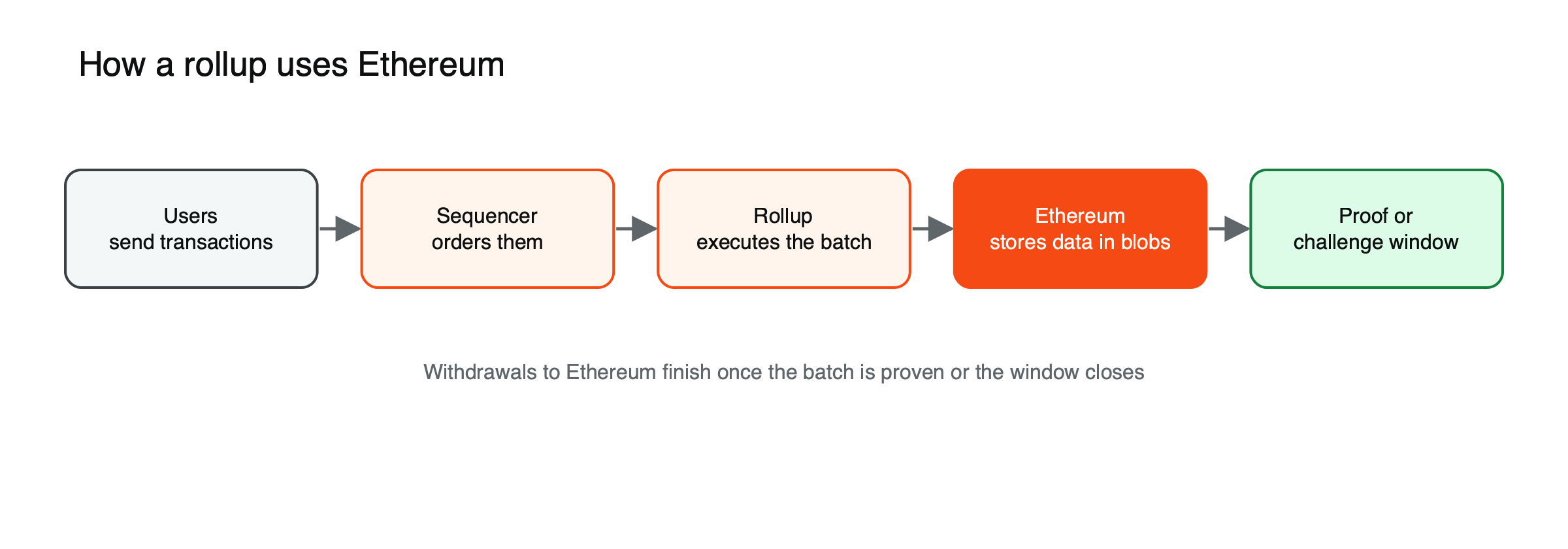
Figure: The path of a rollup transaction from user to Ethereum.
Two families of rollups
Optimistic rollups assume batches are correct and allow anyone to challenge them during a window of roughly seven days. Withdrawals through the official bridge wait for that window to close.
Zero-knowledge (ZK) rollups post a cryptographic validity proof with each batch, so Ethereum can verify the result directly. Withdrawals can complete once the proof is accepted.
The trade-offs between them are covered in optimistic rollups vs ZK rollups.
Why fees are lower
A rollup spreads the cost of posting to Ethereum across hundreds or thousands of transactions in one batch. Compression shrinks the data further, and blobs made that data far cheaper than ordinary transaction data. Users still pay a fee, but most of it covers the rollup’s own operation rather than Ethereum block space.
What risks remain
- Centralized sequencers: many rollups run a single sequencer, which can delay or reorder transactions, or stop for a time.
- Upgrade keys: teams that can upgrade rollup contracts could change the rules; safeguards vary widely.
- Proof systems still maturing: some optimistic rollups have limited or permissioned challenge systems, and ZK proof systems are complex.
- Bridges: moving assets between rollups often uses third-party bridges with their own risks, as the Ronin bridge hack showed.
- Fragmented liquidity: the same token can trade on many rollups with different prices and depth.
Using a rollup: deposit, use, withdraw
Depositing. The simplest route is the rollup’s official bridge: you send ETH or tokens to its contract on Ethereum, and they appear on the rollup, usually within minutes. Many exchanges also let you withdraw directly to a rollup, which skips the bridge and its Ethereum fee. Before using that option, confirm that the exchange supports the exact rollup you have chosen.
Using it. Once there, you use the same wallet and address as on Ethereum, and fees on most major rollups are paid in ETH. You need a small ETH balance on the rollup itself, separate from your balance on Ethereum.
Withdrawing. On a ZK rollup, the official bridge releases funds once the batch containing your withdrawal is proven. On an optimistic rollup, it waits out the challenge window of about a week. Third-party bridges and liquidity providers offer faster exits by fronting you the funds for a fee, which adds their own risk. Withdrawing to an exchange that supports the rollup directly avoids the wait altogether.
What a rollup fee pays for
A rollup fee has two main parts. One covers the rollup’s own work: executing your transaction and running the sequencer. The other covers your share of the cost of posting the batch’s data to Ethereum. Since Dencun, the second part is usually small, but it depends on demand for blob space across all rollups, so fees can rise even when the rollup you use is quiet. See what data availability is.
If the sequencer stops
A single sequencer is a single point of failure for day-to-day use. Well-designed rollups include an escape route: if the sequencer ignores or censors a user, the user can submit a transaction directly through the rollup’s contract on Ethereum, which the rollup must then process after a delay. Some rollups also let users withdraw through Ethereum if the operator disappears entirely. Whether these routes exist, and how long they take, is one of the clearest tests of how much a rollup really relies on its operator.
Rollups and ether’s economics
Ethereum’s roadmap treats rollups as the main place for everyday activity, with the main chain acting as the settlement and data layer beneath them. That shift has a side effect on ether itself. Rollups pay Ethereum for data, not for the transactions they process, so a busy rollup ecosystem can coexist with low fees and a small burn on the main chain. Whether rollup growth ultimately strengthens or dilutes demand for ether is one of the most debated questions about Ethereum’s design. See how the ETH burn affects supply.
How to judge a rollup
Ask whether it has working fraud or validity proofs, who can upgrade its contracts and how quickly, whether users can force a withdrawal if the sequencer stops, and how long it has operated without incident. Independent trackers rate rollups on these points, and the answers differ more than marketing suggests.
For the general idea of layered scaling, read layer 1 vs layer 2. For why posting data matters, see what data availability is, and for the base network, what Ethereum is.
This article is educational content and does not constitute financial, investment, legal or tax advice. Digital assets are volatile and you may lose the amount you invest.
Frequently asked questions
Are my funds safe if the company behind a rollup fails?
On a mature rollup, users should be able to withdraw through Ethereum even if the operator disappears, because the data and the exit rules live on Ethereum. On rollups that still depend on their teams for upgrades or proofs, that guarantee is weaker, which is why the rollup’s maturity rating matters.
Do I need a different wallet to use a rollup?
Usually not. Most Ethereum wallets support major rollups; you add the network in your wallet and use the same address. Keep in mind that your balances on each network are separate.
Why does the same token look different on a rollup?
A token moved through a bridge may arrive as a bridged version rather than the issuer’s native token on that rollup, sometimes with a slightly different name. The two can trade at different prices and be accepted by different apps, so check which version an exchange or application supports before sending it.
Sources
- Scaling (layer 2 and rollups) — ethereum.org Developer Docs
- Optimistic Rollups (challenge period of roughly seven days) — ethereum.org Developer Docs
- Danksharding (blobs pruned after about 18 days) — ethereum.org
- Ethereum’s Dencun upgrade is making ETH inflationary again (Dencun live March 13, 2024; blobs) — The Block, May 2024