
What Is Slashing in Ethereum Staking?
Slashing destroys part of a validator's stake and forces it out for provably breaking Ethereum's rules. What triggers it, how it grows and how to avoid it.
Ethereum slashing is the penalty for a validator that provably breaks the protocol’s rules, such as signing two conflicting blocks. Part of its stake is destroyed, it is forced out of the validator set, and the loss grows if many validators are slashed around the same time. Ordinary downtime is not slashing; it costs only small missed-reward penalties.
What triggers slashing
Slashing applies to actions that could help attack the chain, not to honest mistakes like going offline:
- Double proposing: signing two different blocks for the same slot.
- Double voting: signing two different attestations for the same target.
- Surround voting: signing an attestation that contradicts an earlier one in a way that could support two competing histories.
Each of these leaves cryptographic evidence. Any validator that spots it can submit the proof, and the protocol applies the penalty automatically.
How the penalty works
- An initial penalty is taken from the validator’s balance as soon as the slashing is processed.
- The validator is forced to exit and cannot propose or attest again.
- A correlation penalty is applied later, scaled by how much total stake was slashed in the same period. A lone, accidental slashing costs relatively little; a mass slashing, which looks like a coordinated attack, can cost a validator most or all of its stake.
- The remaining balance is locked for about 36 days (8,192 epochs) before it can be withdrawn.
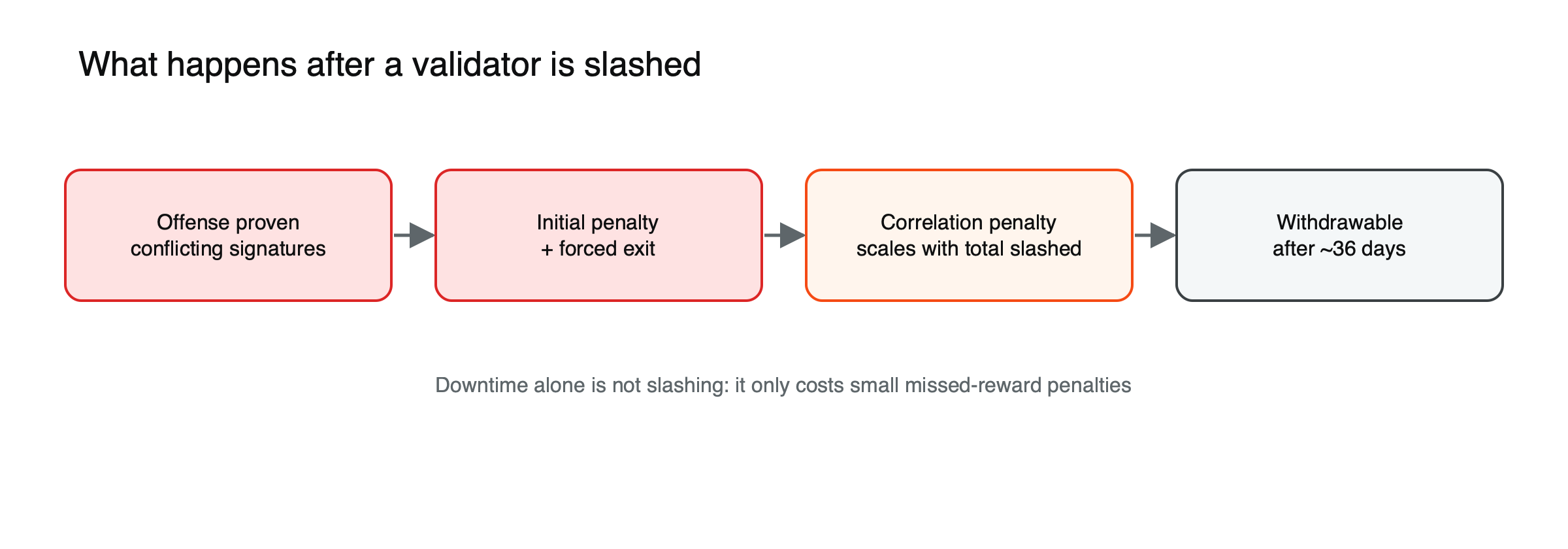
Figure: The sequence after a slashing. The correlation penalty can be small for a lone mistake or very large in a mass slashing.
How the correlation penalty scales
The correlation penalty is what makes slashing a deterrent rather than a fine. Under Ethereum’s rules since the Bellatrix upgrade, it is roughly three times the share of all staked ether that was slashed during the surrounding window, applied to the slashed validator’s balance and capped at the full balance. (Simplified illustration of the rule.)
| Share of all stake slashed in the window | Approximate correlation penalty |
|---|---|
| A single validator, by accident | Close to zero |
| 1% | About 3% of the balance, roughly 0.96 ETH on 32 ETH |
| 10% | About 30% of the balance |
| One-third or more | The entire balance |
The design is deliberate. An isolated mistake is cheap, because one misconfigured machine poses no threat to the network. A coordinated attack, which would need a large share of stake to act together, is punished by the loss of everything those validators staked.
Why slashing makes attacks expensive
To disrupt finality on Ethereum, an attacker would need validators holding about a third of all staked ether to sign conflicting messages. Those signatures are exactly what slashing detects. Because the correlation penalty scales with how many validators misbehave together, a serious attack would cost the attackers essentially all of their stake, on top of whatever damage the attack did to the value of the ether they still held. Slashing turns the stake from a passive deposit into collateral that is actually at risk.
Slashing vs inactivity penalties
| Slashing | Inactivity penalties | |
|---|---|---|
| Cause | Provable rule-breaking (conflicting signatures) | Being offline or late |
| Size | Initial penalty plus correlation penalty | Roughly the rewards you would have earned |
| Removal from validator set | Yes, forced exit | No |
| Extreme case | Mass slashing can take most of the stake | An “inactivity leak” grows if the chain stops finalizing |
The most common cause is running the same keys twice. Most real slashings have not been attacks. They happen when an operator runs the same validator keys on two machines at once, often while migrating servers or setting up a backup. Both machines sign, and the network sees two conflicting signatures. Slashing-protection databases in validator software exist to prevent exactly this.
What happens after a slashing
A slashed validator does not leave immediately. It is placed in the exit queue, stops earning rewards and continues to lose small amounts while it waits. The correlation penalty is calculated about halfway through the withdrawal delay, once the network can see how many other validators were slashed around the same time, and the remaining balance becomes withdrawable after roughly 36 days. For a staker, the practical cost is the penalties plus several weeks of missed rewards, and, for anyone staking through a provider, whatever the provider’s terms say about who absorbs the loss.
How stakers avoid it
- Never run the same validator keys in two places at once.
- Keep and migrate the slashing-protection database when moving a validator.
- Prefer a short planned downtime over a rushed failover; missing duties costs little, double signing costs a lot.
- If staking through a provider, check how it handles key management and whether it covers slashing losses.
- Consider distributed validator technology, which splits a validator’s key across several machines so that no single machine can double sign on its own.
Some providers advertise slashing coverage, promising to reimburse customers if their operations cause a slashing. Coverage usually has limits and conditions, so the terms matter more than the headline.
With liquid staking, a slashing at one operator usually reduces the value of the token for every holder. Our guide to liquid staking covers how protocols share those losses, and proof of stake explains why slashing is central to the system’s security. For the network, see what Ethereum is.
This article is educational content and does not constitute financial, investment, legal or tax advice. Digital assets are volatile and you may lose the amount you invest.
Frequently asked questions
Can a validator be slashed for being offline?
No. Going offline leads to inactivity penalties, which are roughly equal to the rewards the validator would otherwise have earned. They grow larger only in an “inactivity leak,” a rare situation in which the chain stops finalizing and the protocol gradually reduces the balances of offline validators until the remaining ones can finalize again.
How common is slashing?
Rare, relative to the number of validators. Most recorded slashings trace back to operator errors, such as running the same keys on two machines during a migration, rather than to deliberate attacks. Large providers that suffer a single configuration error can, however, see many validators slashed at once.
Does slashing affect people who hold liquid staking tokens?
Usually yes. Liquid staking protocols pool many validators, so a slashing at one operator is typically shared across all holders as a small reduction in the token’s backing, unless the protocol has an insurance fund or operator bond that absorbs it first.
Sources
- Ethereum consensus specifications, Phase 0 beacon chain (slashing conditions; 8,192-epoch slashings vector) — Ethereum, GitHub
- Staking Penalties on Ethereum’s Consensus Layer (slashing and correlation penalties; socialized losses for LSTs) — Aave Governance, April 2025
- Ethereum consensus specifications, Bellatrix beacon chain (proportional slashing multiplier of 3) — Ethereum, GitHub
- Proof-of-stake rewards and penalties (slashing, correlation penalty, inactivity leak) — ethereum.org Developer Docs