
Ethereum vs Solana
Ethereum scales with layer 2 rollups; Solana runs everything on one fast chain. Compare their designs, fees, reliability record and the uses each suits.
The core difference in Ethereum vs Solana is where the activity happens. Ethereum keeps its main chain conservative and pushes most transactions to layer 2 rollups that settle back to it. Solana runs everything on a single, very fast chain with demanding hardware. That choice shapes their fees, reliability and decentralization.
Ethereum: scaling in layers
Ethereum follows a modular approach: the base layer focuses on security and data, while rollups handle execution. Users get low fees on layer 2 and the base chain stays easier for ordinary operators to run.
Solana: scaling a single chain
Solana follows a monolithic approach: one chain processes transactions in parallel, uses a timekeeping technique called proof of history alongside proof of stake, and aims to keep everything in one place so applications can interact directly. Validators need powerful hardware and fast connections. Our guide to modular blockchains explains the two philosophies.
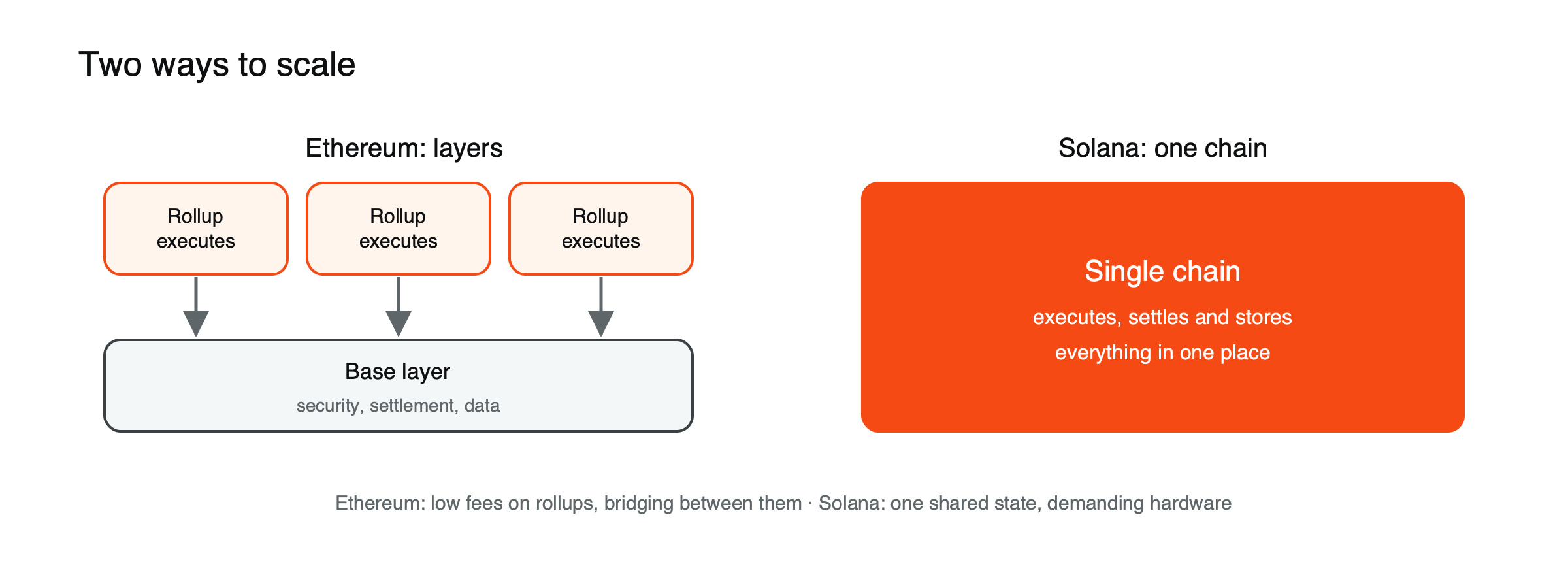
Figure: Modular versus monolithic scaling, the core design difference between the two networks.
How each one handles a transaction
On Ethereum’s main chain, a validator is chosen for each 12-second slot to propose a block, and the network finalizes blocks in batches after about two epochs. Most everyday users, though, send transactions to a rollup, where a sequencer confirms them almost instantly and later posts them to Ethereum.
On Solana, validators take turns as leader according to a schedule known in advance, producing blocks in well under a second. Transactions that touch different accounts can be processed in parallel, which is a large part of Solana’s speed. Because the leader schedule is public, transactions can be sent directly to upcoming leaders rather than waiting in a shared public queue.
Side by side
| Ethereum | Solana | |
|---|---|---|
| Launched | July 2015 | Mainnet beta March 16, 2020 |
| Consensus | Proof of stake | Proof of stake with proof of history |
| Scaling approach | Layer 2 rollups (modular) | Single high-throughput chain (monolithic) |
| Typical fees | Higher on the main chain, low on rollups | Low on the main chain |
| Validator hardware | Modest | Demanding |
| Full network halts | — | Seven between December 2020 and February 2024 |
| Applications | Largest DeFi and stablecoin base | Fast trading, payments, memecoins |
Reliability: the biggest historical gap
Solana’s speed came with a record of outages. Its mainnet stopped producing blocks seven times between December 2020 and February 6, 2024. The longest, on September 14, 2021, lasted about 17 hours after bots flooded a token launch; the last, on February 6, 2024, lasted about five hours. Restarting requires at least 80% of stake to come back online, which is why some halts ran long. Solana has not had a full halt since February 2024.
On Ethereum, the comparable weak point is at layer 2: many rollups depend on a single sequencer, which can pause even while the main chain keeps running.
Fees in practice
Solana charges a very small base fee per transaction signature, plus optional priority fees that users add to get ahead in busy periods. In normal conditions the total is a fraction of a cent. During heavy demand, such as a popular token launch, many transactions can fail to land or need higher priority fees, so cheap does not always mean reliable.
Ethereum’s main chain can be expensive when blocks are full, because the base fee rises with demand. On rollups, fees are usually comparable to Solana’s for ordinary activity, with the added cost of moving funds between the rollup and Ethereum or other rollups.
Running a validator
Solana’s design asks a lot of its validators: fast processors, large amounts of memory and high-bandwidth connections, which raise the cost of participating. Ethereum keeps its validator requirements modest on purpose, so that a staker can run one at home, and pushes heavy computation to rollups. These choices affect how many independent parties can afford to help secure each network, one of the main ways decentralization is measured, alongside how stake is distributed and how many independent client programs exist.
Different developer worlds
Ethereum’s virtual machine has become a shared standard: many other networks, including most rollups, run the same kind of contracts, so applications and tools move between them easily. Solana programs are written differently, typically in Rust, with their own tooling and account model. An application built for one ecosystem cannot simply be copied to the other, which is part of why each has its own communities, wallets and liquidity.
Where Solana fits better
For high-frequency trading, payments and applications that need many cheap transactions in one shared state, Solana’s single chain is simpler: no bridging between layers, fast confirmations and low fees. Much of the 2024 memecoin activity moved there for exactly these reasons.
Activity moves with the cycle
Users and capital have shifted between the two networks over time. During the memecoin rally of 2024, a large share of speculative trading moved to Solana, drawn by fast confirmations and fees low enough for very small trades, and analysts linked part of the drop in Ethereum main-chain activity to that migration. Stablecoin settlement, lending and larger DeFi positions remained concentrated on Ethereum and its rollups. These shifts show that the choice between networks is not fixed: activity follows cost, speed and where other users already are, and it can move back as conditions change. For a user, the practical lesson is to check where the specific assets, apps and liquidity you need are concentrated today rather than relying on an earlier year’s reputation of either network.
Where Ethereum fits better
For large-value settlement, stablecoin issuance and DeFi that needs the deepest liquidity and the longest security record, Ethereum’s base layer remains the reference. Its rollups offer low fees for everyday use, at the cost of bridging between networks.
Comparing like with like
“Solana is faster, so it is better for users” ignores that on Ethereum most users now transact on rollups with similarly low fees. And “Ethereum is more secure” depends on which part of it you use: a rollup with a single sequencer and upgradeable contracts adds its own trust assumptions. The fair comparison is between the specific chain or rollup you would actually use.
What to consider as a user
- Where do the apps and assets you need live? Liquidity and support differ sharply between ecosystems.
- How often will you move funds? Bridging between Ethereum layers or across ecosystems adds cost and risk.
- Does reliability matter for your use? Check recent uptime for the specific chain or rollup.
- Which wallet will you use? Most wallets specialize in one ecosystem, though some support both.
For how Ethereum’s scaling works, read what Ethereum rollups are. For the network itself, see what Ethereum is.
This article is educational content and does not constitute financial, investment, legal or tax advice. Digital assets are volatile and you may lose the amount you invest.
Frequently asked questions
Can I move assets between Ethereum and Solana?
Yes, through bridges and through exchanges that support both networks. Tokens moved by a bridge usually arrive as wrapped or bridged versions, which depend on the bridge’s security. Sending through an exchange avoids bridge risk but depends on the exchange supporting both networks for that token. See what a cross-chain bridge is.
Is one of them the better investment?
That depends on your view of each network’s future use, and both prices have been highly volatile. The comparison here is about how the networks work, not a recommendation of either.
Sources
- A Complete History of Solana Outages (mainnet beta March 16, 2020; seven outages; 80% stake to restart) — Helius
- Is Solana Reliable? The Full Outage History (no full halt since February 6, 2024) — BloFin Academy, September 2026
- Solana network outage (February 6, 2024, five hours; September 14, 2021, about 17 hours) — FXStreet, February 2024
- Ethereum supply climbs to pre-Merge levels (users and liquidity moved to Solana during the memecoin rally) — The Block, February 2025
- Ethereum history (July 2015 launch) — ethereum.org