
How to Check What Backs a Tokenized Asset
Before buying a tokenized asset, find the legal issuer, the underlying asset, the custodian, the reports, your redemption rights and who can hold the token.
Tokenized asset due diligence means answering six questions before you buy: who legally issues the token, what asset sits behind it, who holds that asset, what independent reports confirm it, what you can redeem and on what terms, and whether you are allowed to hold it. A token’s price on a screen tells you none of this.
Before you start
Have the token’s contract address, the issuer’s website and any offering documents ready. Use official sources rather than social media posts.
Six checks
Identify the legal issuer
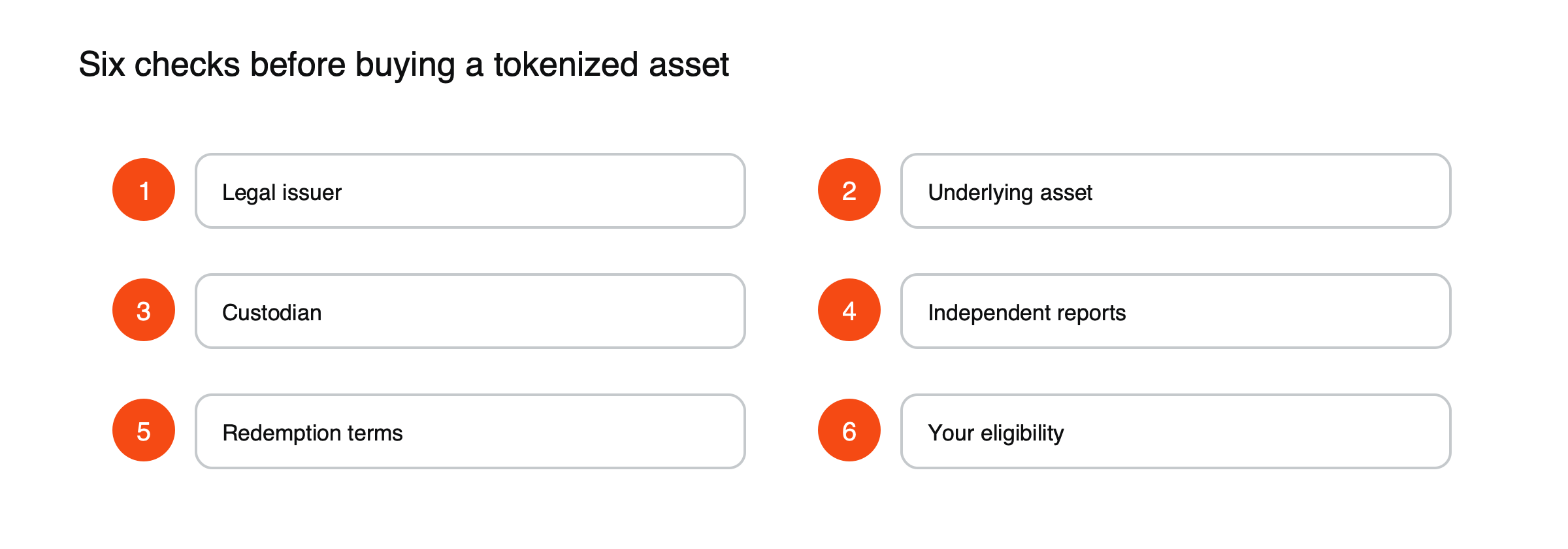
Figure: Six checks before you buy.
Find the company or fund that issued the token and where it is based. Read the offering documents or terms. A token with no named, regulated issuer is a red flag.
Identify the underlying asset
Is it Treasury bills, shares, loans, property or gold? Is the token a share in a fund, a debt claim on the issuer or a derivative that only tracks a price? See what tokenized stocks are for how different structures work.
Find the custodian
Who holds the asset, and is it held separately from the issuer’s own money? For gold, look for bar lists; for securities, a named custodian or transfer agent.
Read the reports
Look for regular, independent attestations or audits, and check their dates. See what a stablecoin attestation is for how such reports work.
Check redemption
Who can redeem, the minimum, fees, timing and whether redemption is in cash or the asset. Many small holders can only exit by selling on the market.
Confirm you are eligible
Check whether the token can be held by investors in your country and in your own wallet. See who can buy tokenized assets.
What to look for by asset type
The six checks apply to every tokenized asset, but the evidence differs:
- Treasury products: fund documents, the fund’s net asset value policy, the named custodian and transfer agent, and regular holdings reports. See what tokenized treasuries are.
- Gold: the vault and its location, bar lists that match tokens in circulation, and the standard the bars meet. See what tokenized gold is.
- Stocks: the legal entity holding the shares, the custodian, how dividends and corporate actions are handled, and what happens if the issuer fails.
- Private credit: who the borrowers are, loan-level or pool-level reports on delinquencies and defaults, collateral and which layer of the pool you hold. See what tokenized private credit is.
- Real estate: which company owns the property, recent independent valuations, the property manager and the rights tokens give over a sale. See what tokenized real estate is.
On-chain checks
Some answers are on the blockchain itself. Confirm that the contract address on a data site matches the one on the issuer’s official website. Check on a block explorer whether the contract allows an administrator to mint new tokens, freeze wallets or change rules, and who holds those powers. Look at how tokens are distributed among holders and whether transfers are restricted to approved wallets, which is normal for securities but affects whether you could hold it yourself.
Where to find each answer
| Question | Where to look |
|---|---|
| Who is the issuer? | Offering documents, terms of service, company registry |
| What backs the token? | Offering documents, fund factsheet |
| Who holds the asset? | Custody agreement summary, attestation reports |
| Is it verified? | Independent attestations or audits, with dates |
| How do I exit? | Redemption terms, platform rules |
| Can I hold it? | Eligibility rules, transfer restrictions in the contract |
The checks applied to an example
Suppose a token promises 12% a year from “premium rental property” and is promoted heavily on social media. (Illustrative scenario.) The website names no company, only a brand. There are no offering documents, just a slide deck. Asked who holds the property, the project points to a partner with no public details. The only “report” is a dashboard published by the project. Redemption is described as “coming soon.” Each check comes back empty, and the yield is far above what rental property normally pays. That pattern does not prove fraud, but it means the buyer would be relying entirely on trust, which is exactly what tokenization is supposed to reduce.
Questions worth sending the issuer
If the documents leave gaps, ask directly, and keep the answers:
- Which legal entity issues the token, and in which country is it regulated?
- Where is the underlying asset held, and is it separated from your company’s own assets?
- Who prepares your reports, and how often?
- How do I redeem, what does it cost and how long does it take?
- What happens to token holders if your company or the custodian fails?
A clear, prompt reply that matches the documents is a good sign. Vague answers, or a reply that only points to marketing material, are not. No reply at all is an answer too.
When to walk away
Some findings should end the process regardless of the yield on offer: no named issuer, no independent report, rights that exist only in marketing, an administrator who can mint or freeze tokens without limits and with no explanation, or pressure to buy quickly before an offer closes. Tokenization makes some checks easier, because ownership is visible on-chain, but it cannot replace the legal and financial foundations underneath.
Keep a short record of each check you make: the document you read, its date, the report you found and any answer the issuer gave. If something goes wrong later, those notes help you, your adviser or a regulator understand what was promised and when. They also make it much faster to review the investment again a year later, when reports should have been updated and the issuer’s terms may have changed. Due diligence is not a single event at the moment of buying; it is a habit of checking carefully that what you were told is still true for as long as you hold the token.
Red flags
- No named issuer or offering documents.
- Reports that are missing, old or prepared by the issuer itself.
- Rights described only in marketing, not in legal terms.
- Promised returns far above the underlying asset’s normal yield.
For the wider category, read what RWA tokenization is.
This article is educational content and does not constitute financial, investment, legal or tax advice. Digital assets are volatile and you may lose the amount you invest.