
What Is XRP?
XRP is the native token of the XRP Ledger, built for fast payments. How it works, how it relates to Ripple, what the SEC case decided and the risks.
XRP is the native token of the XRP Ledger, a blockchain launched in 2012 for fast, low-cost payments and currency transfers. All 100 billion XRP were created at launch, so none are mined. XRP is closely tied to the company Ripple, which received most of the supply and has sold XRP for years to fund its business.
A ledger built for payments
The XRP Ledger was built during 2011 and early 2012 by developers Jed McCaleb, Arthur Britto and David Schwartz. Their goal was narrower than Bitcoin’s: a system for sending payments quickly and cheaply between two parties, in any currency, without the energy cost of mining. In September 2012, McCaleb and Britto, together with Chris Larsen, formed the company that became Ripple, and the founders gave it 80 billion XRP to develop and promote the ledger. The remaining 20 billion went to the founders themselves.
That origin explains much of XRP’s later story. Unlike bitcoin, whose coins were spread over years through mining, most XRP began in the hands of one company and a few individuals. How that supply reached the market has shaped XRP’s price, its reputation and its long legal battle with US regulators.
How the ledger reaches agreement
The XRP Ledger uses neither mining nor staking. Independent servers called validators each maintain a list of other validators they trust, and the network agrees on the next version of the ledger when a large majority of those trusted validators agree. A new ledger version closes every few seconds, and payments typically settle in under five seconds, with fees of a tiny fraction of one XRP. Those fees are destroyed rather than paid to anyone, which very slowly reduces the total supply.
The design trades some of Bitcoin’s openness for speed and low cost: there is no competition among miners, and the default lists of trusted validators carry a lot of weight. Supporters see an efficient payment network; critics see a system that depends more on a small group’s choices than proof-of-work chains do.
The built-in exchange and the bridge-currency idea
The ledger includes a built-in exchange where currencies and tokens issued on it can be traded directly. That supports the idea behind XRP’s best-known use case: acting as a bridge between two currencies. Instead of a bank holding money in advance in a foreign account, a payment could convert dollars into XRP, move across the ledger in seconds and convert into pesos or euros at the other end. Ripple built payment products around this model. How much of XRP’s market value rests on that use, rather than on trading, is one of the main debates about the token.
Escrow: how Ripple’s holdings reach the market
Concern that Ripple could sell huge amounts of XRP at any time led the company, in 2017, to lock 55 billion XRP into escrow accounts on the ledger. The escrows release up to 1 billion XRP each month to Ripple. Whatever Ripple does not use is placed back into new escrows, extending the schedule. On-chain data in recent years has shown roughly 34 billion XRP still in escrow.
The escrow makes the maximum flow of new supply predictable, but it does not stop selling. Ripple can still sell the XRP it unlocks, and analysts track these monthly releases closely. For holders, it means a known, recurring source of supply that does not exist for coins like bitcoin.
The SEC case
In December 2020, the US Securities and Exchange Commission sued Ripple and two of its executives, alleging that XRP sales worth about $1.3 billion were unregistered securities offerings.
- July 13, 2023: Judge Analisa Torres ruled that Ripple’s direct sales to institutional investors were securities transactions, but that sales on exchanges, where buyers did not know they were buying from Ripple, and other distributions were not.
- August 2024: the court issued a final judgment that included a $125 million penalty.
- 2025: the SEC dropped its appeal and Ripple dropped its cross-appeal, ending the case.
The ruling applied to Ripple’s sales in that case. Other courts have not always followed its reasoning, so it is not a general rule about all tokens.
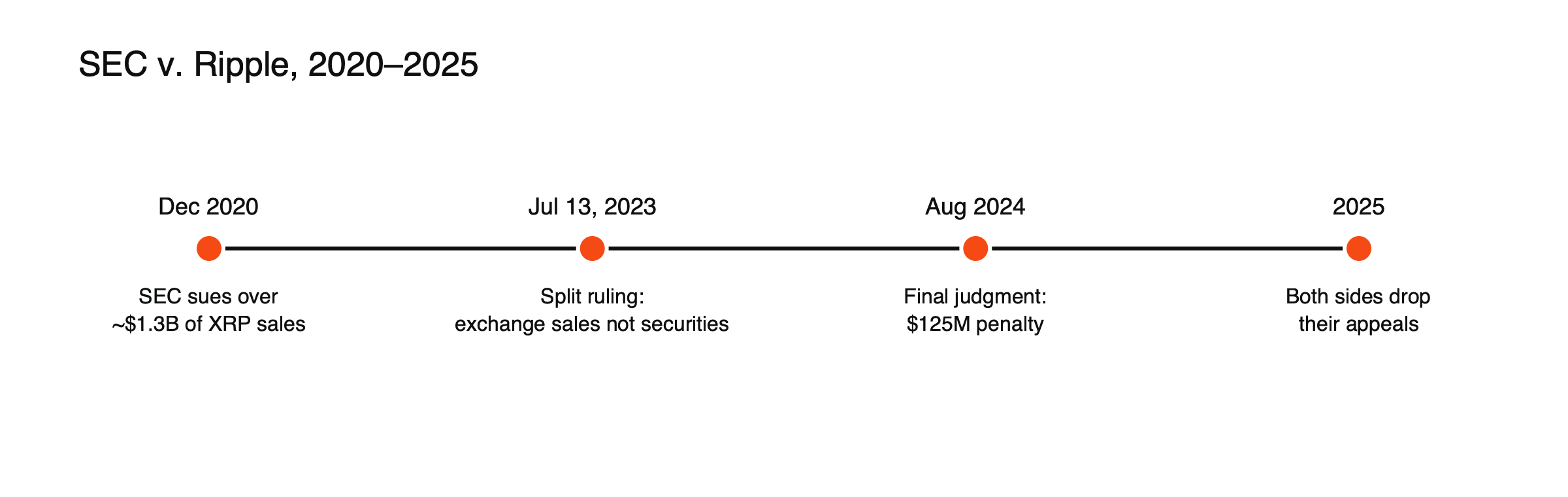
Figure: The SEC case against Ripple from filing to close.
Beyond XRP: RLUSD and new activity
Ripple has broadened what runs on the ledger. In December 2024, after approval from New York’s financial regulator, it launched RLUSD, a dollar stablecoin issued on both the XRP Ledger and Ethereum and aimed at payments and institutional users. The ledger has also hosted tokenized real-world assets and decentralized finance applications. These additions give the network more activity, though they do not require users to hold XRP beyond small amounts for fees and account reserves. See what a stablecoin is.
XRP’s price and XRP’s use
XRP’s price has historically moved far more on trading, legal news and market cycles than on measurable payment volume. That is not unusual in crypto, but it matters for anyone buying XRP as a bet on payment adoption: a bank using Ripple’s software, or a stablecoin moving across the ledger, does not necessarily mean demand for XRP itself. Separating news about Ripple the company from evidence about XRP the token is one of the most useful habits for an XRP holder.
Questions worth asking before buying XRP
- How much XRP is Ripple releasing and selling, and how does that compare with trading volume?
- Which uses actually require XRP, rather than the ledger or Ripple’s other products?
- How concentrated are holdings, including Ripple and early insiders?
- What is the regulatory position where you live, now that the US case has ended?
- How would you cope with a large drawdown? XRP has had very large rallies and declines.
How XRP compares
Unlike bitcoin, XRP was not mined and has no halvings; its supply was fixed at the start and is released largely through one company’s escrow. Unlike Ethereum, its ledger focuses on payments and asset issuance rather than general-purpose smart contracts. For how crypto is used to move money between countries, read stablecoins in cross-border payments, and for the wider category, what an altcoin is.
This article is educational content and does not constitute financial, investment, legal or tax advice. Digital assets are volatile and you may lose the amount you invest.
Sources
- Changing Tides or a Ripple in Still Water? Examining the SEC v. Ripple Ruling (XRP Ledger launched 2012 with 100 billion XRP; July 13, 2023 ruling) — Ropes & Gray, July 2023
- SEC Withdraws Claims Against Ripple (December 2020 suit over $1.3 billion; August 2024 $125 million penalty) — ForkLog, 2025
- Ripple Withdraws Appeal Against SEC — ForkLog, 2025
- XRP Ledger history (built 2011–early 2012 by McCaleb, Britto and Schwartz; 80 billion XRP given to Ripple in September 2012; 55 billion placed in escrow in 2017) — XRPL dev portal archive
- XRP price and profile (escrow releases up to 1 billion per month; unsold tokens returned; settles in under five seconds) — CoinDesk
- Ripple execs sold roughly 58.5 billion XRP since 2012 (about 34.185 billion XRP in escrow) — crypto.news via MEXC
- Ripple reveals official launch for RLUSD (NYDFS approval December 10, 2024; XRP Ledger and Ethereum) — FXStreet, December 2024