
How to Check a Stablecoin’s Reserves Yourself
Six steps to check what backs a stablecoin: find the latest report, compare reserves with supply, read the asset mix and spot warning signs.
To check stablecoin reserves, find the issuer’s latest independent report, confirm its date and the accounting firm, compare reserves with tokens in circulation, read what the reserves are made of and check how you could redeem. It takes about 15 minutes, needs no special tools and tells you far more than the issuer’s marketing.
Before you start
You need the stablecoin’s official name and issuer, and access to its website. Use the issuer’s own site, reached by typing the address yourself, not a link from social media.
Steps
1. Find the transparency page
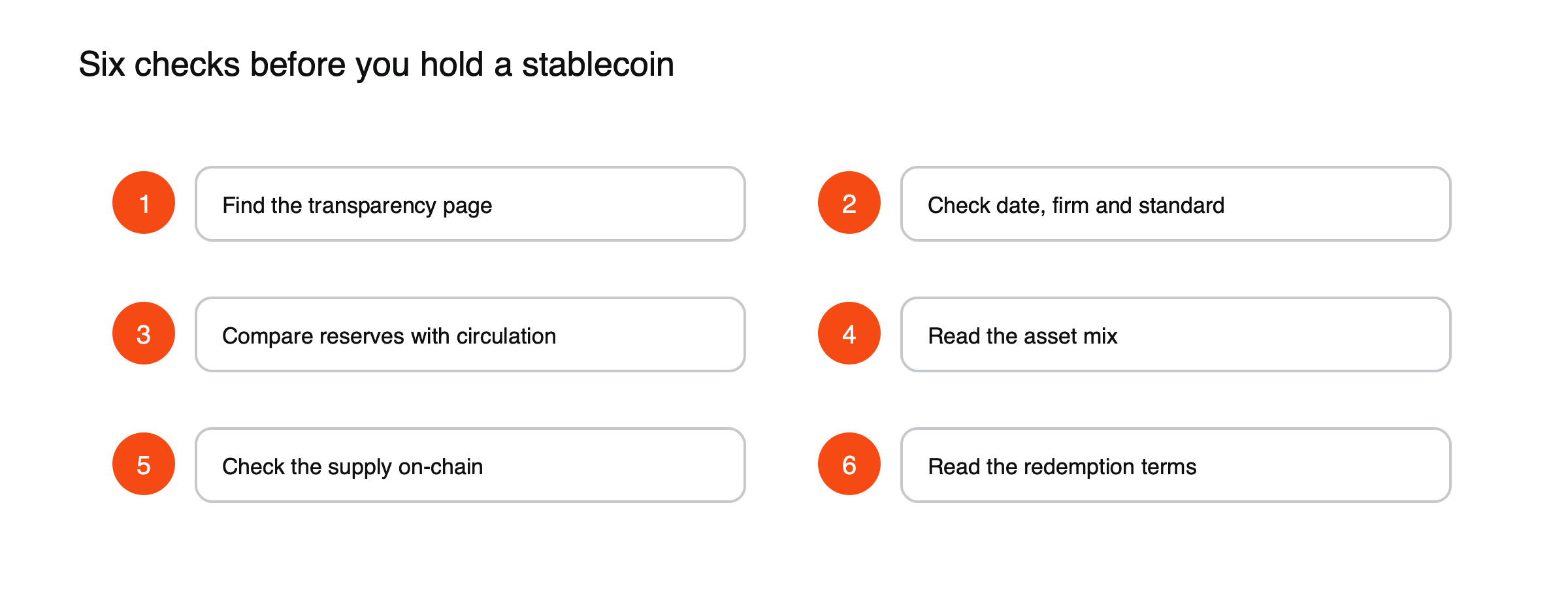
Figure: The six checks in order.
Most large issuers publish reserve reports on a “transparency” page: Circle for USDC and Tether for USDT both do. Regulated euro stablecoin issuers in the EU publish similar information under MiCA, along with a white paper describing the token. If an issuer has no such page, treat that as a warning in itself.
2. Check the date, firm and standard
Open the latest report and note the report date, the accounting firm and the standard used, such as AICPA attestation standards or ISAE 3000. Monthly reports should be recent; Tether reports quarterly. An old report, an unnamed firm or an internal summary is a red flag. Our explainer on what a stablecoin attestation is covers what these reports prove.
3. Compare reserves with circulation
Find two figures: tokens in circulation and total reserve value on the report date. Reserves should be equal or higher. Tether’s report for the end of 2024, for example, showed reserves of about $143.7 billion and an excess over liabilities of about $7.1 billion.
4. Read the asset mix
Look at what the reserves hold. Cash, short-term Treasury bills and overnight repurchase agreements can be turned into dollars quickly. Corporate debt, loans, gold or bitcoin are riskier and slower to sell. Under the US GENIUS Act, payment stablecoin reserves will be limited to cash-like assets such as Treasury bills maturing within 93 days.
5. Check the supply on-chain
Look up the token’s contract on a blockchain explorer for each network it uses and add up the supply. It should roughly match the circulation figure in the report, allowing for the time between the report date and today.
6. Read the redemption terms
Find who can redeem, the minimum amount, fees and how long it takes. Our guide to how stablecoins are minted and redeemed compares Tether and Circle.
A worked check
Suppose a stablecoin’s latest monthly report shows the following on March 31. (Illustrative figures.)
| Item | Figure |
|---|---|
| Tokens in circulation | 20.0 billion |
| Total reserves | 20.1 billion |
| Treasury bills under 3 months | 70% |
| Overnight repurchase agreements | 15% |
| Cash at banks | 12% |
| Other assets | 3% |
Reserves cover circulation with a 0.5% cushion. Ninety-seven percent sits in assets that turn into dollars quickly. The 3% in “other assets” is small, but the report should explain what it is. Checking on-chain on April 20, you find a total supply of 21.2 billion across all networks. That is 6% higher than in the report, which is plausible if new tokens were minted in the three weeks since, and the issuer’s next report should show reserves growing to match. A supply that kept rising for months while reported reserves stayed flat would be a reason for concern. So would a report whose circulation figure was far below the supply you can see on-chain on the same date, since that would suggest some tokens are not being counted.
Good signs and worrying signs
| Check | Reassuring | Worrying |
|---|---|---|
| Report timing | Monthly, on schedule | Irregular or stopped |
| Accounting firm | Named, established firm | Unnamed or frequently changed |
| Asset mix | Mostly T-bills, repos, cash | Loans, corporate debt, crypto |
| Detail | Breakdown by asset and custodian | Only “cash and equivalents” |
| On-chain match | Supply moves in line with reports | Unexplained gaps |
| Redemption | Clear terms, published fees | Vague or discretionary |
Checking a decentralized stablecoin
Crypto-backed stablecoins such as DAI or USDS work differently. There is no accountant’s report, because the collateral sits in smart contracts that anyone can inspect. Their dashboards show total collateral, the collateral ratio and what the collateral consists of. The key question is how much of it is volatile crypto and how much is other stablecoins or tokenized Treasuries, since a large share of USDC in the collateral means the stablecoin partly inherits USDC’s risks, as DAI did in March 2023.
Checking a synthetic dollar
For tokens backed by crypto plus futures hedges, look for the protocol’s transparency page listing collateral, hedge positions by exchange and the size of its reserve fund. See what a synthetic dollar stablecoin is.
How often to check
For stablecoins you use only to move money briefly, a check when you first start using them is enough. For balances you hold for months, a quick look at each new report, and at news about the issuer, keeps you informed without much effort.
Warning signs
- No report, or reports that stopped.
- Reserves described only as “cash and cash equivalents” with no detail.
- Large holdings in assets that are hard to sell quickly.
- A big gap between on-chain supply and reported circulation.
If something looks wrong
A single missing detail is not proof of a problem, but it is a reason to reduce how much you rely on that stablecoin. Practical steps include moving larger balances to a stablecoin with clearer reporting, keeping only what you need for immediate use, and avoiding using a questionable stablecoin as collateral, where a sudden price drop could trigger liquidation. Watching the token’s market price on several exchanges, and its total supply on-chain, gives early warning if other holders start to leave.
What this cannot tell you
A report is a snapshot of one day. It cannot rule out problems between report dates, and it does not check every risk at the issuer. For broader risks, read stablecoin risks. For the basics, see what a stablecoin is.
This article is educational content and does not constitute financial, investment, legal or tax advice. Digital assets are volatile and you may lose the amount you invest.
Sources
- How to Read a Stablecoin Attestation (transparency pages; Circle monthly, Tether quarterly; named firm and standard) — Stablecoin Insider, 2026
- $USDT Issuer Tether Records $13B Profit in 2024 (reserves $143.7 billion; excess $7.09 billion) — BitPinas, 2025
- GENIUS Act (reserve assets: cash, insured deposits, T-bills of 93 days or less, short repos) — Paxos