
How Stablecoins Are Minted and Redeemed
Stablecoins are minted when approved firms send dollars to the issuer and burned on redemption. Who can do it, minimums and fees, and how it holds the peg.
Stablecoin minting and redemption happen directly between the issuer and approved customers. A verified customer sends dollars and the issuer creates the same number of tokens; the customer returns tokens and the issuer destroys them and sends dollars back. Most individuals never do this themselves: they buy and sell stablecoins on exchanges, while large firms handle minting.
Minting step by step
- A customer passes verification with the issuer, typically a company such as an exchange, payment firm or trading firm.
- It sends dollars by bank transfer to the issuer.
- The issuer creates tokens on the chosen blockchain and sends them to the customer’s address.
- The issuer adds the dollars to its reserves, usually investing most of them in short-term government debt.
Circle’s institutional platform for this is Circle Mint. Circle states that it is not available to individuals, though it serves businesses in many countries.
Redemption step by step
- The customer sends tokens back to the issuer.
- The issuer destroys (“burns”) them, reducing the supply in circulation.
- It pays out dollars from reserves to the customer’s bank account.
Why individuals rarely deal with the issuer
Direct minting and redemption are built for institutions. Issuers must verify every customer under anti-money-laundering rules, move money through bank transfers and handle large volumes efficiently, so they set high minimums, charge fixed fees or accept only business accounts. For most people, exchanges and payment apps act as the bridge: they hold large issuer accounts, mint and redeem in bulk, and let customers buy or sell any amount at a market price.
Minimums and fees differ
| Tether (USDT) | Circle (USDC) | |
|---|---|---|
| Who can redeem directly | Verified customers, at Tether’s discretion | Circle Mint business accounts |
| Minimum | $100,000 | No published dollar minimum |
| Fee | The greater of $1,000 or 0.1% | No fee below a high daily volume |
| Account cost | $150 verification fee, paid in USDT | Business verification |
For a $100,000 redemption at Tether, 0.1% is $100, so the $1,000 minimum fee applies: an effective 1% cost.
How this holds the peg
Redemption is what keeps a stablecoin near $1. If USDT trades at $0.99 on an exchange, an eligible firm can buy it there and redeem it with the issuer for $1, profiting from the gap. That buying pushes the price back up. If it trades above $1, firms mint new tokens at $1 and sell them. The peg holds as long as eligible firms can redeem quickly and trust the reserves. When redemption slows, as during the USDC depeg of March 2023 when banks were closed over a weekend, the price can drift.
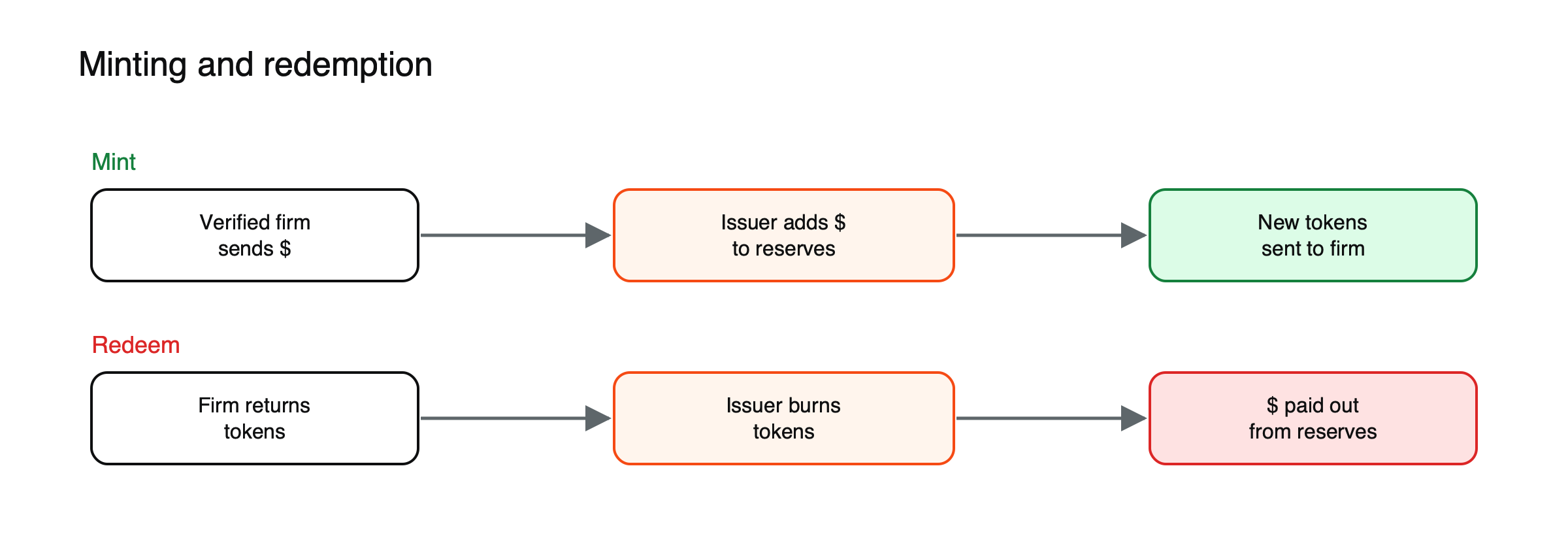
Figure: Minting adds tokens and reserves; redemption removes both.
One token, many blockchains
Major stablecoins are issued natively on several blockchains at once. When a customer mints, it chooses the network, and the issuer creates tokens there. Issuers also run burn-and-mint transfer services: tokens are destroyed on one chain and the same amount is created on another, which moves value between networks without relying on a third-party bridge. Tokens moved by outside bridges, by contrast, arrive as wrapped versions that depend on the bridge’s security. Checking which version you hold matters, because only the issuer’s native tokens can be redeemed directly.
Issuers can freeze tokens
Because the issuer controls the token’s smart contract, it can usually freeze specific addresses, preventing the tokens there from moving, and in some cases destroy and reissue them. Issuers use these powers in response to law enforcement requests, sanctions and hacks. For users, it means a reserve-backed stablecoin is only as permissionless as its issuer allows; tokens received from a sanctioned or stolen-funds address can become unusable. There is no on-chain appeal; the only recourse runs through the issuer and the authorities involved.
What supply data tells you
Every mint and burn is visible on-chain, so total supply is public and updates in real time. A rising supply means firms are paying dollars in to create new tokens, a sign of demand; falling supply means redemptions exceed new issuance. Supply trackers often break the total down by blockchain, which shows where new demand is coming from and where holders are leaving. Sharp drops, like the billions of USDC burned in a single day in March 2023, are one of the clearest early signals that holders are losing confidence. See what happened when USDC lost its peg.
If redemptions slow down
The peg depends on redemptions working smoothly. If an issuer pauses or delays them, because banks are closed, reserves are hard to sell or the company is in trouble, market prices can drift below $1 even when the backing exists. New rules in the US and EU require issuers to publish redemption policies and to hold reserves that can be turned into cash quickly, precisely to keep this route open under stress. Regulators also expect issuers to plan for an orderly wind-down, so that holders can still be paid out if the issuer itself fails.
What it means for everyday users:
- You will usually exit through an exchange or broker, not the issuer.
- Your price depends on that venue’s liquidity, spreads and fees.
- Supply on-chain changes as firms mint and redeem, which is one way to see demand.
For how to cash out in practice, read how to convert crypto to cash. For the basics, see what a stablecoin is and how stablecoins maintain their value.
This article is educational content and does not constitute financial, investment, legal or tax advice. Digital assets are volatile and you may lose the amount you invest.
Frequently asked questions
Can I redeem USDC or USDT directly with the issuer?
Usually not as an individual. Circle’s minting and redemption service is for businesses, and Tether accepts only verified customers above a high minimum. Most people redeem indirectly by selling on an exchange that holds an issuer account, which means the exchange’s own fees, limits and processing times apply. This route can take a full business day or longer.
Is minting the same as buying a stablecoin?
No. Minting creates new tokens in exchange for dollars sent to the issuer, so total supply grows. Buying on an exchange simply transfers existing tokens from a seller to you, and supply does not change.
Why can a stablecoin’s supply change on one blockchain without any trading?
Burn-and-mint transfers move tokens between networks. When someone moves tokens from one chain to another this way, supply falls on the first chain and rises on the second, even though the total across all chains stays the same.
Sources
- How to Redeem a Stablecoin for Dollars (Tether $100,000 minimum; greater of $1,000 or 0.1%; $150 verification; Circle Mint only) — Stablecoin Insider, 2026
- Stablecoin Redemption Comparison (Circle Mint free under $2 million a day; institutional only) — Spark
- How to Open a Circle Mint Account (not for individuals; mint and redeem 1:1) — Stablecoin Insider, 2026
- Stablecoin Redemption (arbitrage keeps the peg) — Spark